



Page 4
Page 4

Engineering Environment-Mediated Multi-Agent Systems ; International Workshop, EEMMAS 2007, Dresden, Germany, October 5, 2007. Selected Revised and Invited Papers
This book constitutes the thoroughly refereed proceedings of the International Workshop on Engineering Environment-Mediated Multi-Agent Systems, held in Dresden,The volume includes 16 thoroughly revised papers, selected from the lectures given at the workshop, together with 2 papers resulting from invited talks by prominent researchers in the field. The papers are organized in sections on engineering self-organizing applications, stigmergic interaction, modeling and structuring mediating environments, and environment-based support for context and organizations.

Emergent Intelligence of Networked Agents
his book is based on communications given at the Workshop on Emergent Intelligence of Networked Agents (WEIN 06) at the Fifth International Joint Conference on Autonomous Agents and Multi-agent Systems (AAMAS 2006), which was held at Future University, Hakodate, Japan, from May 8 to 12, 2006. WEIN 06 was especially intended to increase the awareness of researchers in these two fields sharing the common view on combining agent-based modeling and complex networks in order to develop insight and foster predictive methodologies in studying emergent intelligence on of networked agents. From the broad spectrum of activities, leading experts presented important paper and numerous practical problems appear throughout this book. The papers contained in this book are concerned with emergence of intelligent behaviors over networked agents and fostering the formation of an active multi-disciplinary community on multi-agent systems and complex networks.

Dynamic Epistemic Logic
Dynamic Epistemic Logic is the logic of knowledge change. This is not about one logical system, but about a whole family of logics that allows us to specify static and dynamic aspects of multi-agent systems. This book provides various logics to support such formal specifications, including proof systems. Concrete examples and epistemic puzzles enliven the exposition. The book also contains exercises including answers and is eminently suitable for graduate courses in logic.

Defence Industry Applications of Autonomous Agents and Multi-Agent Systems
In this book defense and security related applications are increasingly being tackled by researchers and practioners using technologies developed in the field of Intelligent Agent research.

Defence Applications of Multi-Agent Systems; International Workshop, DAMAS 2005, Utrecht, The Netherlands, July 25, 2005, Revised and Invited Papers
This book constitutes the thoroughly refereed post-proceedings of the International Workshop on Defence Applications of Multi-Agent Systems, DAMAS 2005, held in Utrecht, The Netherlands in July 2005 as an associated event of AAMAS 2005, the main international conference on autonomous agents and multi-agent systems. The 10 revised full papers presented together with 1 invited article are organized in topical sections on decision support and simulation, unmanned aerial vehicles, as well as on systems and security.
Declarative agent languages and technologies IV ; 4th International Workshop, DALT 2006, Hakodate, Japan, May 8, 2006, Selected, Revised and Invited Papers
Constitutes the thoroughly refereed post-proceedings of the 4th International Workshop on Declarative Agent Languages and Technologies, DALT 2006, held in Japan in May 2006. This was an associated event of AAMAS 2006, the main international conference on autonomous agents and multi-agent systems. The 12 revised full papers presented together with one invited talk and three invited papers were carefully selected for inclusion in the book.

Declarative agent languages and technologies III ; 3rd International Workshop, DALT 2005, Utrecht, The Netherlands, July 25, 2005, Selected and Revised Papers
The workshop on Declarative Agent Languages and Technologies is a we- established venue for researchers interested in sharing their experiences in the areas of declarative and formal aspects of agents and multi-agent systems, and in engineering and technology. Today it is still a challenge to develop techno- gies that can satisfy the requirements of complex agent systems. The design and development of multi-agent systems still calls for models and technologies that ensure predictability, enable feature discovery, allow for the veri?cation of properties, and guarantee ?exibility. Declarative approaches are potentially a valuable means for satisfying the needs of multi-agent system developers and for specifying multi-agent systems.
Declarative agent languages and technologies II ; 2nd international workshop, DALT 2004, New York, NY, USA, July 19, 2004, revised selected papers
Nearly 40 research groups worldwide were motivated to contribute to this event by submitting their most recent research achievements, covering a wide variety of the topics listed in the call for papers. More than 30 top researchers agreed to join the Program Committee, which then collectively faced the hard task of selecting the one-day event program. The fact that research in multi-agent systems is no longer only a novel and promising research horizon at dawn is, in our opinion, the main reason behind DALT’s (still short) success story. On the one hand, agent theories and app- cations are mature enough to model complex domains and scenarios, and to successfully address a wide range of multifaceted problems, thus creating the urge to make the best use of this expressive and versatile paradigm, and also pro?t from all the important results achieved so far. On the other hand, bui- ing multi-agent systems still calls for models and technologies that could ensure system predictability, accommodate ?exibility, heterogeneity and openness, and enable system veri?cation.

Database and expert systems applications ; 16th international conference, DEXA 2005, Copenhagen, Denmark, August 22-26, 2005, Proceedings
DEXA 2005, the 16th International Conference on Database and Expert Systems Applications, was held at the Copenhagen Business School, Copenhagen, Denmark, from August 22 to 26, 2005. The success of the DEXA series has partly been due to the way in which it has kept abreast of recent developments by spawning specialized workshops and conferences each with its own proceedings. In 2005 the DEXA programme was co-located with the 7th International Conference on Data Warehousing and Knowledge Discovery [DaWaK 2005], the 6th International Conference on Electronic Commerce and Web Technologies [EC-Web 2005], the 4th International Conference on Electronic Government [EGOV 2005], the 2nd International Conference on Trust, Privacy, and Security in Digital Business [TrustBus 2005], the 2nd International Conference on Industrial Applications of Holonic and Multi-agent Systems [HoloMAS 2005], as well as 19 specialized workshops. These proceedings are the result of a considerable amount of hard work.

Coordination, organizations, institutions, and norms in agent system ; AAMAS 2005 International Workshops on Agents, Norms, and Institutions for Regulated Multiagent Systems, ANIREM 2005 and on organizations in multi-agent systems, OOOP 2005, Utrecht, The Netherlands, July 25-26, 2005, Revised Selected Papers
This book constitutes the refereed post-proceedings of the International Workshop on Agents, Norms and Institutions for Regulated Multiagent Systems, ANIREM 2005, and the International Workshop on Organizations in Multi-Agent Systems, OOOP 2005, held in Utrecht, The Netherlands, July 2005.

Coordination models and languages ; 10th International Conference, COORDINATION 2008, Oslo, Norway, June 4-6, 2008. Proceedings
This book constitutes the refereed proceedings of the 10th International Conference on Coordination Models and Languages, COORDINATION 2008, held in Oslo, Norway, in June 2008, as one of the federated conferences on Distributed Computing Techniques, DisCoTec 2008.

Computer Supported Cooperative Work in Design II ; 9th International Conference, CSCWD 2005, Coventry, UK, May 24-26, 2005, Revised Selected Papers
This book constitutes the thoroughly refereed post-proceedings of the 9th International Conference on Computer Supported Cooperative Work in Design, CSCWD 2005. it contain expanded versions of the papers presented at the conference and are organized in topical sections on CSCW techniques and methods, Grids and Web services, agents and multi-agent systems, ontology and knowledge management, collaborative design and manufacturing, enterprise collaboration, workflows, and other related approaches and applications.

Computational logic in multi-agent systems ; Vol. 3900 ; 6th International Workshop, CLIMA VI, London, UK, June 27-29, 2005, Revised Selected and Invited Papers
The book presents 14 revised full technical papers, 4 contest papers, and 7 invited papers together with 1 invited article are organized in topical sections on foundational aspects of agency, agent programming, agent interaction and normative systems, the first CLIMA contest, and on the project report of the SOCS project.
Computational logic in multi-agent systems ; Vol. 3487 ; 5th International Workshop, CLIMA V, Lisbon, Portugal, September 29-30, 2004, Revised Selected and Invited Papers
The notion of agency has recently increased its in?uence in the research and - velopment of computational logic based systems, while at the same time sign- cantly gaining from decades of research in computational logic. Computational logic provides a well-de?ned, general, and rigorous framework for studying s- tax, semantics and procedures, for implementations, environments, tools, and standards, facilitating the ever important link between speci?cation and ver- cation of computational systems. The purpose of the Computational Logic in Multi-agent Systems (CLIMA) international workshop series is to discuss techniques, based on computational logic, for representing, programming, and reasoning about multi-agent systems in a formal way. Former CLIMA editions were conducted in conjunction with other major computational logic and AI events Thesubmittedpapersshowedthatthelogicalfoundationsofmulti-agent systems are felt by a large community to be a very important research topic, upon which classical AI and agent-related issues are to be addressed.
Computational logic in multi-agent systems ; 8th International Workshop, CLIMA VIII, Porto, Portugal, September 10-11, 2007. Revised Selected and Invited Papers
This book constitutes the thoroughly refereed post-conference proceedings of the 8th International Workshop on Computational Logic for Multi-Agent Systems, CLIMA VIII, held in Porto, Portugal, in September 2007 - co-located with ICLP 2008, the International Conference on Logic Programming.

Computational Logic in Multi-Agent Systems ; 7th International Workshop, CLIMA VII, Hakodate, Japan, May 8-9, 2006, Revised Selected and Invited Papers
This book constitutes the thoroughly refereed post-proceedings of the 7th International Workshop on Computational Logic for Multi-Agent Systems. It was an associated event of AAMAS 2006, the main international conference on autonomous agents and multi-agent systems.

Computational logic in multi-agent systems ; 4th International Workshop, CLIMA IV, Fort Lauderdale, FL, USA, January 6-7, 2004, Revised Selected and Invited Papers
Though multiagent systems (MASs) are being increasingly used, few methods exist to ensure survivability of MASs. All existing methods suffer from two flaws. First, a centralized survivability algorithm (CSA) ensures survivability of the MAS – unfortunately, if the node on which the CSA exists goes down, the survivability of the MAS is questionable. Second, no mechanism exists to change how the MAS is deployed when external factors trigger a re-evaluation of the survivability of the MAS. In this paper, we present three algorithms to address these two important problems. Our algorithms can be built on top of any CSA. Our algorithms are completely distributed and can handle external triggers to compute a new deployment. We report on experiments assessing the efficiency of these algorithms.
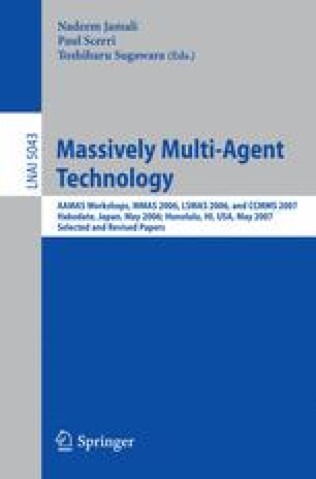
Massively Multi-Agent Technology ; AAMAS Workshops, MMAS 2006, LSMAS 2006, and CCMMS 2007 Hakodate, Japan, May 9, 2006 Honolulu, HI, USA, May 15, 2007 Selected and Revised Papers
This book constitutes the thoroughly refereed post-workshop proceedings of the joint AAMAS 2006 International Workshops on Massively Multi-Agent Systems, MMAS 2006, and on Large scale Multi-Agent Systems, LSMAS 2006, held in Hakodate, Japan, in May 2006, and of the International Workshop on Coordination and Control in Massively Multi-Agent Systems, CCMMS 2007, held in Honolulu, HI, USA, in May 2007 as associated event of AAMAS 2007.
Massively Multi-Agent Systems I ; 1st International Workshop, MMAS 2004, Kyoto, Japan, December 10-11, 2004, Revised Selected and Invited Papers
Originates from the First International Workshop on Massively Multi-Agent Systems, MMAS 2004, held in Kyoto, Japan in December 2004. The 25 revised full selected and invited papers give an excellent introduction and overview on massively multi-agent systems. The papers are organized in parts on massively multi-agent technology, teams and organization, ubiquitous computing and ambient intelligence, and massively multi-agent systems in the public space.

Logics in Artificial Intelligence ; 11th European Conference, JELIA 2008, Dresden, Germany, September 28-October 1, 2008. Proceedings
Constitutes the refereed proceedings of the 11th European Conference on Logics in Artificial Intelligence, JELIA 2008, held in Dresden, Germany, Liverpool, in September/October 2008.The 32 revised full papers presented together with 2 invited talks were carefully reviewed and selected from 98 submissions. The papers cover a broad range of topics including belief revision, description logics, non-monotonic reasoning, multi-agent systems, probabilistic logic, and temporal logic.
