



Page 33
Page 33
Logical Foundations for Rule-Based Systems
Presents logical foundations for rule-based systems, as seen by the Author. An attempt has been made to provide an in-depth discussion of logical and other aspects of such systems, including languages for knowledge representation, inference mechanisms, inference control, design and verification.
Logical Aspects of Computational Linguistics ; 5th International Conference, LACL 2005, Bordeaux, France, April 28-30, 2005, Proceedings
Inaugurates the new FoLLI LNAI subline. It constitutes the refereed proceedings of the 5th International Conference on Logical Aspects of Computational Linguistics, LACL 2005, held in Bordeaux, France in April 2005. The 25 revised full papers presented were carefully reviewed and selected from over 40 submissions. The papers address a wide range of logical and formal methods in computational linguistics with studies of particular grammar formalisms and their computational properties, language engineering, and traditional topics about the syntax/semantics interface.

Logical aspects of computational linguistics ; 4th International Conference, LACL 2001, Le Croisic, France, June 27-29, 2001, Proceedings
Structural Equations in Language Learning.- On the Distinction between Model-Theoretic and Generative-Enumerative Syntactic Frameworks.- Contributed Papers.- A Formal Definition of Bottom-Up Embedded Push-Down Automata and Their Tabulation Technique.- An Algebraic Approach to French Sentence Structure.- Deductive Parsing of Visual Languages.- Lambek Grammars Based on Pregroups.- An Algebraic Analysis of Clitic Pronouns in Italian.- Consistent Identification in the Limit of Any of the Classes k-Valued Is NP-hard.- Polarized Non-projective Dependency Grammars.- On Mixing Deduction and Substitution in Lambek Categorial Grammars.- A Framework for the Hyperintensional Semantics of Natural Language with Two Implementations.- A Characterization of Minimalist Languages.- of Speech Tagging from a Logical Point of View.- Transforming Linear Context-Free Rewriting Systems into Minimalist Grammars.- Recognizing Head Movement.- Combinators for Paraconsistent Attitudes.- Combining Syntax and Pragmatic Knowledge for the Understanding of Spontaneous Spoken Sentences.- Atomicity of Some Categorially Polyvalent Modifiers.
Logical and Relational Learning
This textbook covers logical and relational learning in depth, and hence provides an introduction to inductive logic programming (ILP), multirelational data mining (MRDM) and (statistical) relational learning (SRL). These subfields of data mining and machine learning are concerned with the analysis of complex and structured data sets that arise in numerous applications, such as bio- and chemoinformatics, network analysis, Web mining, natural language processing, within the rich representations offered by relational databases and computational logic.
Logic, Thought and Action
Contribute to our understanding of this dynamic process by clearly presenting and discussing the most important hypotheses, issues and theories in philosophical and logical study of language, thought and action. Among the fundamental issues discussed are the rationality and freedom of agents, theoretical and practical reasoning, individual and collective attitudes and actions, the nature of cooperation and communication, the construction and conditions of adequacy of scientific theories, propositional contents and their truth conditions, illocutionary force, time, aspect and presupposition in meaning, speech acts within dialogue, the dialogical approach to logic and the structure of dialogues and other language games, as well as formal methods needed in logic or artificial intelligence to account for choice, paradoxes, uncertainty and imprecision.

Logic, language, information and computation ; 15th International Workshop, WoLLIC 2008 Edinburgh, UK, July 1-4, 2008 Proceedings
The papers cover all pertinent subjects in computer science with particular interest in cross-disciplinary topics. Typical areas of interest are: foundations of computing and programming; novel computation models and paradigms; broad notions of proof and belief; formal methods in software and hardware development; logical approach to natural language and reasoning; logics of programs, actions and resources; foundational aspects of information organization, search, flow, sharing, and protection.

Logic, language, information and computation ; 14th International Workshop, WoLLIC 2007, Rio de Janeiro, Brazil, July 2-5, 2007, Proceedings
The Workshop on Logic, Language, Information and Computation (WoLLIC) is an annual international forum on inter-disciplinary research involving formal logic, computing and programming theory, and natural language and reasoning. The WoLLIC meetings alternate between Brazil (and Latin America) and other countries, with the aim of fostering interest in applied logic among Latin Am- ican scientists and students, and facilitating their interaction with the international - plied logic community.

Logic, Language, and Computation ; 6th International Tbilisi Symposium on Logic, Language, and Computation. Batumi, Georgia, September 12-16, 2005, Revised Selected Papers
Edited in collaboration with FoLLI, the Association of Logic, Language and Information, this book constitutes the second volume of the FoLLI LNAI subline. It represents the thoroughly refereed post-proceedings of the 6th International Tbilisi Symposium on Logic, Language, and Computation, TbiLLC 2005, held in Batumi, Georgia, in September 2005.
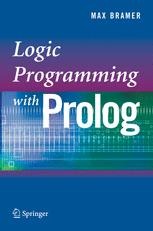
Logic Programming with Prolog
Logic Programming is the name given to a distinctive style of programming, very different from that of conventional programming languages such as C++ and Java. By far the most widely used Logic Programming language is Prolog. Prolog is a good choice for developing complex applications, especially in the field of Artificial Intelligence. This book does not assume that the reader is an experienced programmer or has a background in Mathematics, Logic or Artificial Intelligence. It starts from scratch and aims to arrive at the point where quite powerful programs can be written in the language. It is intended both as a textbook for an introductory course and as a self-study book. On completion the reader will know enough to use Prolog in their own research or practical projects. Each chapter has self-assessment exercises so that the reader may check their own progress. A glossary of the technical terms used completes the book.

Logic Programming and Nonmonotonic Reasoning ; 9th International Conference, LPNMR 2007, Tempe, AZ, USA, May 15-17, 2007, Proceedings
This book constitutes the refereed proceedings of the 9th International Conference on Logic Programming and Nonmonotonic Reasoning, LPNMR 2007, held in Tempe, AZ, USA, May 2007.

Logic Programming ; Vol. 4079 ; 22nd International Conference, ICLP 2006, Seattle, WA, USA, August 17-20, 2006, Proceedings
This book constitutes the refereed proceedings of the 22nd International Conference on Logic Programming, ICLP 2006, held in Seattle, WA, USA, in August 2006. The 20 revised full papers and 6 application papers presented together with 2 invited talks, 2 tutorials and special interest papers, as well as 17 poster presentations and the abstracts of 7 doctoral consortium articles, were carefully reviewed and selected from 83 initial submissions. The papers cover all issues of current research in logic programming - they are organized in topical sections on theory, functional and constraint logic programming, program analysis, answer-set programming, semantics, and applications.
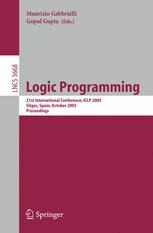
Logic Programming ; Vol. 3668 : 21st International Conference, ICLP 2005, Sitges, Spain, October 2-5, 2005, Proceedings
This volume contains the proceedings of the 21st International Conference on Logic Programming which was held in Sitges (Barcelona), Spain, from October 2nd to 5th, 2005. The conference was colocated with the International Conf- ence on ConstraintProgramming(CP 2005)and the following 6 post-conference workshops: – CICLOPS 2005: Colloquium on Implementation of Constraint and Logic Programming Systems – CSLP 2005: Constraint Solving and Language Processing – WCB 2005: Constraint Based Methods for Bioinformatics – WLPE 2005: Logic-Based Methods in Programming Environments – MoVeLog 2005: Mobile Code Safety and Program Veri?cation Using C- putational Logic Tools – CHR 2005: Constraint Handling Rules The conferencecoincided with a solareclipse

Logic Programming : 24th International Conference, ICLP 2008 Udine, Italy, December 9-13 2008 Proceedings
The 35 revised full papers together with 2 invited talks, 2 invited tutorials, 11 papers of the co-located first Workshop on Answer Set Programming and Other Computing Paradigms (ASPOCP 2008), as well as 26 poster presentations and the abstracts of 11 doctoral consortium articles were carefully reviewed and selected from 177 initial submissions. The papers cover all issues of current research in logic programming - they are organized in topical sections on applications, algorithms, systems, and implementations, semantics and foundations, analysis and transformations, CHRs and extensions, implementations and systems, answer set programming and extensions, as well as constraints and optimizations.

Logic for Programming, Artificial Intelligence, and Reasoning ; 15th International Conference, LPAR 2008, Doha, Qatar, November 22-27, 2008. Proceedings
This book constitutes the refereed proceedings of the 15th International Conference on Logic for Programming, Artificial Intelligence, and Reasoning, LPAR 2008, which took place in Doha, Qatar, during November 22-27, 2008.The 45 revised full papers presented together with 3 invited talks were carefully revised and selected from 153 submissions. The papers address all current issues in automated reasoning, computational logic, programming languages and their applications and are organized in topical sections on automata, linear arithmetic, verification knowledge representation, proof theory, quantified constraints, as well as modal and temporal logics.
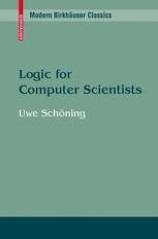
Logic for Computer Scientists
This book introduces the notions and methods of formal logic from a computer science standpoint, covering propositional logic, predicate logic, and foundations of logic programming. It presents applications and themes of computer science research such as resolution, automated deduction, and logic programming in a rigorous but readable way.The style and scope of the work, rounded out by the inclusion of exercises, make this an excellent textbook for an advanced undergraduate course in logic for computer scientists.
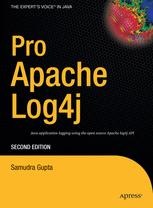
Logging in Java with the JDK 1.4 Logging API and Apache log4j
In development scenarios where things can't be run in a debugger, or when you run the risk of masking the problem, logs are the greatest source of information about running a program. Pro Apache Log4j, Second Edition provides best practices guidelines and comprehensive coverage of the most recent release. Step by step, the book explains core concepts, from basic to advanced. Code samples are in Java and include guidelines for different application-specific needs. You'll also learn how to extend the API to write custom components and best practices for using the feature-rich log4j API. This book concludes with enterprise Java applications using log4j with JSP and J2EE.
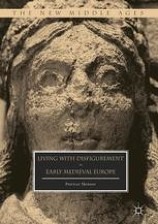
Living with Disfigurement in Early Medieval Europe
Examines social and medical responses to the disfigured face in early medieval Europe, arguing that the study of head and facial injuries can offer a new contribution to the history of early medieval medicine and culture, as well as exploring the language of violence and social interactions. Despite the prevalence of warfare and conflict in early medieval society, and a veritable industry of medieval historians studying it, there has in fact been very little attention paid to the subject of head wounds and facial damage in the course of war and/or punitive justice. The impact of acquired disfigurement —for the individual, and for her or his family and community—is barely registered, and only recently has there been any attempt to explore the question of how damaged tissue and bone might be treated medically or surgically..
Literature-based Discovery
When Don Swanson hypothesized a connection between Raynaud’s phenomenon and dietary fish oil, the field of literature-based discovery (LBD) was born. During the subsequent two decades a steady stream of researchers have published articles about LBD and the field has made steady progress in laying foundations and creating an identity. LBD is an inherently multi-disciplinary enterprise where collaborations between the information and biomedical sciences are readily encountered. It is the hope and intention that this volume will plant a flag in the ground and inspire new researchers to the LBD challenge.
LINQ for Visual C# 2008
Every C# programmer needs to learn about LINQ (Language–Integrated Query), Microsoft's breakthrough technology for simplifying and unifying data access from any data source. With LINQ, you can write more elegant and flexible code—not just to access databases and files, but to manipulate data structures and XML. This book is a short, yet comprehensive guide to the major features of LINQ and the significant enhancements introduced with .NET 3.5. There is no better source for getting a head–start on the future of these technologies than this book.
LINQ for Visual C# 2005
LINQ for Visual C# 2005 is a short, yet comprehensive guide to the major features of LINQ. It thoroughly covers LINQ to Objects, LINQ to SQL, LINQ to DataSet, and LINQ to XML. It also details significant enhancements to C#, .NET, and ADO.NET.
