



Page 32
Page 32

Finite Element Analysis for Civil Engineering with DIANA Software
Introduces readers to the finite element analysis software DIANA (DIsplacement ANAlyzer) and its applications in civil engineering. Developed by TNO Corporation in the 1970s, DIANA is frequently used in civil engineering and engineering mechanics. This book presents a simplified overview of the basic background theory to help beginners master the software quickly. It also discusses GUI operation and the command console in Python language, and includes examples involving classical modeling operations to help readers review each section.
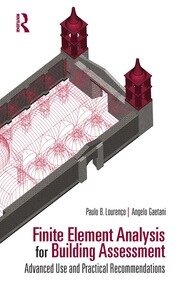
Finite element analysis for building assessment : Advanced use and practical recommendations
Existing structures represent a heterogeneous category in the global built environment as often characterized by the presence of archaic materials, damage and disconnections, uncommon construction techniques and subsequent interventions throughout the building history. In this scenario, the common linear elastic analysis approach adopted for new buildings is incapable of an accurate estimation of structural capacity, leading to overconservative results, invasive structural strengthening, added intervention costs, excessive interference to building users and possible losses in terms of aesthetics or heritage values. For a rational and sustainable use of the resources, this book deals with advanced numerical simulations, adopting a practical approach to introduce the fundamentals of Finite Element Method, nonlinear solution procedures and constitutive material models.

Finite Difference Computing with Exponential Decay Models
This text provides a very simple, initial introduction to the complete scientific computing pipeline: models, discretization, algorithms, programming, verification, and visualization. The pedagogical strategy is to use one case study – an ordinary differential equation describing exponential decay processes – to illustrate fundamental concepts in mathematics and computer science. The book is easy to read and only requires a command of one-variable calculus and some very basic knowledge about computer programming. Contrary to similar texts on numerical methods and programming, this text has a much stronger focus on implementation and teaches testing and software engineering in particular.

Finding the limits of the limes : Modelling demography, economy and transport on the edge of the Roman Empire
This book demonstrates the application of simulation modelling and network analysis techniques. The book shows the added value of state-of-the-art computer modelling techniques and bridges computational and conventional approaches. Topics that will be of particular interest to archaeologists are the question of (forced) surplus production, the demographic and economic effects of the Roman occupation on the local population, and the structuring of transport networks and settlement patterns. For modellers, issues of sensitivity analysis and validation of modelling results are specifically addressed. This book will appeal to students and researchers working in the computational humanities and social sciences, in particular, archaeology and ancient history.

Fault-Diagnosis Systems : An Introduction from Fault Detection to Fault Tolerance
This book gives an introduction into the field of fault detection, fault diagnosis and fault-tolerant systems with methods which have proven their performance in practical applications. It guides the reader in a structured tutorial style: supervision methods, reliability, safety, system integrity and related terminology; fault detection with signal-based methods for periodic and stochastic signals; fault detection with process model-based methods like parameter estimation, state estimation, parity equations and principal component analysis; fault diagnosis with classification and inference methods; fault-tolerant systems with hardware and analytical redundancy; many practical simulation examples and experimental results for processes like electrical motors, pumps, actuators, sensors and automotive components; end-of-chapter exercises for self testing or for practice.

Fast Simulation of Electro-Thermal MEMS : Efficient Dynamic Compact Models
Fast Simulation of Electro-Thermal MEMS provides the reader with a complete methodology and software environment for creating efficient dynamic compact models for electro-thermal MEMS devices. It supplies the basic knowledge and understanding for using model order reduction at the engineering level. Emphasis is placed on the application of the Arnoldi method for effective order reduction of thermal systems. This tutorial is written for MEMS engineers and is enriched with many case studies which equip readers with the know-how to facilitate the simulation of a specific problem.

Extrusion in Ceramics
This is the first book worldwide about extrusion in ceramics to cover the complete subject. For the first time, readers find the principles of extrusion of ceramics, the history of extrusion in the ceramic industry, rheology of ceramic bodies, simulation for ceramic extrusion, wear and contamination in extrusion, additives for extrusion and more in 20 chapters, each chapter written by well known experts. Extrusion in Ceramics is written for advanced students in Material Sciences as well as for scientists, for experienced managers in the ceramic industry, as well as for newcomers who want to broaden their knowledge about the possibilities of this technology . The essential literature is cited for each chapter as well as for the whole field.

Extremes in Nature : An Approach Using Copulas
The study of the statistics of extreme events is an essential first step in the mitigation of natural catastrophies, that often cause severe economic losses worldwide. This book is about the theoretical and practical aspects of the statistics of Extreme Events in Nature. Most importantly, this is the first text in which Copulas are introduced and used in Geophysics. Several topics are fully original, and show how standard models and calculations can be improved by exploiting the opportunities offered by Copulas. In addition, new quantities useful for design and risk assessment are introduced. Practicioners in all research areas of Geosciences and extreme events (including Finance and Insurance, closely related to natural disasters) will definitely benefit from the new Copula-approach outlined in the book.

Extreme Man-Made and Natural Hazards in Dynamics of Structures
The present threat of the terrorist attacks or accidental explosions, the climate change which brings strong stormy winds or yet the destructive earthquake motion that occurs in previously inactive regions or brings about tsunamis, are a few examples of the kind of applications we seek to address in this work.

Extreme Events in Nature and Society
Significant, and usually unwelcome, surprises, such as floods, financial crisis, epileptic seizures, or material rupture, are the topics of Extreme Events in Nature and Society. The book, authored by foremost experts in these fields, reveals unifying and distinguishing features of extreme events, including problems of understanding and modelling their origin, spatial and temporal extension, and potential impact. The chapters converge towards the difficult problem of anticipation: forecasting the event and proposing measures to moderate or prevent it. Extreme Events in Nature and Society will interest not only specialists, but also the general reader eager to learn how the multifaceted field of extreme events can be viewed as a coherent whole.

Extending the Horizons : Advances in Computing, Optimization, and Decision Technologies
Computer Science and Operations Research continue to have a synergistic relationship and this book represents the results of cross-fertilization between OR/MS and CS/AI. It is this interface of OR/CS that makes possible advances that could not have been achieved in isolation. Taken collectively, these articles are indicative of the state-of-the-art in the interface between OR/MS and CS/AI and of the high caliber of research being conducted by members of the INFORMS Computing Society.

Experimenting with Dynamic Macromodels : Growth and Cycles
This book presents a macroeconomic dynamic model à la Solow-Swan, including the market for labour, in a discrete time structure. Labour supply is modelled as a reversed S curve (derived in the appendix). The models are expanded to include expenditure on R&D (thus endogenous technical progress), and public expenditure on infrastructures. For each of the three models, numerical simulations are implemented in MAPLE, and the results are shown in time series figures, which make it easy to detect that even small changes in the parameters produce responses in the time behaviour of the main variables: from steady growth, to regular cycles, to chaotic-like time paths. The simulations show that cycles do not promote material welfare, as measured by total undiscounted consumption along the time horizon, and that the comparative action of R&D versus public expenditure is strictly linked to the values assigned to the parameters.

Experimental vibration analysis for civil structures : Testing, sensing, monitoring, and control
Covers a wide range of topics in the areas of vibration testing, instrumentation, and analysis of civil engineering and critical infrastructure. It explains how recent research, development, and applications in experimental vibration analysis of civil engineering structures have progressed significantly due to advancements in the fields of sensor and testing technologies, instrumentation, data acquisition systems, computer technology, computational modeling and simulation of large and complex civil infrastructure systems. The book also examines how cutting-edge artificial intelligence and data analytics can be applied to infrastructure systems.

Experimental Research in Evolutionary Computation : The New Experimentalism
This book introduces the new experimentalism in evolutionary computation, providing tools to understand algorithms and programs and their interaction with optimization problems. The book develops and applies statistical techniques to analyze and compare modern search heuristics such as evolutionary algorithms and particle swarm optimization. Treating optimization runs as experiments, the author offers methods for solving complex real-world problems that involve optimization via simulation, and he describes successful applications in engineering and industrial control projects.

Experimental Algorithms ; 6th International Workshop, WEA 2007, Rome, Italy, June 6-8, 2007, Proceedings
Fostering and disseminating high quality research results focused on the experimental analysis of algorithms the papers are devoted to the design, analysis, implementation, experimental evaluation, and engineering of efficient algorithms. Among the application areas addressed are most fields applying advanced algorithmic techniques, such as combinatorial optimization, approximation, graph theory, discrete mathematics, data mining, simulation, cryptography and security, scheduling, searching, sorting, string matching, coding, networking, etc.

Evolutionary Computer Music
The evolutionary computation approach to music is an exciting new development for composers and musicologists alike. For composers, it provides an innovative and natural means for generating musical ideas from a specifiable set of primitive components and processes. For musicologists, these techniques are used to model the cultural transmission and change of a population's body of musical ideas over time. In both cases, musical evolution can be guided by a variety of constraints and tendencies built into the system, such as realistic psychological factors that influence the way music is expressed, experienced, learned, stored, modified, and passed on among individuals. This book discusses not only the applications of evolutionary computation to music, but also the tools needed to create and study such systems. These tools are drawn in part from research into the origins and evolution of biological organisms, ecologies, and cultural systems on the one hand, and from computer simulation methodologies on the other. They can be combined to create surrogate artificial worlds populated by interacting simulated organisms in which complex musical experiments can be performed that would otherwise be impossible.

Evolutionary computation, machine learning and data mining in bioinformatics ; 6th European Conference, EvoBIO 2008, Naples, Italy, March 26-28, 2008. Proceedings
The feld of bioinformatics has two main objectives: the creation and main- nance of biological databases, and the discovery of knowledge from life sciences data in order to unravel the mysteries of biological function, leading to new drugs and therapies for human disease. Life sciences data come in the form of biological sequences, structures, pathways, or literature. One major aspect of discovering biological knowledge is to search, predict, or model specifc infortioninagivendatasetinorderto generate new in teresting knowledge.Computer science methods such as evolutionary computation, machine learning, and data mining all have a great deal to ofer the feld of bioinformatics.

Evolutionary computation, machine learning and data mining in bioinformatics ; 5th European Conference, EvoBIO 2007, Valencia, Spain, April 11-13, 2007, Proceedings
This book Covers brings together experts in computer science with experts in bioinformatics and the biological sciences. It presents contributions on fundamental and theoretical issues along with papers dealing with different applications areas.

Evolution, Monitoring and Predicting Models of Rockburst : Precursor Information for Rock Failure
Focuses on investigating predicting precursor information and key points of rockburst in mining engineering through laboratory experiment, theoretical analysis, numerical simulation and case studies. Understanding the evolution patterns for the microstructure instability of rock is a prerequisite for rockburst prediction. The book provides a guide for readers seeking to understand the evolution patterns for the microstrucure of rock failure, the predicting key point of rock failure and the rockburst predicting model. It will be an essential reference to understand mechanism of rockburst and sheds new light on dynamic disasters prediction. Chapters are carefully developed to cover (1) The evolution patterns for the microstructure instability of rock; (2) Rockburst hazard monitoring and predicting criterion and predicting models. The book addresses the issue with a holistic and systematic approach that investigates the occurrence mechanism of rockburst based on the evolution patterns for the microstructure of rock failure and establishes the predicting model of rockburst.

Evolution of Thin Film Morphology : Modeling and Simulations
Thin film deposition is the most ubiquitous and critical of the processes used to manufacture high tech devices. Morphology and microstructure of thin films directly controls their optical, magnetic, and electrical properties. This book focuses on modeling and simulations used in research on the morphological evolution during film growth. The authors emphasize the detailed mathematical formulation of the problem both through numerical calculations based on Langevin continuum equations, and through Monte Carlo simulations based on discrete surface growth models when an analytical formulism is not convenient. Evolution of Thin-Film Morphology will be of benefit to university researchers and industrial scientists working in the areas of semiconductor processing, optical coating, plasma etching, patterning, micro-machining, polishing, tribology, and any discipline that requires an understanding of thin film growth processes.
