



Page 3
Page 3
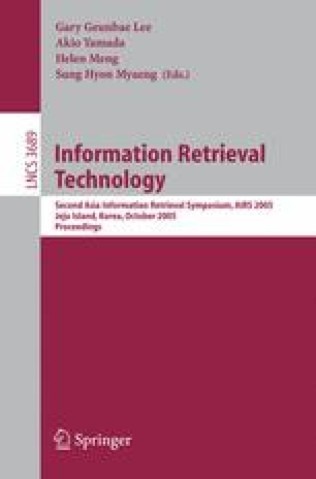
Information Retrieval Technology ; Vol. 3689 ; 2nd Asia information retrieval symposium, AIRS 2005, Jeju Island, Korea, October 13-15, 2005, Proceedings
Asia Information Retrieval Symposium (AIRS) was established in 2004 by the Asian information retrieval community after the successful series of Information Retrieval with Asian Languages (IRAL) workshops held in six different locations in Asia, starting from 1996. The AIRS symposium aims to bring together international researchers and developers to exchange new ideas and the latest results in the field of information retrieval (IR). The scope of the symposium covers applications, systems, technologies and theoretical aspects of information retrieval in text, audio, image, video and multi-media data. We are very pleased to report that we saw a sharp and steady increase in the number of submissions and their qualities, compared with previous IRAL workshop series. We received 136 submissions from all over the world including Asia, North America, Europe, Australia, and even Africa, from which 32 papers (23%) were presented in oral sessions and 36 papers in poster sessions (26%). We also held a special session called “Digital Photo Albuming,” where 4 oral papers and 3 posters were presented. It was a great challenge and hard work for the program committee to select the best among the excellent papers. The high acceptance rates witness the success and stability of the AIRS series. All the papers and posters are included in this LNCS (Lecture Notes in Computer Science) proceedings volume, which is S- indexed. The technical program included two keynote talks by Prof. Walter Bender and Prof.
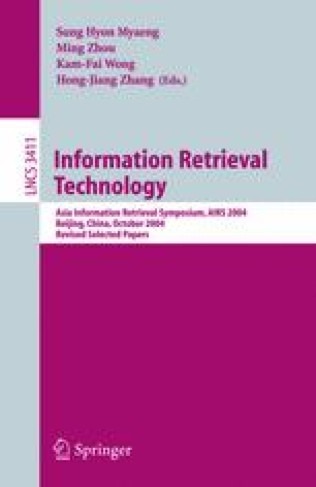
Information retrieval technology ; Vol. 3411 ; Asia information retrieval symposium, AIRS 2004, Beijing, China, October 18-20, 2004. Revised Selected Papers
TheAsiaInformationRetrievalSymposium(AIRS)wasestablishedbytheAsian information retrieval community after the successful series of Information - trieval with Asian Languages (IRAL) workshops held in six di?erent locations in Asia, starting from 1996. While the IRAL workshops had their focus on inf- mation retrieval problems involving Asian languages, AIRS covers a wider scope of applications, systems, technologies and theory aspects of information retrieval in text, audio, image, video and multimedia data. This extension of the scope re?ects and fosters increasing research activities in information retrieval in this region and the growing need for collaborations across subdisciplines. We are very pleased to report that we saw a sharp increase in the number of submissions and their quality, compared to the IRAL workshops. We received 106papersfromninecountriesinAsiaandNorthAmerica,fromwhich28papers (26%) were presented in oral sessions and 38 papers in poster sessions (36%). It was a great challenge for the Program Committee to select the best among the excellent papers. The low acceptance rates witness the success of this year’s conference. After a long discussion between the AIRS 2004 Steering Committee and Springer, the publisher agreed to publish our proceedings in the Lecture Notes in Computer Science (LNCS) series, which is SCI-indexed. We feel that this strongly attests to the excellent quality of the papers.
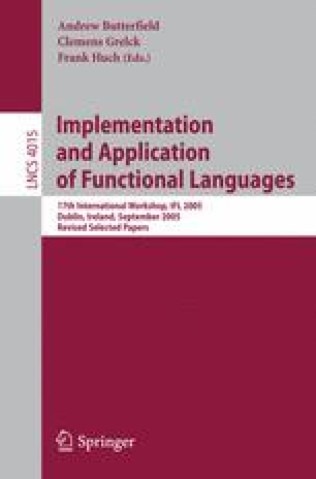
Implementation and Application of Functional Languages ; Vol. 4015 ; 17th International Workshop, IFL 2005, Dublin, Ireland, September 19-21, 2005, Revised Selected Papers
The 17th International Workshop on Implementation and Application of Functional Languages (IFL 2005) was held in Dublin, Ireland, September 19–21, 2005. It was organized by the Department of Computer Science at Trinity College, University of Dublin. IFL 2005 was the 17th event in the annual series of IFL workshops. The aim of the workshop series is to bring together researchers actively engaged in the implementation and application of functional and function-based programming languages. It provides an open forum for researchers who wish to present and discuss new ideas and concepts, work in progress, preliminary results, etc., related primarily, but not exclusively, to the implementation and application of functional languages. Topics of interest cover a wide range from theoretical aspects over language design and implementation towards applications and tool support.

Implementation and application of functional languages ; Vol. 3474 ; 16th International Workshop, IFL 2004, Lübeck, Germany, September 8-10, 2004, Revised Selected Papers
The 16th International Workshop on Implementation and Application of Fu- tional Languages (IFL 2004) was held in Lub ¨ eck, Germany, September 8–10, 2004. It was jointly organized by the Institute of Computer Science and Applied Mathematics of the University of Kiel and the Institute of Software Technology and Programming Languages of the University of Lub ¨ eck. IFL 2004 was the sixteenth event in the annual series of IFL workshops. The aim of the workshop series is to bring together researchers actively engaged in the implementation and application of functional and function-based progr- ming languages. It provides an open forum for researchers who wish to present and discuss new ideas and concepts, work in progress, preliminary results, etc., related primarily, but not exclusively, to the implementation and application of functional languages. Topics of interest cover a wide range from theoretical - pects over language design and implementation towards applications and tool support.
ICCS 2007 ; Proceedings of the 15th International Workshops on Conceptual Structures
The 15th International Conference on Conceptual Structures (ICCS 2007) is the latest in a series of annual conferences that have been held in Europe, Australia, and North America since 1993. Some of the world's best minds in information technology, arts, humanities and social science converged to explore novel ways that information and communications technology (ICT) can augment human intelligence.

Human Interaction with Machines ; Proceedings of the 6th International Workshop held at the Shanghai JiaoTong University, March 15-16, 2005
The International Workshop on “Human Interaction with Machines” is the sixth in a successful series of workshops that were established by Shanghai Jiao Tong University and Technische Universität Berlin. The goal of those workshops is to bring together researchers from both universities in order to present research results to an international community. The series of workshops started in 1990 with the International Workshop on “Artificial Intelligence” and was continued with the International Workshop on “Advanced Software Technology” in 1994.

High-Performance Computing ; 6th International Symposium, ISHPC 2005, Nara, Japan, September 7-9, 2005, First International Workshop on Advanced Low Power Systems, ALPS 2006, Revised Selected Papers
This is the joint post-proceedings of the 6th International Symposium on High Performance Computing (ISHPC-VI) and the First International Workshop on Advanced Low Power Systems 2006 (ALPS2006). The post-proceedings also contain the papers presented at the Second HPF International Workshop: - periences and Progress (HiWEP2005) and the Workshop on Applications for PetaFLOPS Computing (APC2005), which are workshops of ISHPC-VI. ISHPC-VI, HiWEP2005 and APC2005 were held in Nara, Japan during September 7–9, 2005. Fifty-eight papers from 11 countries were submitted to ISHPC-VI. After the reviews of the submitted papers, the ISHPC-VI Program Committee selected 15 regular (12-page) papers for oral presentation. In ad- tion, several other papers with favorable reviews were recommended for poster presentation, and 14 short (8-page) papers were also selected.

High performance computing on vector systems 2006 ; Proceedings of the High Performance Computing Center Stuttgart, March 2006
With this second issue of "High Performance Computing on Vector Systems ~ Proceedings of the High Performance Computing Center Stuttgart" we con tinue our publication of most recent results in high performance computing and innovative architecture. Together with our book series on "High Perfor mance Computing in Science and Engineering'06 - Transactions of the High Performance Computing Center Stuttgart" this book gives an overview of the most recent developments in high performance computing and its use in scientific and engineering applications. This second issue covers presentations and papers given by scientists in two workshops held at Stuttgart and Tokyo in spring and summer 2006.
High performance computing ; 4th International Symposium, ISHPC 2002, Kansai Science City, Japan, May 15-17, 2002. Proceedings
The objective of this symposium is to exchange the latest research results in software, architecture, and applications in HPC in a more informal and friendly atmosphere. I am delighted that the symposium is, like past successful ISHPCs, comprised of excellent invited talks, panels, workshops, as well as high-quality technical papers on various aspects of HPC. We hope that the symposium will provide an excellent opportunity for lively exchange and discussion about - rections in HPC technologies and all the participants will enjoy not only the symposium but also their stay in Kansai Science City.

Hardware and software : Verification and testing ; 1st International Haifa Verification Conference, Haifa, Israel, November 13-16, 2005, Revised Selected Papers
The First Haifa Verification Conference was held at the IBM Haifa Research Lab and at the Haifa University in Israel from November 13 to16, 2005. The conference incorporated three different workshops that took place separately in previous years. The IBM Verification Workshop is now its sixth year, the IBM Software Testing Workshop is now in its fourth year, and the PADTAD Workshop on testing and debugging multi-threaded and parallel software was held for the third time. The Verification Conference was a three-day, single-track conference followed by a one-day tutorial on the testing and review of multi-threaded code. The conference presented a unique combination of fields that brought together the hardware and software testing communities. Merging the different communities under a single roof gave the conference a distinctive flavor and provided the participants with added benefits. While the applications in these separate fields are different, the techniques used are often very similar. By offering lectures in these disparate but related disciplines, the conference engendered an environment of collaboration and discovery.

Handbook of pharmacokinetics and toxicokinetics
An effort to blend the common approaches to pharmacokinetics and toxicokinetics. It integrates the principles held in common by both fields through a logical and systematic approach, which includes mathematical descriptions of physical and physiological processes employed in approaches to PK/TK modeling. It emphasizes general principles and concepts and related isolated applications and case studies observations.The systematic compilation of mathematical concepts and methodologies allows readers to decide on relevant concepts and approaches for their research, scientific or regulatory decisions, or for offering advance courses/workshops and seminars.
Graph Transformations ; 3rd International Conference, ICGT 2006, Rio Grande do Norte, Brazil, September 17-23, 2006, Proceedings
ICGT 2006 was the 3rd International Conference on Graph Transformation, following the previous two in Barcelona (2002) and Rome (2004), and a series of six international workshops between 1978 and 1998. The scope of the conference concerned graphical structures of various kinds (like graphs, diagrams and visual sentences) that are useful when describing complex structures and systems in a direct and intuitive way. These structures are often enriched with formalisms that model their evolution via suitable kinds of transformations. The ?eld of the conference was concerned with the theory, applications, and implementation issues of such formalisms. Particularemphasis wasputonmetamodelswhichcanaccommodateavarietyofgraphicalstructures within the same abstract theory.

Globalization and Summit Reform : An Experiment in International Governance
This account of the 'L-20 project' describes and analyses a 3-year mobilization designed as an alternative to the political deadlocks preventing progress on critical global issues. The L-20 would include leaders from the existing G-countries, augmented by key regional powers such as China, Brazil, India, South Africa and Egypt. The book traces the origins and findings of the project, which generated a broad array of cutting-edge research and over twenty substantive, action-oriented workshops involving hundreds of experts and practitioners around the world. The workshop series examined in detail the operational possibilities for a Leaders Group addressing a range of issues, including infectious disease control, climate change/global warming, energy security, nuclear proliferation, management of international financial crises, and the provision of safe drinking water and sanitation, to name just a few.
Gesture in Human-Computer Interaction and Simulation ; 6th International Gesture Workshop, GW 2005, Berder Island, France, May 18-20, 2005, Revised Selected Papers
The international Gesture Workshops have become the leading interdisciplinary events for dissemination of the latest results on gesture-based communication. The goal of these workshops is to bring together researchers who want to meet and share ideas on advanced research on gesture related to multidisciplinary scienti?c ?elds. Depending on the ?elds, the objectives can be very di?erent. While physiology and biomechanics aim to extract fundamental knowledge of physical gesture, computer sciences try to capture di?erent aspects of gesture and extract features that help to identify, interpret or rebuild the underlying mechanisms of communication gestures. Other approaches and methodologies are followed by cognitive sciences and linguistics, bringing a complementary - derstanding of motor control and gesture meaning. The results can be enhanced by technological applications or demonstrations.

Genetic rogramming ; Vol. 3447 : 8th European conference, EuroGP 2005, Lausanne, Switzerland, March 30-April 1, 2005, Proceedings
In this volume we present the contributions for the 18th European Conference on Genetic Programming (EuroGP 2005). The conference took place from 30 March to 1 April in Lausanne, Switzerland. EuroGP is a well-established conf- ence and the only one exclusively devoted to genetic programming. All previous proceedings were published by Springer in the LNCS series. From the outset, EuroGP has been co-located with the EvoWorkshops focusing on applications of evolutionary computation. Since 2004, EvoCOP, the conference on evolutionary combinatorial optimization, has also been co-located with EuroGP, making this year’s combined events one of the largest dedicated to evolutionary computation in Europe. Genetic programming (GP) is evolutionary computation that solves complex problems or tasks by evolving and adapting a population of computer programs, using Darwinian evolution and Mendelian genetics as its sources of inspiration. Some of the 34 papers included in these proceedings address foundational and theoretical issues and there is also a wide variety of papers dealing with di?erent application areas, such as computer science, engineering, language processing, biology and computational design, demonstrating that GP is a powerful and practical problem-solving paradigm.
Generative programming and component engineering ; 4th International conference, GPCE 2005, Tallinn, Estonia, September 29 - October 1, 2005, Proceedings
Generative Programming and Component Engineering (GPCE) is a leading - searchconferenceonautomaticprogrammingandcomponentengineering.These approaches to software engineering have the potential to revolutionize software development as automation and components revolutionized manufacturing. The conference brings together researchers and practitioners interested in adva- ing automation for software development. It is also a premier forum for cro- fertilization between the programming language and software engineering - search communities. GPCEaroseasajointconference, mergingthepriorconferenceonGenerative and Component-Based Software Engineering (GCSE) and the Workshop on - mantics, Applications, andImplementationofProgramGeneration(SAIG). The proceedingsofthepreviousGPCEconferenceswerepublishedintheLNCSseries of Springer as volumes2487,2830, and 3286.In 2005 GPCE wasco-locatedwith the International Conference on Functional Programming (ICFP) and the s- posium on Trends in Functional Programming (TFP), re?ecting the vigorous interaction between the functional programming and generative programming research communities. GPCE and ICFP are both sponsored by the Association for Computing Machinery. The quality and breadth of the papers submitted to GPCE 2005 was impr- sive. All 86 papers, including 5 papers for tool demonstrations, were rigorously reviewed by 17 highly quali?ed Program Committee members. The members of the Program Committee ?rst provided in-depth individual reviews of the s- mitted papers, and then debated the merits of the papers through an extended electronicProgramCommitteemeeting.After much(friendly) argument,25r- ular papers and 2 tool demonstration papers were selected for publication. The ProgramCommittee provided extensive technical feedback to the authors of the submittedpapers.Theconferenceprogramwascomplementedwiththreeinvited talks, three extended tutorials, and three all-day workshops.
Fundamental approaches to software engineering ; Vol. 3442 ; 8th International Conference, FASE 2005, Held as Part of the Joint European conferences on theory and practice of software, ETAPS 2005, Edinburgh, UK, April 4-8, 2005, Proceedings
ETAPS 2005 was the eighth instance of the European Joint Conferences on Theory and Practice of Software. ETAPS is an annual federated conference that was established in 1998 by combining a number of existing and new conf- ences. This year it comprised ?ve conferences (CC, ESOP, FASE, FOSSACS, TACAS), 17 satellite workshops (AVIS, BYTECODE, CEES, CLASE, CMSB, COCV, FAC, FESCA, FINCO, GCW-DSE, GLPL, LDTA, QAPL, SC, SLAP, TGC, UITP), seven invited lectures (not including those that were speci?c to the satellite events), and several tutorials. We received over 550 submissions to the ?ve conferences this year, giving acceptance rates below 30% for each one. The events that comprise ETAPS address various aspects of the system - velopment process, including speci?cation, design, implementation, analysis and improvement. The languages, methodologies and tools which support these - tivities are all well within its scope. Di?erent blends of theory and practice are represented, with an inclination towards theory with a practical motivation on the one hand and soundly based practice on the other. Many of the issues involved in software design apply to systems in general, including hardware s- tems,andtheemphasisonsoftwareisnotintendedtobeexclusive.

Frontiers of high performance computing and networking – ISPA 2007 workshops ; ISPA 2007 International workshops, SSDSN, UPWN, WISH, SGC, ParDMCom, HiPCoMB, and IST-AWSN, Niagara Falls, Canada, August, 28-September 1, 2007, Proceedings
This book constitutes the refereed joint proceedings of seven international workshops held in conjunction with the 5th International Symposium on Parallel and Distributed Processing and Applications, ISPA 2007, held in Niagara Falls, Canada in August 2007.

Frontiers of high performance computing and networking – ISPA 2006 workshops ; ISPA 2006 International workshops FHPCN, XHPC, S-GRACE, GridGIS, HPC-GTP, PDCE, ParDMCom, WOMP, ISDF, and UPWN, Sorrento, Italy, December 4 -7, 2006, Proceedings
This book constitutes the refereed joint proceedings of ten internationl workshops held in conjunction with the 4th International Symposium on Parallel and Distributed Processing and Applications, ISPA 2006, held in Sorrento, Italy in December 2006 (see LNCS 4330). Topics addressed are frontiers of high performance computing and networking (FHPCN 2006), XEN in HPC cluster and grid computing environments (XHPC 2006), semantic grid applications in computing and engineering (S-GRACE 2006), fertilization of grid computing and geographic information system (GridGIS 2006), high performance computing in genomic proteomic and transcriptomic (HPC-GTP 2006), parallel and distributed computing in engineering (PDCE 2006), parallel and distributed multimedia computing (ParDMCom 2006), middleware performance (WOMP 2006), information security and digital forensics (ISDF 2006), and ubiquitous processing for wireless networks (UPWN 2006).

Foundations of genetic algorithms ; 8th International Workshop, FOGA 2005, Aizu-Wakamatsu City, Japan, January 5-9, 2005, Revised Selected Papers
The8thWorkshopontheFoundationsofGeneticAlgorithms,FOGA-8,washeld at the University of Aizu in Aizu-Wakamatsu City, Japan, January 5–9, 2005. This series of workshops was initiated in 1990 to encourage further research on the theoretical aspects of genetic algorithms, and the workshops have been held biennially ever since. The papers presented at these workshops are revised, edited and published as volumes during the year following each workshop. This series of (now eight) volumes provides an outstanding source of reference for the theoretical work in this ?eld. At the same time this series of volumes provides a clear picture of how the theoretical research has grown and matured along with the ?eld to encompass many evolutionary computation paradigms including evolution strategies (ES), evolutionary programming (EP), and genetic programming (GP), as well as the continuing growthininteractionswith other ?elds suchas mathematics,physics, and biology.
