


Refine Results
Sort By
From
To

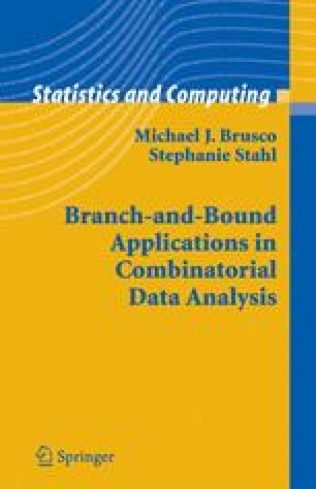
There are a variety of combinatorial optimization problems that are relevant to the examination of statistical data. Combinatorial problems arise in the clustering of a collection of objects, the seriation (sequencing or ordering) of objects, and the selection of variables for subsequent multivariate statistical analysis such as regression. The options for choosing a solution strategy in combinatorial data analysis can be overwhelming. Because some problems are too large or intractable for an optimal solution strategy, many researchers develop an over-reliance on heuristic methods to solve all combinatorial problems. However, with increasingly accessible computer power and ever-improving methodologies, optimal solution strategies have gained popularity for their ability to reduce unnecessary uncertainty. In this monograph, optimality is attained for nontrivially sized problems via the branch-and-bound paradigm.

In line with the current focus on a sustainable economy, bioethanol and other biofuels have received tremendous attention, making many headlines. Being produced in steadily growing volumes has made it necessary to consider production of biofuels from renewable raw materials that are not currently used. Therefore, the production of biofuels is at the gateway of moving from traditional raw materials to others such as lignocellulosic materials. However, sucha transfer requires new production processes that are economically feasible.This volume addresses and discusses the current status of biofuels, covering aspects from enabling technologies to different technology and processes options, as well as economical and policy perspectives.
This book deals with many topics in modern financial mathematics in a way that does not use advanced mathematical tools and shows how these models can be numerically implemented in a practical way. The book is aimed at undergraduate students, MBA students, and executives who wish to understand and apply financial models in the spreadsheet computing environment.The basic building block is the one-step binomial model where a known price today can take one of two possible values at the next time. In this simple situation, risk neutral pricing can be defined and the model can be applied to price forward contracts, exchange rate contracts, and interest rate derivatives.
Considering the stupendous gain in importance, in the banking and insurance industries since the early 1990’s, of mathematical methodology, especially probabilistic methodology, it was a very natural idea for the French "Académie des Sciences" to propose a series of public lectures, accessible to an educated audience, to promote a wider understanding for some of the fundamental ideas, techniques and new tools of the financial industries. These lectures were given at the "Académie des Sciences" in Paris by internationally renowned experts in mathematical finance, and later written up for this volume which develops, in simple yet rigorous terms, some challenging topics such as risk measures, the notion of arbitrage, dynamic models involving fundamental stochastic processes like Brownian motion and Lévy processes.

"This book reviews the principle and rationale for using artificial gravity during space missions, and describes the current options proposed, including a short-radius centrifuge contained within a spacecraft. In Artificial Gravity, experts provide recommendations on the research needed to assess whether or not short-radius centrifuge workouts can help limit deconditioning of physiological systems.""Aided by an exquisite group of experts, Gilles Clement and Angie Bukley have managed to put together THE new, comprehensive reference book on artificial gravity. This book will be an essential resource for students, scientists, and program planners alike."
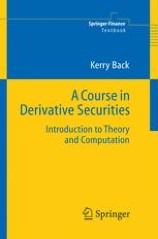
This book aims at a middle ground between the introductory books on derivative securities and those that provide advanced mathematical treatments. It is written for mathematically capable students who have not necessarily had prior exposure to probability theory, stochastic calculus, or computer programming. It provides derivations of pricing and hedging formulas (using the probabilistic change of numeraire technique) for standard options, exchange options, options on forwards and futures, quanto options, exotic options, caps, floors and swaptions, as well as VBA code implementing the formulas. It also contains an introduction to Monte Carlo, binomial models, and finite-difference methods.

Daraa Highway - Ghabagheb - Syria
+963-15 2050 - 15 860 380 /1/2/3 - 11 662 3900