



Page 29
Page 29

Advanced Data Mining and Applications ; 4th International Conference, ADMA 2008, Chengdu, China, October 8-10, 2008. Proceedings
This book constitutes the refereed proceedings of the 4th International Conference on Advanced Data Mining and Applications, ADMA 2008, held in Chengdu, China, in October 2008.

Advanced Concepts for Intelligent Vision Systems ; 9th International Conference, ACIVS 2007, Delft, The Netherlands, August 28-31, 2007, Proceedings
This volume collects the papers accepted for presentation at the Ninth International Conference on “Advanced Concepts for Intelligent Vision Systems”The ACIVS conference was established in 1999 in Baden-Baden (Germany) as part of a large m ulticonference. Since then ACIVS has been developed as an independent scientific event and has maintained the tradition of being a single track event with oral presentations of 25 minutes each, even though the number of participants has been steadily growing every year. The conference currently attracts computer scientists from more than 20 countries, mostly from Europe, Australia and Japan, but also from the USA, Asia and the Middle East.
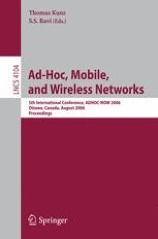
Ad-Hoc, mobile, and wireless networks ; Vol. 4104 ; 5th International Conference, ADHOC-NOW 2006, Ottawa, Canada, August 17-19, 2006 Proceedings
The 5th International Conference on Adhoc, Mobile and Wireless Networks (Adhoc-Now 2006) was held during August 17–19, 2006, in Ottawa, Canada. The ?rst four conferences in this series were held in Toronto (2002), Montreal (2003), Vancouver (2004) and Cancun (2005), respectively. The purpose of this conference is to provide a forum for researchers from academia/industry and practitioners to meet and exchange ideas regarding recent developments in the areas of ad hoc wireless networks. We received more than 170 papers for the conference submitted by authors from the following 25 countries: Australia, Bangladesh, Brazil, Canada, China, France, Germany, Greece, India, Iran, Ireland, Italy, Korea, Malaysia, Mexico, Nepal, Norway,Poland, Spain, Taiwan, The Netherlands, Turkey, UK, USA and Venezuela. Each paper was assignedto three members of the Technical Program Committee (TPC).
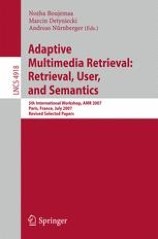
Adaptive Multimedial Retrieval : Retrieval, User, and Semantics ; 5th International Workshop, AMR 2007, Paris, France, July 5-6, 2007 Revised Selected Papers
This book constitutes the thoroughly refereed post-workshop proceedings of the 5th International Workshop on Adaptive Multimedia Retrieval, AMR 2007, held in Paris, France, in July 2007.
Adaptive and Personalized Semantic Web
Web Personalization can be defined as any set of actions that can tailor the Web experience to a particular user or set of users. To achieve effective personalization, organizations must rely on all available data, including the usage and click-stream data (reflecting user behaviour), the site content, the site structure, domain knowledge, as well as user demographics and profiles. In addition, efficient and intelligent techniques are needed to mine this data for actionable knowledge, and to effectively use the discovered knowledge to enhance the users' Web experience.

Accessing Multilingual Information Repositories ; 6th Workshop of the Cross-Language Evaluation Forum, CLEF 2005, Vienna, Austria, 21-23 September, 2005, Revised Selected Papers
The sixth campaign of the Cross Language Evaluation Forum (CLEF) for European languages was held from January to September 2005. CLEF is by now an established international evaluation initiative and 74 groups from all over the world submitted results for one or more of the different evaluation tracks in 2005, compared with 54 groups in 2004. There were eight distinct evaluation tracks, designed to test the performance of a wide range of systems for multilingual information access. Full details regarding the design of the tracks, the methodologies used for evaluation, and the results obtained by the participants can be found in the different sections of these proceedings.
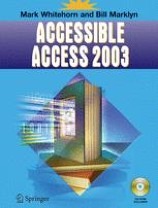
Accessible access 2003
In that book we tried very hard not to simply list everything that we knew about the product. Instead we tried to act as intelligent filters, presenting only the essential information that you need to get started. Every screen shot has been retaken and every section has been re-checked to ensure, not only that it still works, but also that it is actually still relevant. We have re-written parts where the product has changed and also added some. For example, there is a new section on Object Dependencies and a whole new chapter about Data Access Pages - helping you to put your Access database onto an intranet.
Abord clinique du malade âgé = Clinic Approach for the Elderly Patient
The general practitioner and the specialists are brought to examine a growing number of elderly or very old patients. Until now, they have hardly been prepared for this very special clinical approach where each symptom can relate to several causes, where the diseases are almost always multiple, symptomatic, or ready to reveal themselves by a complication, where a diagnosis can be. hide another, where a history - key to the diagnosis - may have been forgotten or concealed.

3-D Structural Geology : A Practical Guide to Quantitative Surface and Subsurface Map Interpretation
This book provides an overview of techniques for constructing structural interpretations in 2-D, 2½-D and 3-D environments; for interpolating - tween and extrapolating beyond the control points; and for validating the final int- pretation. The underlying philosophy is that structures are three-dimensional solid bodies and that data from throughout the structure, whether in 2-D or 3-D format, should be integrated into an internally consistent 3-D interpretation. It is assumed that most users of this book will do their work on a computer. C- sequently, the book provides quantitative structural methods and techniques that are designed for use with spreadsheets, mapping software, and three-dimensional c- puter-graphics programs. The book is also intended to provide the background for understanding what interpretive software, for example, a computer contouring p- gram, does automatically. Most techniques are presented in both a traditional format appropriate for paper, pencil, and a pocket calculator, and in quantitative format for use with spreadsheets and computer-graphics or computer-aided-design programs.
