



Page 28
Page 28

Interfacial Nanochemistry : Molecular Science and Engineering at Liquid-Liquid Interfaces
The presence of liquid-liquid interface means that real liquids are far from ideal liquids that must be miscible with any kinds of liquids and have no interface. Thus it can be said that the non-ideality of liquids might generate the liquid-liquid interface indeed and that biological systems might be generated from the non-ideal interface. The liquid-liquid interface has been, therefore, studied as a model of biological membrane. From pairing two-phases of gas, liquid and solid, nine different pairs can be obtained, which include three homo-pairs of gas-gas, liquid-liquid and solid-solid pairs. The gas-gas interface, however, is practically no use under the ordinary conditions. Among the interfaces produced by the pairing, the liquid-liquid interface is most slippery and difficult to be studied experimentally in comparison with the gas-liquid and solid-liquid interfaces, as the liquid-liquid interface is flexible, thin and buried between bulk liquid phases. Therefore, in order to study the liquid-liquid interface, the invention of innovative measurement methods has a primary importance.

Interest Rate Models : an Infinite Dimensional Stochastic Analysis Perspective
Interest Rate Models: an Infinite Dimensional Stochastic Analysis Perspective studies the mathematical issues that arise in modeling the interest rate term structure. These issues are approached by casting the interest rate models as stochastic evolution equations in infinite dimensions. The book is comprised of three parts. Part I is a crash course on interest rates, including a statistical analysis of the data and an introduction to some popular interest rate models. Part II is a self-contained introduction to infinite dimensional stochastic analysis, including SDE in Hilbert spaces and Malliavin calculus. Part III presents some recent results in interest rate theory, including finite dimensional realizations of HJM models, generalized bond portfolios, and the ergodicity of HJM models.

Interdisciplinary Perspectives on Mortality and its Timings : When is Death?
This volume provides a series of illuminating perspectives on the timings of death, through in-depth studies of Shakespearean tragedy, criminal execution, embalming practices, fears of premature burial, rumours of Adolf Hitler’s survival, and the legal concept of brain death. In doing so, it explores a number of questions, including: how do we know if someone is dead or not? What do people experience at the moment when they die? Is death simply a biological event that comes about in temporal stages of decomposition, or is it a social event defined through cultures, practices, and commemorations? In other words, when exactly is death? Taken together, these contributions explore how death emerges in a series of stages that are uncertain, paradoxical, and socially contested.

Interdisciplinary mathematics education : A state of the art
This book provides an essential introduction to the state-of the-art in interdisciplinary Mathematics Education. First, it begins with an outline of the field’s relevant historical, conceptual and theoretical backgrounds, what “discipline” means and how inter-, trans-, and meta-disciplinary activities can be understood. Relevant theoretical perspectives from Marx, Foucault and Vygotsky are explained, along with key ideas in theory, e.g. boundaries, discourses, identity, and the division of labour in practice. Second, the book reviews research findings of mainly empirical studies on interdisciplinary work involving mathematics in education, in all stages of education that have become disciplined. For example, it reports that a common theme in studies in middle and high schools is assessing the motivational benefits for the learner of subsuming disciplinary motives and even practices to extra-academic problem-solving activities; this is counter-balanced by the effort needed to overcome the disciplinary boundaries in academic institutions, and in professional identities. These disciplinary boundaries are less obviously limitations in middle and primary schools, and in some vocational courses. Third and finally, it explores selected case studies that illustrate these concepts and findings, both in terms of the motivational benefits for learners and the institutional and other boundaries involved.

Interdisciplinary Aspects of Information Systems Studies ; The Italian Association for Information Systems
Chapters of this book offer a careful selection of the best contributions to the Italian Association for Information Systems (ItAIS) Annual Conference, that took place in Venice, San Servolo Island, in October 2007. The main goal of this book is to disseminate academic knowledge, both theoretical and pragmatic, in the information systems community. Recognizing the relevance of many different disciplines, the book takes an interdisciplinary approach to the subject of information systems, thus providing a comprehensive and current coverage of this important area.

Interconnect Noise Optimization in Nanometer Technologies
The authors bring together a wealth of information presenting a range of CAD algorithms and techniques for synthesizing and optimizing interconnect. Practical aspects of the algorithms and the models are explained with sufficient details. The book investigates the most effective parameters in layout optimization. Different post-layout optimization techniques with complexity analysis and benchmarks tests are provided. The impact crosstalk noise and coupling on the wire delay is analyzed. Parameters that affect signal integrity are also considered.
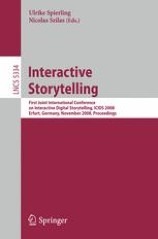
Interactive storytelling ; 1st Joint International Conference on interactive digital storytelling, ICIDS 2008 Erfurt, Germany, November 26-29, 2008 Proceedings
This book constitutes the refereed proceedings of the First Joint International Conference on Interactive Digital Storytelling, ICIDS 2008, held in Erfurt, Germany, in November 2008.The 19 revised full papers, 5 revised short papers, and 5 poster papers presented together with 3 invited lectures and 8 demo papers were carefully reviewed and selected from 62 submission. The papers are organized in topical sections on future perspectives on interactive digital storytelling, interactive storytelling applications, virtual characters and agents, user experience and dramatic immersion, architectures for story generation, models for drama management and interacting with stories, as well as authoring and creation of interactive narrative.

Interactive Media : The Semiotics of Embodied Interaction
Human Computer Interaction has been looking at versions of these questions for a long time now, but as technology advances so quickly it is hard to keep pace with the changes. In reflecting on some of these issues and by providing a way to relate some of the disparate threads of theory from fields such as phenomenology, cognitive science, semiotics and the ecological theory of perception, Shaleph O’Neill provides an exploration of the theories that impact our understanding over a spectrum of interactive media.

Interactive drink machine company - (IDM company)
This project is a continuation of our previous project for a hot drink machine by adding the capability for electronic payment and developing the company's management system and making the hot drink machine linkable with the company's server via the Internet and more interactive with the customer through the development of this project according to several aspects. On the software level: An integrated system that allows recording customer requests and executed operations, in addition to information about users, including their personal information, current balance, and executed requests. On the level of employees, their personal information, their work tasks and the operations carried out by them (Receipt and delivery of materials and servicing of machines).

Intentional acts and institutional facts : Essays on John Searle’s social ontology
This book includes ten original essays that critically examine central themes of John Searle’s ontology of society, as well as a new essay by Searle that summarizes and further develops his work in that area. The critical essays are grouped into three parts. Part I (Aspects of Collective Intentionality) . Part II (From Intentions to Institutions: Development and Evolution) . Part III (Aspects of Institutional Reality).

Intensive and Critical Care Medicine : Reflections, Recommendations and Perspectives
The volume will provide an update on problems concerning respiration, cardiovascular medicine, monitoring, organizational aspects and quality of care; other important aspects will be discussed, from critical patients' treatment and informed consent to costs managements, research and auditing, severity scores and control of infections in intensive care. Sepsis and organ dysfunction will be dealt with in detail. A brief account of records of the World Federation of Intensive and Critical Care Medicine introduces some of the drawbacks encountered during its thirty-year-old history.

Intelligent Techniques and Tools for Novel System Architectures
Provides a source wherein academics, researchers and practitioners may derive high-quality, original and state-of-the-art papers describing theoretical aspects, systems architectures, analysis and design tools and techniques, and implementation experiences in intelligent systems where information and knowledge management should be mainly characterised as a net-centric infrastructure riding on the fifth wave of "distributed intelligence".

Intelligent systems and applications ; Proceedings of the 2020 intelligent systems Conference (IntelliSys) Vol.3
The book Intelligent Systems and Applications - Proceedings of the 2020 Intelligent Systems Conference is a remarkable collection of chapters covering a wider range of topics in areas of intelligent systems and artificial intelligence and their applications to the real world. This book collects both theory and application based chapters on all aspects of artificial intelligence, from classical to intelligent scope.

Intelligent systems and applications ; Proceedings of the 2020 intelligent systems Conference (IntelliSys) Vol.2
The book Intelligent Systems and Applications - Proceedings of the 2020 Intelligent Systems Conference is a remarkable collection of chapters covering a wider range of topics in areas of intelligent systems and artificial intelligence and their applications to the real world. This book collects both theory and application based chapters on all aspects of artificial intelligence, from classical to intelligent scope.

Intelligent systems and applications ; Proceedings of the 2020 intelligent systems Conference (IntelliSys) Vol.1
The book Intelligent Systems and Applications - Proceedings of the 2020 Intelligent Systems Conference is a remarkable collection of chapters covering a wider range of topics in areas of intelligent systems and artificial intelligence and their applications to the real world. This book collects both theory and application based chapters on all aspects of artificial intelligence, from classical to intelligent scope.

Intelligent interactive multimedia systems for e-Healthcare applications
includes high-quality research on various aspects of intelligent interactive multimedia technologies in healthcare services. The topics covered in the book focus on state-of-the-art approaches, methodologies, and systems in the design, development, deployment, and innovative use of multimedia systems, tools, and technologies in healthcare. The volume provides insights into smart healthcare service demands. It presents all information about multimedia uses in e-healthcare applications. The book also includes case studies and self-assessment problems for readers and future researchers. This book proves to be a valuable resource to know how AI can be an alternative tool for automated and intelligent analytics for e-healthcare applications.

Intelligent information processingg II ; IFIP TC12/WG12.3 International Conference on Intelligent Information Processing (IIP2004) October 21-23, 2004, Beijing, China
This book is based on IIP2004, which provides a forum for engineers and scientists in academia, university and industry to present their latest research findings in any aspect of intelligent information processing. Papers on intelligence science, intelligent agents, machine learning, and autonomic computing, as well as papers that highlight bioinformatics, e-commerce, and business intelligence were presented. IIP2004 meets the needs of a large and diverse community.

Intelligent information processing III ; IFIP TC12 International Conference on Intelligent Information Processing (IIP 2006), September 20-23, Adelaide, Australia
The IFIP series publishes state-of-the-art results in the sciences and technologies of information and communication. The principal aim of the IFIP series is to encourage education and the dissemination and exchange of information about all aspects of computing.

Intelligent Educational Machines : Methodologies and Experiences
Artificial Intelligence and Education is an ever-growing research area. It uses artificial intelligence tools and techniques to provide the foundations for intelligent tutoring and learning systems. The main concern is taking advantage of computer-based technology to examine, discuss and foster the processes of cognition, learning, teaching and related subjects. This book supports and develops innovative teaching methods and learning systems. The goal of this volume has been to offer a wide spectrum of sample works developed in leading research throughout the world about innovative methodologies of artificial intelligence in education and foundations of engineering educational intelligent systems as well as applications and interesting experiences in the field. The book should be useful both for beginners and experienced researchers interested in applying computational intelligence to the educational process.

Intelligent Computing ; International Conference on Intelligent Computing, ICIC 2006, Kunming, China, August 16-19, 2006, Proceedings, Part I
The International Conference on Intelligent Computing (ICIC) was formed to provide an annual forum with dedication to the emerging and challenging topics in artificial intelligence, machine learning, bioinformatics, and computational biology, etc. It aims to bring together researchers and practitioners from both the academia and industry to share ideas, problems and solutions related to the multifaceted aspects of intelligent computing. The ICIC 2006 to be held in Kunming, Yunnan, China, 16-19 August 2006 is the second International Conference on Intelligent Computing, which is built upon the success of ICIC 2005 held in Hefei, China, 2005. This year, the conference mainly concentrates on the theories & methodologies as well as the emerging applications of intelligent computing. It intends to unify the contemporary intelligent computing techniques within an integral framework that highlights the trends in advanced computational intelligence and bridges the theoretical research with the applications. In particular, the bio-inspired computing emerges as a key role in pursuing for novel technology in recently years. The resulting techniques vitalize the life science engineering and daily life applications. In light of this trend, the theme for this conference is the Emerging Intelligent Computing Technology and Applications. Papers related to this theme were especially solicited, including theories, methodologies, and applications in science and technology.
