



Page 26
Page 26

Contemporary Reflections on Business Ethics
Ronald F. Duska, who began his career as a philosopher, has, over the last 30 years, established himself as one of the leading scholars in the field of business ethics. In the past decade, he has concentrated on ethics in the financial services industry because of his affiliation with The American College in Bryn Mawr, Pennsylvania, an institution that specializes in educating financial services professionals. This affiliation gives Duska regular interaction with producers, managers, and top executives in the financial services industry. This book includes a selection of the articles Duska has written throughout the years on ethics, business ethics, teaching ethics, agency theory, postmodernism, employee rights, and ethics in accounting and the financial services industry. The articles reflect Duska’s underlying philosophical concerns and their application to the real-world challenges of practitioners—an overarching method that might be called an Aristotelian common-sense approach to ethical decision making.

Contemporary Qualitative Research : Exemplars for Science and Mathematics Educators
This volume offers a unique set of research exemplars for science, mathematics and technology educators. The volume explores the important challenge of how to translate leading-edge methodologies into practical research strategies and techniques. The book is divided into three major sections, The Golden Age of Research, Meeting the Research Crises and A New Era of Research, with chapters exploring a variety of methodologies and representational forms and texts. These include historical, narrative, literary, phenomenological, autobiographical, virtual and performance texts, among others. Qualitative Research in Postmodern Times is an exciting and accessible book that will be essential reading for science, mathematics and technology educators interested in new forms of educational research. Beginning researchers will find it practically helpful in planning and conducting their research studies, while experienced researchers will welcome new theoretical insights into postmodern methodologies.

Contemporary issues in sustainable finance : Exploring performance, impact measurement and financial inclusion
This book sheds light on contemporary challenges in sustainable finance, addressing two key perspectives: measurement and performance, and products and business models. In particular, the volume examines theoretically and empirically the relations between business models and non-financial impact, both environmental and social.

Contemporary Developments in Entrepreneurial Finance : An Academic and Policy Lens on the Status-Quo, Challenges and Trends
Provides a contemporary research-based overview of the latest trends in entrepreneurial finance and outlines expected future developments. Starting with the status quo in market regulations and the financing structure of SMEs, it addresses a broad range of new financing alternatives for innovative startups (e.g. business angel financing, venture capital and corporate venture capital), as well as recent social phenomena (e.g. crowdfunding and initial coin offerings (ICOs)). Incorporating qualitative, quantitative and mixed analytical methods, the book contributes to a better understanding of the financing world by reflecting both the researcher’s and the practitioner’s perspective.

Contaminated soils, sediments and water ; Vol.10 : Successes and challenges
Contaminated Soils, Sediments and Water: Successes and Challenges, Volume 10 contains a valuable collection of success stories (and challenges) in the areas of environmental fate, heavy metals, modeling, MTBE and oxygenates, regulatory, remediation, risk assessment, site assessment and sampling methodology. It demonstrates the progress that has been made in working together toward the optimization of established approaches, as well as embracing departures from traditional regulatory models in order to address the threats to our natural resources. The book is divided into eight sections: Part I: Environmental Fate; Part II: Heavy Metals; Part III: Modeling; Part IV: MTBE and Oxygenates; Part V: Radionuclides; Part VI: Regulatory; Part VII: Remediation; Part VIII: Risk Assessment and Remedial Approaches Towards Restoration and Management of Contaminated Rivers.

Container terminals and cargo systems : Design, operations management, and logistics control issues
Significant gains in productivity can be achieved through advanced terminal layouts, more efficient IT-support and improved logistics control software systems. The primary objective of this book is to reflect these challenges and to present new insights and successful solutions to operational problems of automated container terminals and cargo systems.

Concepts in action : Representation, learning, and application
This book is a timely contribution in presenting recent issues, approaches, and results that are not only central to the highly interdisciplinary field of concept research but also particularly important to newly emergent paradigms and challenges. The contributors present a unique, holistic picture for the understanding and use of concepts from a wide range of fields including cognitive science, linguistics, philosophy, psychology, artificial intelligence, and computer science. The chapters focus on three distinct points of view that lie at the core of concept research: representation, learning, and application. The contributions present a combination of theoretical, experimental, computational, and applied methods that appeal to students and researchers working in these fields.

Concept and Design Developments in School Improvement Research : Longitudinal, Multilevel and Mixed Methods and Their Relevance for Educational Accountability
This book discusses challenges in school improvement research and different methodological approaches that have the potential to foster school improvement research. Research on school improvement and accountability analysis places high demands on a study’s design and method. The potential of combining the depth of case studies with the breath of quantitative measures and analyses in a mixed-methods design seems very promising. Consequently, the focus of the book lies on innovative methodological approaches.

Computer Vision Beyond the Visible Spectrum
Recently, there has been a dramatic increase in the use of sensors in the non-visible bands. As a result, there is a need for existing computer vision methods and algorithms to be adapted for use with non-visible sensors, or for the development of completely new methods and systems. Computer Vision Beyond the Visible Spectrum is the first book to bring together state-of-the-art work in this area. It presents new & pioneering research across the electromagnetic spectrum in the military, commercial, and medical domains. By providing a detailed examination of each of these areas, it focuses on the development of state-of-the-art algorithms and looks at how they can be used to solve existing & new challenges within computer vision. Essential reading for academics & industrial researchers working in the area of computer vision, image processing, and medical imaging, it will also be useful background reading for advanced undergraduate & postgraduate students.
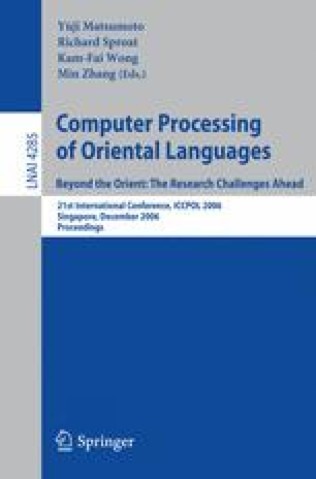
Computer Processing of Oriental Languages. Beyond the Orient : The Research Challenges Ahead ; 21st International Conference, ICCPOL 2006, Singapore, December 17-19, 2006, Proceedings
This book constitutes the thoroughly refereed proceedings of the 21st International Conference on Computer Processing of Oriental Languages, ICCPOL 2006.The papers are organized in topical sections on information retrieval, document classification, questions and answers, summarization, machine translation, word segmentation, chunking, abbreviation expansion, writing-system issues, parsing, semantics, and lexical resources.

Computer and Information Science
The purpose of the 7th IEEE/ACIS International Conference on Computer and Information Science (ICIS 2008) and the 2nd IEEE/ACIS International Workshop on e-Activity (IWEA 2008) is to bring together scientists, engineers, computer users, and students to share their experiences and exchange new ideas and research results about all aspects (theory, applications and tools) of computer and information science; and to discuss the practical challenges encountered along the way and the solutions adopted to solve them.

Computational science and its applications - ICCSA 2005 ; Vol. 3483 ; International Conference, Singapore, May 9-12, 2005, Proceedings, Part IV
The four volume set assembled following The 2005 International Conference on Computational Science and its Applications, ICCSA 2005, held in Suntec International Convention and Exhibition Centre, Singapore, from 9 May 2005 till 12 May 2005, represents the ?ne collection of 540 refereed papers selected from nearly 2,700 submissions. Computational Science has ?rmly established itself as a vital part of many scienti?c investigations, a?ecting researchers and practitioners in areas ranging from applications such as aerospace and automotive, to emerging technologies such as bioinformatics and nanotechnologies, to core disciplines such as ma- ematics, physics, and chemistry. Due to the shear size of many challenges in computational science, the use of supercomputing, parallel processing, and - phisticated algorithms is inevitable and becomes a part of fundamental t- oretical research as well as endeavors in emerging ?elds.

Computational science and its applications - ICCSA 2005 ; Vol. 3482 ; International Conference, Singapore, May 9-12. 2005, Proceedings, Part III
The four volume set assembled following The 2005 International Conference on Computational Science and its Applications, ICCSA 2005, held in Suntec International Convention and Exhibition Centre, Singapore, from 9 May 2005 till 12 May 2005, represents the ?ne collection of 540 refereed papers selected from nearly 2,700 submissions. Computational Science has ?rmly established itself as a vital part of many scienti?c investigations, a?ecting researchers and practitioners in areas ranging from applications such as aerospace and automotive, to emerging technologies such as bioinformatics and nanotechnologies, to core disciplines such as ma- ematics, physics, and chemistry. Due to the shear size of many challenges in computational science, the use of supercomputing, parallel processing, and - phisticated algorithms is inevitable and becomes a part of fundamental t- oretical research as well as endeavors in emerging ?elds.

Computational science and its applications - ICCSA 2005 ; International Conference, Singapore, May 9-12, 2005, Proceedings, Part II
The four volume set assembled following The 2005 International Conference on Computational Science and its Applications, ICCSA 2005, held in Suntec International Convention and Exhibition Centre, Singapore, from 9 May 2005 till 12 May 2005, represents the ?ne collection of 540 refereed papers selected from nearly 2,700 submissions. Computational Science has ?rmly established itself as a vital part of many scienti?c investigations, a?ecting researchers and practitioners in areas ranging from applications such as aerospace and automotive, to emerging technologies such as bioinformatics and nanotechnologies, to core disciplines such as ma- ematics, physics, and chemistry. Due to the shear size of many challenges in computational science, the use of supercomputing, parallel processing, and - phisticated algorithms is inevitable and becomes a part of fundamental t- oretical research as well as endeavors in emerging ?elds.

Computational methods for rational drug design
Covers the tools and techniques of drug design with applications to the discovery of small molecule-based therapeutics, detailing methodologies and practical applications and addressing the challenges of techniques like AI/ML and drug design for unknown receptor structures. Divided into 23 chapters, the contributors address various cutting-edge areas of therapeutic importance such as neurodegenerative disorders, cancer, multi-drug resistant bacterial infections, inflammatory diseases, and viral infections.

Computational Methods for Algebraic Spline Surfaces : ESF Exploratory Workshop
The papers included in this volume provide an overview about the state-of-the-art in approximative implicitization and various related topics, including both the theoretical basis and the existing computational techniques. The novel idea of approximate implicitization has strengthened the existing link between Computer Aided Geometric Design and classical algebraic geometry. There is a growing interest from researchers and professionals both in CAGD and Algebraic Geometry, to meet and combine knowledge and ideas, in order to better solve industrial--type challenges, as well as to initiate new directions for basic research. This volume will support this exchange of ideas between the various communities.

Computational intelligence for agent-based systems
In these last years the digital technology explosion has spawned so many new lifestyle models that the boundaries between "real" and "digital" are fiercely debated. This scenario has deeply changed the viewpoint about computer applications: computers become smaller, cheapest and hugely distributed in wired or unwired networks, applications become so flexible and intelligent as to tailor its communication facilities in order to increase the usability of the system. Such data-intensive, unstructured spaces featured by minimal or no centralized control flow, present a challenge for traditional methods of analysis, design and integration of advanced, distributed and intelligent computer systems. Within this challenge, an important role is played by two important research areas : Fuzzy Technology, thanks to its ability to exploit the tolerance for imprecision to achieve tractability and Agent Technology, thanks to its nature to employ agent-wise communities to carry out complex goals by means of smart interaction, cooperation, and pro-activeness.

Computational formalism : Art history and machine learning
"Computational Formalism investigates examples of art historical analysis in the fields of computer and information sciences, and frames this research in the context of art historiography. The use of machine learning to analyze art images has ushered in a renewed interest in formalism in art history, but these new techniques create new critical challenges for the field"

Computational Forensic ; 2nd International Workshop, IWCF 2008, Washington, DC, USA, August 7-8, 2008. Proceedings
This book constitutes the refereed proceedings of the Second International Workshop, IWCF 2008, held in Washington, DC, USA, August 2008. The papers are organized in topical sections on trends and challenges; scanner, printer, and prints; human identification; shoeprints; linguistics;decision making and search; speech analysis; signatures and handwriting.

Computational earthquake physics ; Part II
Exciting developments in earthquake science have benefited from new observations, improved computational technologies, and improved modeling capabilities. Designing realistic supercomputer simulation models for the complete earthquake generation process is a grand scientific challenge due to the complexity of phenomena and range of scales involved from microscopic to global. The present volume - Part II - incorporates computational environment and algorithms, data assimilation and understanding, model applications and iSERVO. Topics covered range from iSERVO and QuakeSim: implementing the international solid earth research virtual observatory by integrating computational grid and geographical information web services; LURR (Load-Unload Response Ratio) described in six papers involving this promising earthquake forecasting model; pattern informatics and phase dynamics and their applications, which was also a highlight in the Workshop; computational algorithms, including continuum damage models and visualization and analysis of geophysical datasets; evolution of mantle material; the state vector approach; and assimilation of data such as geodetic data, GPS data, and seismicity and laboratory experimental data.
