



Page 203
Page 203

Embedded Systems Specification and Design Languages : Selected contributions from FDL’07
FDL is the most important European and, probably, worldwide forum to present research results, to exchange experiences, and to learn about new trends in the application of specification and design languages and the associated design and modeling methods and tools for complex, heterogeneous HW/SW embedded systems.

Embedded Systems -- Modeling, Technology, and Applications ; Proceedings of the 7th International Workshop held at Technische Universität Berlin, June 26/27, 2006
This book synthesizes the results of the seventh in a successful series of workshops that were established by Shanghai Jiao Tong University and Technische Universitat Berlin, bringing together researchers from both universities in order to present research results to an international community.

Embedded System Design : Topics, Techniques and Trends; IFIP TC10 Working Conference: International Embedded Systems Symposium (IESS), May 30 - June 1, 2007, Irvine (CA), USA
Embedded systems have gained an enormous amount of processing power and functionality. Many of the formerly external components can now be integrated into a single System-on-Chip. This tendency has resulted in a dramatic reduction in the size and cost of embedded systems. As a unique technology, the design of embedded systems is an essential element of many innovations. This book including design methodology, specification and modeling, embedded software and hardware synthesis, networks-on-chip, distributed and networked systems, and system verification and validation. Particular emphaisis is paid to automotive and medical applications. A set of actual case studies and special aspects in embedded system design are included as well.

Embedded System Design : Embedded Systems Foundations of Cyber-Physical Systems, and the Internet of Things
A unique feature of this open access textbook is to provide a comprehensive introduction to the fundamental knowledge in embedded systems, with applications in cyber-physical systems and the Internet of things. It starts with an introduction to the field and a survey of specification models and languages for embedded and cyber-physical systems

Embedded System Design
Embedded System Design starts with an introduction into the area and a survey of specification languages for embedded systems. A brief overview is provided of hardware devices used for embedded systems and also presents the essentials of software design for embedded systems. Real-time operating systems and real-time scheduling are covered briefly. Techniques for implementing embedded systems are also discussed, using hardware/software codesign. It closes with a survey on validation techniques. Embedded System Design can be used as a text book for courses on embedded systems and as a source which provides pointers to relevant material in the area for PhD students and teachers. The book assumes a basic knowledge of information processing hardware and software.

Embedded Software and Systems Vol. 3605 ; 1st International Conference, ICESS 2004, Hangzhou, China, December 9-10, 2004, Revised Selected Papers
Welcome to the post proceedings of the First International Conference on Embedded Software and Systems (ICESS 2004), which was held in Hangzhou, P. R. China, 9–10 December 2004. Embedded Software and Systems technology is of increasing importance for a wide range of industrial areas, such as aerospace, automotive, telecommunication, and manufacturing automation. Embedded technology is playing an increasingly dominant role in modern society. This is a natural outcome of amazingly fast developments in the embedded field. The ICESS 2004 conference brought together researchers and developers from academia, industry, and government to advance the science, engineering, and technology in embedded software and systems development, and provided them with a forum to present and exchange their ideas, results, work in progress, and experience in all areas of embedded systems research and development. The ICESS 2004 conference attracted much more interest than expected.

Embedded Software and Systems ; Vol. 3820 ; 2nd International Conference, ICESS 2005, Xi'an, China, December 16-18, 2005, Proceedings
Welcome to the proceedings of the 2005 International Conference on Emb- ded Software and Systems (ICESS 2005) held in Xian, China, December 16-18, 2005. With the advent of VLSI system level integration and system-on-chip, the center of gravity of the computer industry is now moving from personal c- puting into embedded computing. Embedded software and systems are incre- ingly becoming a key technological component of all kinds of complex technical systems, ranging from vehicles, telephones, aircraft, toys, security systems, to medical diagnostics, weapons, pacemakers, climate control systems, etc. The ICESS 2005 conference provided a premier international forum for - searchers, developers and providers from academia and industry to address all resulting profound challenges; to present and discuss their new ideas, - search results, applications and experience; to improve international com- nication and cooperation; and to promote embedded software and system - dustrialization and wide applications on all aspects of embedded software and systems.

Embedded Java Security : Security for Mobile Devices
Whereas Java brings functionality and versatility to the world of mobile devices, at the same time it also introduces new security threats. The rapid growth of the number of mobile devices that support Java makes this a pressing issue. Embedded Java Security carefully examines the security aspects of Java and offers a security evaluation for the Java platform. After explaining background material on the architecture of embedded platforms and relating to its role in security, the book deconstructs the security model into its main components: It explains each component and relates it to the aim of securing the applications and the device. Toward this end, several implementations of the Java platform are examined and tested to relate the model to its actual implementation on devices. The security holes found are further used to clarify security issues and point out common errors. Finally, the book provides an evaluation of embedded Java security that includes security models and security tests performed on real-life implementations.

Embedded Computer Systems : Architectures, Modeling, and Simulation; 20th International Conference, SAMOS 2020, Samos, Greece, July 5–9, 2020, Proceedings
This book constitutes the refereed proceedings of the 20th International Conference on Embedded Computer Systems: Architectures, Modeling, and Simulation, SAMOS 2020, held in Samos, Greece, in July 2020.* The 16 regular papers presented were carefully reviewed and selected from 35 submissions. In addition, 9 papers from two special sessions were included, which were organized on topics of current interest: innovative architectures for security and European projects on embedded and high performance computing for health applications.

Embedded Computer Systems : Architectures, Modeling, and Simulation ; Vol. 4017 ; 6th International Workshop, SAMOS 2006, Samos, Greece, July 17-20, 2006, Proceedings
This book constitutes the refereed proceedings of the 6th International Workshop on Systems, Architectures, Modeling, and Simulation, SAMOS 2006, held in Samos, Greece on July 2006.The 47 revised full papers presented together with 2 keynote talks were thoroughly reviewed and selected from 130 submissions.

Embedded computer systems : Architectures, modeling, and simulation ; Vol. 3553 ; 5th International Workshop, SAMOS 2005, Samos, Greece, July 18-20, Proceedings
The SAMOS workshop is an international gathering of highly quali?ed researchers from academia and industry, sharing in a 3-day lively discussion on the quiet and - spiring northern mountainside of the Mediterranean island of Samos. As a tradition, the workshop features workshop presentations in the morning, while after lunch all kinds of informal discussions and nut-cracking gatherings take place. The workshop is unique in the sense that not only solved research problems are presented and discussed but also (partly) unsolved problems and in-depth topical reviews can be unleashed in the sci- ti?c arena. Consequently, the workshop provides the participants with an environment where collaboration rather than competition is fostered. The earlier workshops, SAMOS I–IV (2001–2004), were composed only of invited presentations. Due to increasing expressions of interest in the workshop, the Program Committee of SAMOS V decided to open the workshop for all submissions. As a result the SAMOS workshop gained an immediate popularity; a total of 114 submitted papers were received for evaluation. The papers came from 24 countries and regions: Austria (1), Belgium (2), Brazil (5), Canada (4), China (12), Cyprus (2), Czech Republic (1), Finland (15), France (6), Germany (8), Greece (5), Hong Kong (2), India (2), Iran (1), Korea (24), The Netherlands (7), Pakistan (1), Poland (2), Spain (2), Sweden (2), T- wan (1), Turkey (2), UK (2), and USA (5). We are grateful to all of the authors who submitted papers to the workshop.
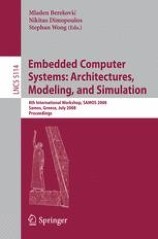
Embedded Computer Systems : Architectures, Modeling, and Simulation ; 8th International Workshop, SAMOS 2008, Samos, Greece, July 21-24, 2008. Proceedings
This book constitutes the refereed proceedings of the 8th International Workshop on Systems, Architectures, Modeling, and Simulation, SAMOS 2008, held in Samos, Greece, in July 2008.

Embedded Computer Systems : Architectures, Modeling, and Simulation ; 7th International Workshop, SAMOS 2007, Samos, Greece, July 16-19, 2007, Proceedings
The book is unique in the sense that not only solved research problems are presented and discussed but also (partly) unsolved pr- lems and in-depth topical reviews can be unleashed in the scientific arena. C- sequently, it provides the participants with an environment where collaboration rather than competition is fostered.

EM Modeling of Antennas and RF Components for Wireless Communication Systems
The book focuses on the practical aspects of computational electrodynamics. A short review of electromagnetic field theory and an illustrative introduction to basic concepts of numerical methods provide the mathematical and physical background. The main part the book guides the reader step-by-step through the modelling process: from the initial "what question shall the model answer?", through the setting up of a computer model by creating geometry, boundary conditions, sources, …, to post processing, validation, and optimization. A number of antenna and filter examples demonstrate the advantages and disadvantages of different numerical methods. So the book provides a realistic view on the capabilities and limits of state-of-the-art 3D-field simulators and on how to apply this knowledge efficiently to EM analysis and designing of RF applications in modern communication systems.

Elliptic Theory and Noncommutative Geometry : Nonlocal Elliptic Operators
This comprehensive yet concise book deals with nonlocal elliptic differential operators, whose coefficients involve shifts generated by diffeomorophisms of the manifold on which the operators are defined. The main goal of the study is to relate analytical invariants (in particular, the index) of such elliptic operators to topological invariants of the manifold itself. This problem can be solved by modern methods of noncommutative geometry. This is the first and so far the only book featuring a consistent application of methods of noncommutative geometry to the index problem in the theory of nonlocal elliptic operators. Although the book provides important results, which are in a sense definitive, on the above-mentioned topic, it contains all the necessary preliminary material, such as C*-algebras and their K-theory or cyclic homology.

Elevating video content creation with ai assistance = ارتقاء إنشاء محتوى الفيديو بمساعدة الذكاء الاصطناعي
We developed an AI Assistant equipped with features such as description crafting, title generation, keyword extraction, image captioning, clickbait detection, and sentiment analysis.To achieve these functionalities, we proposed a model for generating video descriptions using ResNet50 as a feature extractor and a LSTM network with an attention mechanism as a sequence generator, achieving a BLEU-1 score of 0.907 and a ROUGE-L score of 0.645. For keyword extraction, we utilized Sentence Transformer to identify strategically relevant keywords from the generated descriptions. For title generation, we fine-tuned the BART model, achieving a ROUGE-L score of 0.45. For clickbait detection, we used SVC classifier with linear kernel and TF-IDF vectorization for feature extraction, resulting in 96% accuracy. Our sentiment analysis model using a CNN-LSTM architecture achieved 80% accuracy in analyzing comments on videos. For image captioning, we employed a feature extractor with a CNN layer followed by an LSTM model, achieving a BLEU-1 score of 0.53. Our platform empowers creators by simplifying complex tasks and offering deeper audience engagement insights, making it a powerful tool in the evolving digital content creation.

Elementary physics of complex plasmas
Complex plasmas are dusty plasmas in which the density and electric charges of the dust grains are sufficiently high to induce long-range grain-grain interactions, as well as strong absorption of charged-plasma components. Together with the sources replenishing the plasma such systems form a highly dissipative thermodynamically open system that exhibits many features of collective behaviour generally found in complex systems. Most notably among them are self-organized patterns such as plasma crystals, plasma clusters, dust stars and further spectacular new structures. Beyond their intrinsic scientific interest, the study of complex plasmas grows in importance in a great variety of fields, ranging from space-plasma sciences to applied fields such as plasma processing, thin-film deposition and even the production of computer chips by plasma etching, in which strongly interacting clouds of complex plasmas can cause major contamination of the final product.

Elementary Dirichlet Series and Modular Forms
The main topics of the book are the critical values of Dirichlet L-functions and Hecke L-functions of an imaginary quadratic field, and various problems on elliptic modular forms. As to the values of Dirichlet L-functions, all previous papers and books reiterate a single old result with a single old method. After a review of elementary Fourier analysis, the author presents completely new results with new methods, though old results will also be proved. No advanced knowledge of number theory is required up to this point. As applications, new formulas for the second factor of the class number of a cyclotomic field will be given.

Electrostatic Accelerators : Fundamentals and Applications
Electrostatic accelerators are an important and widespread subgroup within the broad spectrum of modern, large particle acceleration devices. They are specifically designed for applications that require high-quality ion beams in terms of energy stability and emittance at comparatively low energies (a few MeV). Their ability to accelerate virtually any kind of ion over a continuously tunable range of energies make them a highly versatile tool for investigations in many research fields including, but not limited to, atomic and nuclear spectroscopy, heavy ion reactions, accelerator mass spectroscopy as well as ion-beam analysis and modification. The book is divided into three parts. The first part concisely introduces the field of accelerator technology and techniques that emphasize their major modern applications. The second part treats the electrostatic accelerator per se: its construction and operational principles as well as its maintenance. The third part covers all relevant applications in which electrostatic accelerators are the preferred tool for accelerator-based investigations. Since some topics are common to all types of accelerators, Electrostatic Accelerators will also be of value those more familiar with other types of accelerators.

Electronics Process Technology : Production Modelling, Simulation and Optimisation
Electronics Process Technology is a systemised presentation of new techniques and methods in electronics manufacture. Planning, preparation and execution are interlinked to achieve robust manufacturing processes that realise optimum quality, costs and quantities in the final product. Topics covered include: • modelling of manufacturing processes; • graph-theoretical approach to manufacturing planning; • process simulation and optimisation including cost optimisation; • quality assurance and statistical process analysis and control; • reliability models for electronic products and • assembly accuracy.
