


Refine Results
Sort By
From
To

The theory of Lie algebras and algebraic groups has been an area of active research in the last 50 years. It intervenes in many different areas of mathematics : for example invariant theory, Poisson geometry, harmonic analysis, mathematical physics. The aim of this book is to assemble in a single volume the algebraic aspects of the theory so as to present the foundation of the theory in characteristic zero. Detailed proofs are included and some recent results are discussed in the last chapters. All the prerequisites on commutative algebra and algebraic geometry are included.
This book contains a detailed and complete demonstration of the existence of an equivariate isomorphism between the Lubin-Tate and Drinfeld p-adic turns. The result is established in equal and unequal characteristics. There is also given as an application a proof that the equivariant cohomologies of these two turns are isomorphic, a result which has applications to the study of the local Langlands correspondence. During the proof, reminders and complements are given on the structure of the two preceding moduli spaces, the p-divisible formal groups and the p-adic rigid analytical geometry.
From the Preface: K-theory was introduced by A. Grothendieck in his formulation of the Riemann- Roch theorem. For each projective algebraic variety, Grothendieck constructed a group from the category of coherent algebraic sheaves, and showed that it had many nice properties. Atiyah and Hirzebruch considered a topological analog defined for any compact space X, a group K{X) constructed from the category of vector bundles on X. It is this ''topological K-theory" that this book will study. Topological K-theory has become an important tool in topology. Using K- theory, Adams and Atiyah were able to give a simple proof that the only spheres which can be provided with H-space structures are S1, S3 and S7. Moreover, it is possible to derive a substantial part of stable homotopy theory from K-theory.
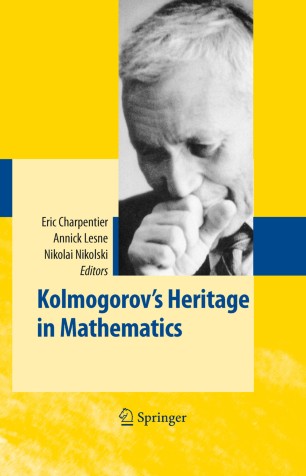
A.N. Kolmogorov (b. Tambov 1903, d. Moscow 1987) was one of the most brilliant mathematicians that the world has ever known. Incredibly deep and creative, he was able to approach each subject with a completely new point of view: in a few magnificent pages, which are models of shrewdness and imagination, and which astounded his contemporaries, he changed drastically the landscape of the subject.Most mathematicians prove what they can, Kolmogorov was of those who prove what they want. For this book several world experts were asked to present one part of the mathematical heritage left to us by Kolmogorov.
Completeness is one of the most important notions in logic and the foundations of mathematics. Many variants of the notion have been de?ned in literature. We shallconcentrateonthesevariants,andaspects,of completenesswhicharede?ned in propositional logic. Completeness means the possibility of getting all correct and reliable sc- mata of inference by use of logical methods. The word ‘all’, seemingly neutral, is here a crucial point of distinction. Assuming the de?nition as given by E. Post we get, say, a global notion of completeness in which the reliability refers only to syntactic means of logic and outside the correct schemata of inference there are only inconsistent ones. It is impossible, however, to leave aside local aspects of the notion when we want to make it relative to some given or invented notion of truth. Completeness understood in this sense is the adequacy of logic in relation to some semantics, and the change of the logic is accompanied by the change of its semantics.
Almost a century earlier, in 1782, Euler [180] published some results on classifying small Latin squares, but for the ?rst few steps in this direction one should actually go at least as far back as ancient Greece and the proof that there are exactly ?ve Platonic solids. One of the most remarkable achievements in the early, pre-computer era is the classi?cation of the Steiner triple systems of order 15, quoted above. An onerous task that, today, no sensible person would attempt by hand calcu- tion. Because, with the exception of occasional parameters for which com- natorial arguments are e?ective (often to prove nonexistence or uniqueness), classi?cation in general is about algorithms and computation.
This book is based on real inner product spaces X of arbitrary (finite or infinite) dimension greater than or equal to 2. With natural properties of (general) translations and general distances of X, euclidean and hyperbolic geometries are characterized. For these spaces X also the sphere geometries of Möbius and Lie are studied (besides euclidean and hyperbolic geometry), as well as geometries where Lorentz transformations play the key role. The geometrical notions of this book are based on general spaces X as described. This implies that also mathematicians who have not so far been especially interested in geometry may study and understand great ideas of classical geometries in modern and general contexts.

This book covers categories, homological algebra and sheaves in a systematic and exhaustive manner starting from scratch, and continues with full proofs to an exposition of the most recent results in the literature, and sometimes beyond.The authors present the general theory of categories and functors, emphasising inductive and projective limits, tensor categories, representable functors, ind-objects and localization. Then they study homological algebra including additive, abelian, triangulated categories and also unbounded derived categories using transfinite induction and accessible objects. Finally, sheaf theory as well as twisted sheaves and stacks appear in the framework of Grothendieck topologies.
Aimed at first-year undergraduates in mathematics and the physical sciences, the only prerequisites are basic algebra, coordinate geometry and the beginnings of differentiation as covered in school. The transition from school to university mathematics is addressed by means of a systematic development of important classes of techniques, and through careful discussion of the basic definitions and some of the theorems of calculus, with proofs where appropriate, but stopping short of the rigour involved in Real Analysis.The influence of technology on the learning and teaching of mathematics is recognised through the use of the computer algebra and graphical package MAPLE to illustrate many of the ideas.
The book covers a wide range of beautiful topics in analysis, is extremely well organized and well written, with elegant, detailed proofs. The book has educated a whole generation of mathematicians with backgrounds in complex analysis and function algebras.
Basic Algebra and Advanced Algebra systematically develop concepts and tools in algebra that are vital to every mathematician, whether pure or applied, aspiring or established. Together, the two books give the reader a global view of algebra and its role in mathematics as a whole.Basic Algebra presents the subject matter in a forward-looking way that takes into account its historical development. It is suitable as a text in a two-semester advanced undergraduate or first-year graduate sequence in algebra, possibly supplemented by some material from Advanced Algebra at the graduate level. It requires of the reader only familiarity with matrix algebra, an understanding of the geometry and reduction of linear equations, and an acquaintance with proofs.
Ulrich Kohlenbach presents an applied form of proof theory that has led in recent years to new results in number theory, approximation theory, nonlinear analysis, geodesic geometry and ergodic theory (among others). This applied approach is based on logical transformations (so-called proof interpretations) and concerns the extraction of effective data (such as bounds) from prima facie ineffective proofs as well as new qualitative results such as independence of solutions from certain parameters, generalizations of proofs by elimination of premises. The book first develops the necessary logical machinery emphasizing novel forms of Gödel's famous functional ('Dialectica') interpretation. It then establishes general logical metatheorems that connect these techniques with concrete mathematics. Finally, two extended case studies (one in approximation theory and one in fixed point theory) show in detail how this machinery can be applied to concrete proofs in different areas of mathematics.
This book is an elementary introduction to stable maps and quantum cohomology, starting with an introduction to stable pointed curves, and culminating with a proof of the associativity of the quantum product. The viewpoint is mostly that of enumerative geometry, and the red thread of the exposition is the problem of counting rational plane curves. Kontsevich's formula is initially established in the framework of classical enumerative geometry, then as a statement about reconstruction for Gromov–Witten invariants, and finally, using generating functions, as a special case of the associativity of the quantum product.
This is an undergraduate textbook on the basic aspects of personal savings and investing with a balanced mix of mathematical rigor and economic intuition. It uses routine financial calculations as the motivation and basis for tools of elementary real analysis rather than taking the latter as given. Proofs using induction, recurrence relations and proofs by contradiction are covered. Inequalities such as the Arithmetic-Geometric Mean Inequality and the Cauchy-Schwarz Inequality are used. Basic topics in probability and statistics are presented.
The book integrates both classical and modern treatments of difference equations. It contains the most updated and comprehensive material, yet the presentation is simple enough for the book to be used by advanced undergraduate and beginning graduate students. This third edition includes more proofs, more graphs, and more applications. The author has also updated the contents by adding a new chapter on Higher Order Scalar Difference Equations, along with recent results on local and global stability of one-dimensional maps, a new section on the various notions of asymptoticity of solutions, a detailed proof of Levin-May Theorem, and the latest results on the LPA flour-beetle model

The book starts with easily-formulated problems with non-trivial solutions – for example, Bézout’s theorem and the problem of rational curves – and uses these problems to introduce the fundamental tools of modern algebraic geometry: dimension; singularities; sheaves; varieties; and cohomology. The treatment uses as little commutative algebra as possible by quoting without proof (or proving only in special cases) theorems whose proof is not necessary in practice, the priority being to develop an understanding of the phenomena rather than a mastery of the technique. A range of exercises is provided for each topic discussed, and a selection of problems and exam papers are collected in an appendix to provide material for further study.
For the third edition, the author has added a new chapter on associative algebras that includes the well known characterizations of the finite-dimensional division algebras over the real field (a theorem of Frobenius) and over a finite field (Wedderburn's theorem); polished and refined some arguments (such as the discussion of reflexivity, the rational canonical form, best approximations and the definitions of tensor products); upgraded some proofs that were originally done only for finite-dimensional/rank cases; added new theorems, including the spectral mapping theorem; considerably expanded the reference section with over a hundred references to books on linear algebra.
In Abstract Algebra the first chapters blend standard contents with a careful introduction to proofs with arrowsand in the last chapters, on universal algebras and categories, including tripleability, give valuable general views of algebra.
The first part of the book is historical, yet at the same time, places historical systems (like Russell's RTT) in the modern setting. The second part deals with modern type theory as it developed since the 1940s, and with the role of propositions as types (or proofs as terms), but at the same time, places another historical system (the proof checker Automath) in the modern setting. The third part uses this bridging in the first two parts between historical and modern systems to propose new systems that bring more advantages together. This book has much to offer to mathematicians, logicians and to computer scientists in general. It will have considerable influence for many years to come.' - Henk Barendregt
This book provides a self-contained and rigorous introduction to calculus of functions of one variable. The presentation and sequencing of topics emphasizes the structural development of calculus. At the same time, due importance is given to computational techniques and applications. The authors have strived to make a distinction between the intrinsic definition of a geometric notion and its analytic characterization. It highlight the fact that calculus provides a firm foundation to several concepts and results that are generally encountered in high school and accepted on faith. For example, one can find here a proof of the classical result that the ratio of the circumference of a circle to its diameter is the same for all circles. Also, this book helps get a clear understanding of the concept of an angle and the definitions of the logarithmic, exponential and trigonometric functions together with a proof of the fact that these are not algebraic functions. A number of topics that may have been inadequately covered in calculus courses and glossed over in real analysis courses are treated here in considerable detail. As such, this book provides a unified exposition of calculus and real analysis.

Daraa Highway - Ghabagheb - Syria
+963-15 2050 - 15 860 380 /1/2/3 - 11 662 3900