



Page 2
Page 2

Test and Analysis of Web Services
The service-oriented approach has become more and more popular, now allowing highly integrated and yet heterogeneous applications. Web services are the natural evolution of conventional middleware technologies to support Web-based and enterprise-level integration. The highly dynamic characteristics of service-oriented applications means their validation is a continuous process that often runs in parallel with execution. It is not possible to clearly distinguish between the predeployment validation of a system and its use, nor is it possible to guarantee that the checks passed at a certain time will be passed at a later time and in the actual execution environment as well.

Systems aspects in organic and pervasive computing - ARCS 2005 ; 18th International Conference on Architecture of Computing Systems, Innsbruck, Austria, March 14-17, 2005, Proceedings
Constitutes the refereed proceedings of the 18th International Conference on Architecture of Computing Systems, ARCS 2005, held in Innsbruck, Austria in March 2005. The 18 revised full papers presented were carefully reviewed and selected from 52 submissions. The papers are organized in topical sections on adaptation, power consumption, and scheduling; adaptation and agents; adaptation and services; application of adaptable systems; and pervasive computing and communication.

Software Technologies for Embedded and Ubiquitous Systems ; 6th IFIP WG 10.2 International Workshop, SEUS 2008, Anacarpi, Capri Island, Italy, October 1-3, 2008 Proceedings
This book includes model-driven development; middleware; real time; quality of service and performance; applications; pervasive and mobile systems: wireless embedded systems; synthesis, verification and protection.

Software Technologies for Embedded and Ubiquitous Systems ; 5th IFIP WG 10.2 International Workshop, SEUS 2007, Santorini Island, Greece, May 7-8, 2007, Revised Papers
This book constitutes the thoroughly refereed post-proceedings of the 5th IFIP WG 10.2 International Workshop on Software Technologies for Future Embedded and Ubiquitous Systems, SEUS 2007, held on Santorini Island, Greece, in May 2007 in conjunction with ISORC 2007, the 10th IEEE International Symposium on Object/component/service-oriented Real-time Distributed Computing.

Software Engineering Techniques : Design for Quality
The IFIP series publishes state-of-the-art results in the sciences and technologies of information and communication. The scope of the series includes: foundations of computer science; software theory and practice; education; computer applications in technology; communication systems; systems modeling and optimization; information systems; computers and society; computer systems technology; security and protection in information processing systems; artificial intelligence; and human-computer interaction. Proceedings and post-proceedings of referred international conferences in computer science and interdisciplinary fields are featured. These results often precede journal publication and represent the most current research. The principal aim of the IFIP series is to encourage education and the dissemination and exchange of information about all aspects of computing.

Software Engineering for Experimental Robotics
Collects contributions that describe the state of the art in software development for the Robotics domain. It reports on innovative ideas that are progressively introduced in the software development process, in order to promote the reuse of robotic software artifacts: domain engineering, components, frameworks and architectural styles. It illustrates the results of the most successful and well-known research projects which aim to develop reusable robotic software systems. Most of the chapters report on concepts and ideas discussed at the well attended ICRA2005 Workshop on "Principles and Practice of Software Development in Robotics", Barcelona, Spain, April 18 2005.

Software engineering and middleware ; 4th International Workshop, SEM 2004, Linz, Austria, September 20-21, 2004 Revised Selected Papers
Middleware provides an integration framework for multiple and potentially - verse computing platforms. It allows developers to engineer distributed appli- tions more easily, providing abstractions and primitives to handle distribution and coordination. Middlewareisconstantlyfacingnewchallenges.Today’sadvancesincomp- ing, including development of pervasive applications, exacerbates the diversity problem, introducing variations not only in terms of performance, but also in terms of environments and device characteristics. Software engineers are the- fore challenged both in the area of the development of new and scalable m- dleware systems, where open, heterogeneous, component-based platforms should provide richer functionality and services, and in the area of application devel- ment, where tools to simplify the use of middleware solutions are necessary.

Software Composition ; 7th International Symposium, SC 2008, Budapest, Hungary, March 29-30, 2008. Proceedings
The goal of the International Symposia on Software Composition is to advance the state of the research in component-based software development.

Software Composition ; 6th International Symposium, SC 2007, Braga, Portugal, March 24-25, 2007, Revised Selected Papers
On behalf of the Organizing Committee we are pleased to present the proceedings of the 2007 Symposium on Software Composition (SC2007).The goal of SC2007 was to bring together the research and industrial communities in order to address the challenges of the component-based softwaredevelopment approach. SC 2007 was the sixth symposium on software composition in the SC series that seeks to develop a better understanding of how software components may be used to build and maintain large software systems. This LNCS volume contains the revised versions of the papers presented at SC 2007, which was held as a satellite event of the European Joint Conferences on Theory and Practice of Software (ETAPS) in Braga, Portugal, March 24–25, 2007.

Software architecture ; Vol. 3527 ; 2nd European Workshop, EWSA 2005, Pisa, Italy, June 13-14, 2005, Proceedings
Cnstitutes the refereed proceedings of the 2nd European Workshop on Software Architecture, EWSA 2004, held in Pisa, Italy in June 2005. The 12 revised full research papers, one revised case study, and four revised position papers presented together with one invited presentation on ongoing European projects on software architectures were carefully reviewed and selected from 41 submissions. All current aspects of software architectures are addressed ranging from foundational and methodological issues to application issues of practical relevance.

Software Architecture ; 1st European Conference, ECSA 2007, Madrid, Spain, September 24-26, 2007, Proceedings
Software architecture has emerged as an important subdiscipline of software engineering encompassing a broad set of languages, styles, models, tools, and processes. The role of software architecture in the engineering of software-intensive applications has become more and more important and widespread. Indeed, component-based and service-oriented architectures have become key to the design, development, and evolution of most software systems. The European Conference on Software Architecture (ECSA) is the premier European conference dedicated to the field of software architecture, covering all architectural features of software and service engineering. It is the follow-up of a successful series of European workshops on software architecture held in the United Kingdom in 2004 (Springer LNCS 3047), Italy in 2005 (Springer LNCS 3527), and France in 2006 (Springer LNCS 4344).

Simulation, Modeling, and Programming for Autonomous Robots ; 1st International Conference, SIMPAR 2008 Venice, Italy, November 3-6, 2008. Proceedings
The book address all current issues of robotics applications and simulation environments thereof, such as 3D robot simulation, reliability, scalability and validation of robot simulation, simulated sensors and actuators, offline simulation of robot design, online simulation with realtime constraints, simulation with software/hardware-in-the-loop, middleware for robotics, modeling framework for robots and environments, testing and validation of robot control software, standardization for robotic services, communication infrastructures in distributed robotics, interaction between sensor networks and robots, human robot interaction, and multirobot. The papers are organized in topical sections on simulation, programming, and applications.

Service-Oriented Computing - ICSOC 2008 ; 6th International Conference, Sydney, Australia, December 1-5, 2008. Proceedings
Presents original research in the field of service oriented computing, from theoretical and foundational results to empirical evaluations as well as practical and industrial experiences. Topics addressed include services foundations, business service modelling, integrating systems of systems using services, service engineering, service assembly, service management, SOA runtime, quality of service, service applications (grid, e-science, government, etc.), as well as business and economical aspects of services.

Service Availability Vol. 3694 ; 2nd International Service Availability Symposium, ISAS 2005, Berlin, Germany, April 25-26, 2005, Revised Selected Papers
This book constitutes the thoroughly refereed post-proceedings of the Second International Service Availability Symposium, ISAS 2005, held in Berlin, Germany in April 2005. The 15 revised full papers presented together with a keynote talk were carefully selected for inclusion in the book. The papers are organized in topical sections on data and computation availability, specifying, modeling and verifying service availability, high-availability by service-oriented architectures, modeling and composition, and verification and availability assessment.
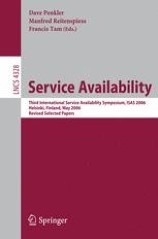
Service Availability ; Vol. 4328 ; 3rd International Service Availability Symposium, ISAS 2006, Helsinki, Finland, May 15-16, 2006, Revised Selected Papers
This book constitutes the thoroughly refereed post-proceedings of the Third International Service Availability Symposium, ISAS 2006, held in Helsinki, Finland, in May 2006. The 19 revised full papers presented were carefully reviewed and selected from 38 submissions. The papers are organized in topical sections on availability modeling, estimation and analysis, dependability techniques and their applications, performability: measurements and assessments, service availability standards: experience reports and futures.

Service availability ; Vol. 3335 ; 1st International Service Availability Symposium, ISAS 2004, Munich, Germany, May 13-14, 2004, Revised Selected Papers
This book constitutes the thoroughly refereed post-proceedings of the First International Service Availability Symposium, ISAS 2004, held in Munich, Germany in May 2004. The 15 revised full papers presented were carefully selected from 28 submissions during two rounds of reviewing and improvement. Among the topics addressed are high availability database architectures, data persistence, dependable mobile Internet services, System Availability Forum standards, QoS control, middleware, service-level management, service management, location-based services, service robustness, service availability evaluation, continuous services, AMF services, etc

Service Availability ; 5th International Service Availability Symposium, ISAS 2008 Tokyo, Japan, May 19-21, 2008 Proceedings
The book is organized in topical sections on enterprise system dependability, software service availability, service availability platform, and service dependability analysis.

Semantic Management of Middleware
Current middleware solutions, such as application servers and Web services, are very complex software products that are hard to tame because of intricacies of distributed systems. This work contributes an ontology-based approach to support the development and administration of middleware-based applications.

Security in Pervasive Computing ; Vol. 3934 ; Third International Conference, SPC 2006, York, UK, April 18-21, 2006, Proceedings
This volume contains the papers presented at the Third International Conference on Security in Pervasive Computing (SPC 2006), held , 2006 in York, UK. The conference focused on methods, tools, principles, and practices for assessing and achieving security in a pervasive environment. New security concepts were discussed, in domains and applications such as handheld devices, mobile phones, smartcards, RFID chips, and smart labels, as well as new, emerging technological spaces

Scientific applications of grid computing ; First International Workshop, SAG 2004, Beijing, China, September, Revised Selected and Invited Papers
This workshop was held in September 2004, in conjunction with the 2004 IEEE/WIC/ACM International Joint Conference on Web Intelligence (WI 2004) and Intelligent Agent Technology (IAT 2004). The WI and IAT conferences have provided, for several years, a leading international forum to bring together researchers and practitioners from diverse fields, such as computer science, information technology, business, education, human factors, systems engineering, and robotics, to explore the fundamental roles as well as practical impacts of artificial intelligence (AI) (e.g., knowledge representation, planning, knowledge discovery, and data mining, intelligent agents and social network intelligence) and advanced information technology (IT) (e.g., wireless networks, ubiquitous devices, social networks, the Wisdom Web, and data/knowledge grids), and to examine the design principles and performance characteristics of various approaches in intelligent agent technology.
