


Refine Results
Sort By
From
To


After publishing an introduction to the Navier–Stokes equation and oceanography (Vol. 1 of this series), Luc Tartar follows with another set of lecture notes based on a graduate course in two parts, as indicated by the title. A draft has been available on the internet for a few years. The author has now revised and polished it into a text accessible to a larger audience.
This text is the first to provide a comprehensive introduction to SDS. Driven by numerous examples and thought-provoking problems, the presentation offers good foundational material on finite discrete dynamical systems which leads systematically to an introduction of SDS. Techniques from combinatorics, algebra and graph theory are used to study a broad range of topics, including reversibility, the structure of fixed points and periodic orbits, equivalence, morphisms and reduction. Unlike other books that concentrate on determining the structure of various networks, this book investigates the dynamics over these networks by focusing on how the underlying graph structure influences the properties of the associated dynamical system.
This book provides twelve computational projects aimed at numerically solving problems from a broad range of applications including Fluid Mechanics, Chemistry, Elasticity, Thermal Science, Computer Aided Design, Signal and Image Processing. For each project the reader is guided through the typical steps of scientific computing from physical and mathematical description of the problem, to numerical formulation and programming and finally to critical discussion of numerical results. Considerable emphasis is placed on practical issues of computational methods. The last section of each project contains the solutions to all proposed exercises and guides the reader in using the MATLAB scripts.
This book gives an introduction to modern geometry. Starting from an elementary level the author develops deep geometrical concepts, playing an important role nowadays in contemporary theoretical physics. He presents various techniques and viewpoints, thereby showing the relations between the alternative approaches.
The first part of the volume is devoted to the description of scattering processes in the context of relativistic quantum field theory. The use of the semi-classical approximation allows us to illustrate the relevant computation techniques in a reasonably small amount of space. Our approach to relativistic processes is original in many respects. The second part contains a detailed description of the construction of the standard model of electroweak interactions, with special attention to the mechanism of particle mass generation. The extension of the standard model to include neutrino masses is also described. We have included a number of detailed computations of cross sections and decay rates of pedagogical and phenomenological relevance.
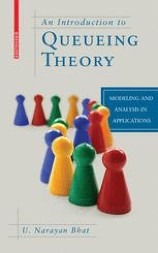
This introductory textbook is designed for a one-semester course on queueing theory that does not require a course in stochastic processes as a prerequisite. By integrating the necessary background on stochastic processes with the analysis of models, the work provides a sound foundational introduction to the modeling and analysis of queueing systems for a broad interdisciplinary audience of students in mathematics, statistics, and applied disciplines such as computer science, operations research, and engineering.
The book covers numerical methods for solving a wide range of problems, from integration to the numerical solution of differential equations or the stimulation of random processes. Examples of programmes that solve problems directly, as well as those that use MATLAB’s high-level commands are given. Each chapter includes extensive examples and tasks, at varying levels of complexity. For practice, the early chapters include programmes that require debugging by the reader, while full solutions are given for all the tasks. The book also includes: A glossary of MATLAB commands / Aappendices of mathematical techniques used in numerical methods / Designed as a text for a first course in programming and algorithm design, as well as in numerical methods courses, the book will be of benefit to a wide range of students from mathematics and engineering, to commerce."

This textbook provides a rigorous and lucid introduction to the theory of ordinary differential equations (ODEs), which serve as mathematical models for many exciting real-world problems in science, engineering, and other disciplines.
The subject of this book is operator theory on the Hardy space H2, also called the Hardy-Hilbert space. The goal is to provide an elementary and engaging introduction to this subject that will be readable by everyone who has understood introductory courses in complex analysis and in functional analysis.

An Introduction to Number Theory provides an introduction to the main streams of number theory. Starting with the unique factorization property of the integers, the theme of factorization is revisited several times throughout the book to illustrate how the ideas handed down from Euclid continue to reverberate through the subject. In particular, the book shows how the Fundamental Theorem of Arithmetic, handed down from antiquity, informs much of the teaching of modern number theory. The result is that number theory will be understood, not as a collection of tricks and isolated results, but as a coherent and interconnected theory. A number of different approaches to number theory are presented, and the different streams in the book are brought together in a chapter that describes the class number formula for quadratic fields and the famous conjectures of Birch and Swinnerton-Dyer. The final chapter introduces some of the main ideas behind modern computational number theory and its applications in cryptography.

The Introduction to Navier-Stokes Equation and Oceanography corresponds to a graduate course in mathematics, taught at Carnegie Mellon University in the spring of 1999. Comments were added to the lecture notes distributed to the students, as well as short biographical information for all scientists mentioned in the text, the purpose being to show that the creation of scientific knowledge is an international enterprise, and who contributed to it, from where, and when. The goal of the course is to teach a critical point of view concerning the partial differential equations of continuum mechanics, and to show the need for developing new adapted mathematical tools.
This book aims to present meshfree methods in a friendly and straightforward manner, so that beginners can very easily understand, comprehend, program, implement, apply and extend these methods. It provides first the fundamentals of numerical analysis that are particularly important to meshfree methods. Typical meshfree methods, such as EFG, RPIM, MLPG, LRPIM, MWS and collocation methods are then introduced systematically detailing the formulation, numerical implementation and programming. Many well-tested computer source codes developed by the authors are attached with useful descriptions. The application of the codes can be readily performed using the examples with input and output files given in table form. These codes consist of most of the basic meshfree techniques, and can be easily extended to other variations of more complex procedures of meshfree methods. Readers can easily practice with the codes provided to effective learn and comprehend the basics of meshfree methods.
Biomedical imaging is a fascinating research area to applied mathematicians. Challenging imaging problems arise and they often trigger the investigation of fundamental problems in various branches of mathematics. This is the first book to highlight the most recent mathematical developments in emerging biomedical imaging techniques. The main focus is on emerging multi-physics and multi-scales imaging approaches. For such promising techniques, it provides the basic mathematical concepts and tools for image reconstruction. Further improvements in these exciting imaging techniques require continued research in the mathematical sciences, a field that has contributed greatly to biomedical imaging and will continue to do so.
This self-contained introduction to modern cryptography emphasizes the mathematics behind the theory of public key cryptosystems and digital signature schemes. The book focuses on these key topics while developing the mathematical tools needed for the construction and security analysis of diverse cryptosystems. Only basic linear algebra is required of the reader; techniques from algebra, number theory, and probability are introduced and developed as required.
Provides a more accessible introduction than other books on Markov processes by emphasizing the structure of the subject and avoiding sophisticated measure theoryLeads the reader to a rigorous understanding of basic theory

Manifolds, the higher-dimensional analogs of smooth curves and surfaces, are fundamental objects in modern mathematics. Combining aspects of algebra, topology, and analysis, manifolds have also been applied to classical mechanics, general relativity, and quantum field theory. In this streamlined introduction to the subject, the theory of manifolds is presented with the aim of helping the reader achieve a rapid mastery of the essential topics. By the end of the book the reader should be able to compute, at least for simple spaces, one of the most basic topological invariants of a manifold, its de Rham cohomology. Along the way the reader acquires the knowledge and skills necessary for further study of geometry and topology.
In this revised and extended version of his course notes from a 1-year course at Scuola Normale Superiore, Pisa, the author provides an introduction – for an audience knowing basic functional analysis and measure theory but not necessarily probability theory – to analysis in a separable Hilbert space of infinite dimension.Starting from the definition of Gaussian measures in Hilbert spaces, concepts such as the Cameron-Martin formula, Brownian motion and Wiener integral are introduced in a simple way. These concepts are then used to illustrate some basic stochastic dynamical systems (including dissipative nonlinearities) and Markov semi-groups, paying special attention to their long-time behavior: ergodicity, invariant measure. Here fundamental results like the theorems of Prokhorov, Von Neumann, Krylov-Bogoliubov and Khas'minski are proved. The last chapter is devoted to gradient systems and their asymptotic behavior.

Numerical weather prediction is receiving increased attention as weather forecasters aim to improve the numerical models used to forecast the weather. This is a textbook on global spectral modeling, which is an important component for global weather forecasts at numerous operational centers. This book covers all areas of model development including numerical analysis, treatment of clouds, mountains, radiation, precipitation processes, and the surface layers over land and the ocean. The objectives of this book are to provide a systematic and sequential background for students, researchers, and operational weather forecasters in order to develop comprehensive weather forecast models. This is designed for a one semester introductory graduate level course on weather prediction methodologies. As a prerequisite it requires a basic background in meteorology, applied mathematics, and numerical analysis.

This book presents the foundations of fluid mechanics and transport phenomena in a concise way. It is suitable as an introduction to the subject as it contains many examples, proposed problems and a chapter for self-evaluation. The solutions to all problems are displayed in the corresponding appendix.

This book provides an introduction into the ethics of robots and artificial intelligence. The book was written with university students, policy makers, and professionals in mind but should be accessible for most adults. The book is meant to provide balanced and, at times, conflicting viewpoints as to the benefits and deficits of AI through the lens of ethics. As discussed in the chapters that follow, ethical questions are often not cut and dry. Nations, communities, and individuals may have unique and important perspectives on these topics that should be heard and considered. While the voices that compose this book are our own, we have attempted to represent the views of the broader AI, robotics, and ethics communities.

Daraa Highway - Ghabagheb - Syria
+963-15 2050 - 15 860 380 /1/2/3 - 11 662 3900