



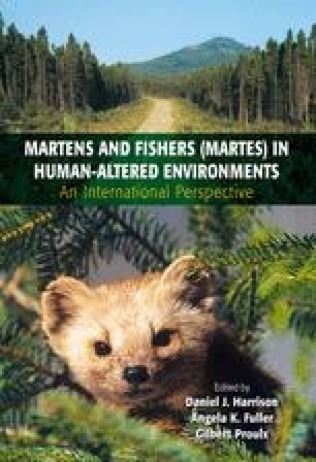
Martens and Fishers (Martes) in human-altered environments : An international perspective
Examines the conditions where humans and martens are compatible and incompatible, and promotes land use practices that allow Martes to be representatively distributed and viable. All Martes have been documented to use forested habitats and 6 species (excluding the stone marten) are generally considered to require complex mid- to late-successional forests throughout much of their geographic ranges. All species in the genus require complex horizontal and vertical structure to provide escape cover protection from predators, habitat for their prey, access to food resources, and protection from the elements. Martens and the fisher have high metabolic rates, have large spatial requirements, have high surface area to volume ratios for animals that often inhabit high latitudes, and often require among the largest home range areas per unit body weight of any group of mammals. Resulting from these unique life history characteristics, this genus is particularly sensitive to human influences on their habitats, including habitat loss, stand-scale simplification of forest structure via some forms of logging, and landscape-scale effects of habitat fragmentation. Given their strong associations with structural complexity in forests, martens and the fisher are often considered as useful barometers of forest health and have been used as ecological indicators, flagship, and umbrella species in different parts of the world. Thus, efforts to successfully conserve and manage martens and fishers are associated with the ecological fates of other forest dependent species and can greatly influence ecosystem integrity within forests that are increasingly shared among wildlife and humans.We have made great strides in our fundamental understanding of how animals with these unique life history traits perceive and utilize habitats, respond to habitat change, and how their populations function and perform under different forms of human management and mismanagement.
Related Books
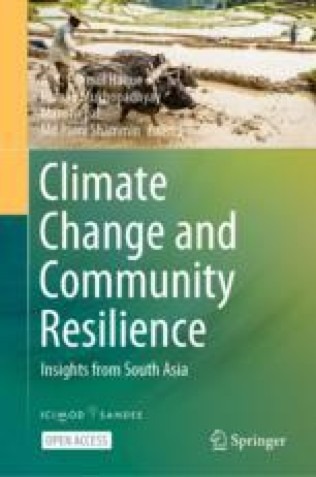
Climate Change and Community Resilience : Insights from South Asia
Documents myriads of ways community-based climate change adaptation and resilience programs are being implemented in South Asian countries. The narrative style of writing in this volume makes it accessible to a diverse audience from academics and researchers to practitioners in various governmental, non-governmental and international agencies. At a time when climate change presents humanity with a gloomy future, the stories of innovation, creativity, grassroots engagement and locally applicable solutions highlighted in this book provides insights into hopeful ways of approaching climate solutions.
China's Long-Term Low-Carbon Development Strategies and Pathways : Comprehensive Report
This book introduces a multi-disciplinary and comprehensive research on China's long-term low-carbon emission strategies and pathways. After comprehensively considering China’s own socioeconomic conditions, policy design, energy mix, and other macro-development trends and needs, the research team has proposed suggestions on China’s low-carbon development strategies and pathways until 2050, with required technologies and policies in order to realize the goals of building a great modern socialist country and a beautiful China.

Lewis Fry Richardson : His Intellectual Legacy and Influence in the Social Sciences
A pioneer in meteorology and peace research and remains a towering presence in both fields. This edited volume reviews his work and assesses its influence in the social sciences, notably his work on arms races and their consequences, mathematical models, the size distribution of wars, and geographical features of conflict
Assessment of climate change over the Indian Region : A report of the Ministry of Earth Sciences (MoES), Government of India
Discusses the impact of human-induced global climate change on the Indian subcontinent and regional monsoon, the adjoining Indian Ocean and the Himalayas. It also examines the regional climate change projections based on the climate models used by the IPCC Fifth Assessment Report (AR5) and national climate change modeling studies using the IITM Earth System Model (ESM) and CORDEX South Asia datasets
