



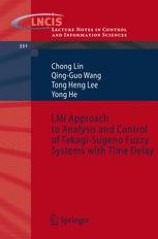
LMI Approach to Analysis and Control of Takagi-Sugeno Fuzzy Systems with Time Delay
A fuzzy system is, in a very broad sense, any fuzzy logic-based system where fuzzy logic can be used either asthebasisfor the representation of different forms of system knowledge or the model for the interactions and relationships among the system variables. Fuzzy systems have proven to be an important tool for modeling complex systems for which, due to complexity or imprecision, classical tools are unsuccessful. There have been diverse fields of applications of fuzzy technology from medicine to management, from engineering to behavioral science, from vehicle control to computational linguistics, and so on. Fuzzy modeling is a conjunction to understand the s- tem’s behavior and build useful mathematical models. Different types of fuzzy models have been proposed in the literature, among which the Takagi-Sugeno (T-S) fuzzy model is a rule-based one suitable for the accurate approximation and identi?cation of a wide class of nonlinear systems.
Related Books

Hotel building in Damascus city
Show a hotel building in Damascus. The project is a facility consisting of one basement use as a storage rooms and shelter, and ground story and twelve story.

A structural study and study of the site of Al-Rahma hospital - Deir Ez-Zour
Presents the structural study and design of Al-Rahma Hospital, located in Deir Ez-Zour, Al-Kanamat area near the Euphrates River. The hospital includes two basement levels and ten floors above ground. The basements house medical imaging rooms, storage spaces, and a shelter.

Introduction to finite element analysis : A textbook for engineering students
Covers the basic concepts and applications of finite element analysis. It is specifically aimed at introducing this advanced topic to undergraduate-level engineering students and practicing engineers in a lucid manner. It also introduces a structural and heat transfer analysis software FEASTSMT which has wide applications in civil, mechanical, nuclear and automobile engineering domains.

Fundamentals of durable reinforced concrete
The book presents a framework for specification through internationally adopted codes and standards and summarises the background to probabilistic approaches to durability design, providing a state-of-the-art review of mathematical modelling of deterioration mechanisms along with current directions in test methods for performance-based specifications.
