



Page 1
Page 1

New Frontiers in Polymer Synthesis
It is generally accepted that a new material is often developed by ?nding a new synthesis method of reaction or a new reaction catalyst. Historically, a typical example may be referred to as a Ziegler–Natta catalyst, which has allowed large-scale production of petroleum-based polyole?ns since the middle of the 20th century. New polymer synthesis, therefore, will hopefully lead to creation of new polymer materials in the 21st century. This special issue contributed by three groups focuses on recent advances in polymer synthesis methods, which handle the cutting-edge aspects of the advanced technology.

Modeling Marvels : Computational Anticipation of Novel Molecules
The aim of this book is to survey a number of chemical compounds that chemists, both theoretical and experimental, find fascinating. Some of these compounds, like planar carbon species or oxirene, offer no obvious practical applications; nitrogen oligomers and polymers, in contrast, have been touted as possible high-energy-density materials. What unites this otherwise eclectic collection is that these substances are unknown and offer a challenge to theory and to synthesis.

Hydroboration and Organic Synthesis : 9-Borabicyclo [3.3.1] nonane (9-BBN)
Borabicyclo [3.3.1]nonane, a commercially available reagent, is the most versatile hydroborating reagent to synthesize organoboranes (B-R-9-BBN). The reagent exhibits remarkable regio-, chemo-, and stereoselectivity during hydroboration reactions. The organoboranes can be converted to C-H, C-O, C-N, C-S, C-halogen, C-metal and above all C-C bonds. In addition, the suitable substituted / unsaturated R of B-R-9-BBN can be utilized to produce dienes, enynes, allenes etc. with defined stereochemistry. 9-BBN’s derivatives have been elegantly used for the asymmetric reduction of ketone moiety. Diels-Alder and Suzuki reactions have expanded the utility of 9-BBN for the synthesis of a variety of organic compounds required for industry. Consequently, this vast field in the form of a book will be helpful to synthetic organic chemists for easy access to literature, required for chemical transformations.

Heterocycles from Carbohydrate Precursors
This book is a volume in the series Topics in Heterocyclic Chemistry.Itc- ers the key methods used for designing synthetic approaches to heterocycles from carbohydrates and the value and scope of these methods. Carbohydrates are widely distributed in nature and constitute the largest part of renewable biomasses. Moreover, many carbohydrates and their derivatives are comm- cially available at relatively cheap prices. Consequently their utilization is highly encouraged and economically they are of great signifcance. Moreover, carbohydrates are highly functionalized compounds that can be readily deritized and/or cyclized to provide heterocyclic compounds. This book provides a modern account and an up-to-date description of the advancement in the synthesis of diverse heterocycles from carbohydrates. Carbohydrates can be considered as a source of chiral centers in addition to the variable modifcation thereof.
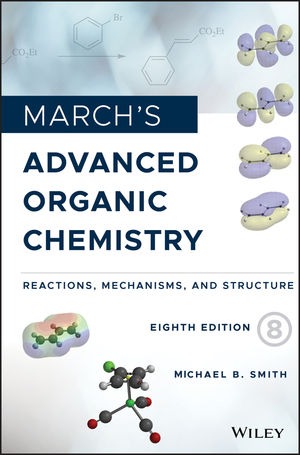
March's Advanced Organic Chemistry : Reactions, Mechanisms, and Structure
The opening chapters of March's Advanced Organic Chemistry deal with the structure of organic compounds and discuss important organic chemistry bonds, fundamental principles of conformation, and stereochemistry of organic molecules, and reactive intermediates in organic chemistry. Further coverage concerns general principles of mechanism in organic chemistry, including acids and bases, photochemistry, sonochemistry and microwave irradiation. The relationship between structure and reactivity is also covered.

Chemistry for pharmacy students : General, organic and natural product chemistry ; 2nd ed.
Opens with an overview of the general aspects of chemistry and their importance to modern life, with emphasis on medicinal applications. The text then moves on to discuss the concepts of atomic structure and bonding and the fundamentals of stereochemistry and their significance to pharmacy in relation to drug action and toxicity. Various aspects of organic functional groups, organic reactions, heterocyclic chemistry, nucleic acids and their pharmaceutical importance are then covered in subsequent chapters, with the final chapter dealing with drug discovery and development, and natural product chemistry. Provides a student-friendly introduction to the main areas of chemistry required by pharmacy degree courses. Written at a level suitable for non-chemistry students in pharmacy, but also relevant to those in life sciences, food science, and the health sciences Includes learning objectives at the beginning of each chapter Focuses on the physical properties and actions of drug molecules
Amino acids and the asymmetry of life : Caught in the act of formation
This book describes how the basic building blocks of life, the amino acids, formed. After a comprehensible introduction into stereochemistry, the author addresses the inherent property of amino acids in living organisms, namely the preference for left-handedness. What was the cause for violation of parity of amino acids in the emergence of life on Earth? All the fascinating models proposed by physicists, chemists and biologist are vividly presented including the scientific conflicts.
Advanced organic chemistry ; Part A : structure and mechanisms
Advanced Organic Chemistry Part A provides a close look at the structural concepts and mechanistic patterns that are fundamental to organic chemistry. It relates those mechanistic patterns, including relative reactivity and stereochemistry, to underlying structural factors. Understanding these concepts and relationships will allow students to recognize the cohesive patterns of reactivity in organic chemistry. Part A: Structure and Mechanism and Part B: Reaction and Synthesis - taken together - are intended to provide the advanced undergraduate or beginning graduate student in chemistry with a foundation to comprehend and use the research literature in organic chemistry
