



Page 1
Page 1

The Deck Access Housing Design Guide : A Return to Streets in the Sky
A practical design guide to deck access housing. It focuses on the contemporary use of deck access housing, sharing practical guidance and providing in-depth case studies, while also presenting historical context about this flexible and evolving housing type. Featured architects from the UK: AHMM · Apparata · Cartwright Pickard · Collective Architecture · DO Architecture · Hawkins Brown · Haworth Tompkins · Henley Halebrown · Levitt Bernstein · Maccreanor Lavington · Mæ · Matthew Lloyd · Pitman Tozer · Pollard Thomas Edwards · Proctor & Matthews · PRP · RCKa. Featured architects from mainland Europe: ANMA · Arquitectura Produccions · Atelier Kempe Thill · Bureau Massa · DAMAST · Estudio Herreros · Fink + Jocher · KAAN · LEVS · Martin-Löf · MEF · Muñoz Miranda · Passelac & Roques · Waechter + Waechter

Progress in pattern recognition, image analysis and applications ; Vol. 3773 : 10th Iberoamerican Congress on Pattern Recognition, CIARP 2005, Havana, Cuba, November 15-18, 2005, Proceedings
X CIARP was a forum for scientific research, experience exchange, share of new knowledge and increase in cooperation between research groups in pattern recognition, computer vision and related areas. The 10th Iberoamerican Congress on Pattern Recognition was organized by the Cuban Association for Pattern Recognition (ACRP) and sponsored by the Institute of Cybernetics, Mathematics and Physics (ICIMAF), the Advanced Technologies Application Center (CENATAV), the University of Oriente (UO), the Polytechnic Institute “José A Echevarria” (ISPJAE), the Central University of Las Villas (UCLV), the Ciego de Avila University (UNICA), as well as the Center of Technologies Research on Information and Systems (CITIS-UAEH) in Mexico. The conference was also co-sponsored by the Portuguese Association for Pattern Recognition (APRP), the Spanish Association for Pattern Recognition and Image Analysis (AERFAI), the Special Interest Group of the Brazilian Computer Society (SIGPR-SBC), and the Mexican Association for Computer Vision, Neurocomputing and Robotics (MACVNR). X CIARP was endorsed by the International Association for Pattern Recognition (IAPR).

Platelet-Rich Plasma (PRP): Therapy and Applications
Platelet-Rich Plasma (PRP) is a portion of the plasma fraction of autologous blood with a platelet concentration above the baseline with the full complement of growth factors and other plasma proteins, the purpose of this research is to evaluate and summarize literature, with particular focus on rejuvenation process, these include regeneration of soft tissue, skin aging mechanisms, as well as wound healing and a study reported in burns. Emerging autologous cellular therapies that utilize platelet-rich plasma (PRP) applications have the potential to play adjunctive roles in a variety of regenerative medicine treatment plans. There is a global unmet need for tissue repair strategies to treat musculoskeletal, osteoarthritis (OA), and patients with chronic complex and recalcitrant wounds.

Pattern Recognition and Image Analysis ; Vol. 3523 : 2nd Iberian Conference, IbPRIA 2005, Estoril, Portugal, June 7-9, 2005, Proceeding, Part II
IbPRIA 2005 (Iberian Conference on Pattern Recognition and Image Analysis) was the second of a series of conferences jointly organized every two years by the Portuguese and Spanish Associations for Pattern Recognition (APRP, AERFAI), with the support of the International Association for Pattern Recognition (IAPR). This year, IbPRIA was hosted by the Institute for Systems and Robotics and the Geo-systems Center of the Instituto Superior Tecn ´ ico and it was held in Estoril, Por- gal. It provided the opportunity to bring together researchers from all over the world to discuss some of the most recent advances in pattern recognition and all areas of video, image and signal processing. There was a very positive response to the Call for Papers for IbPRIA 2005. We - ceived 292 full papers from 38 countries and 170 were accepted for presentation at the conference. The high quality of the scienti?c program of IbPRIA 2005 was due ?rst to the authors who submitted excellent contributions and second to the dedicated colla- ration of the international Program Committee and the other researchers who reviewed the papers. Each paper was reviewed by two reviewers, in a blind process. We would like to thank all the authors for submitting their contributions and for sharing their - search activities. We are particularly indebted to the Program Committee members and to all the reviewers for their precious evaluations, which permitted us to set up this publication.

Pattern Recognition and Image Analysis ; Vol. 3522 : 2nd Iberian Conference, IbPRIA 2005, Estoril, Portugal, June 7-9, 2005, Proceedings, Part 1
IbPRIA 2005 (Iberian Conference on Pattern Recognition and Image Analysis) was the second of a series of conferences jointly organized every two years by the Portuguese and Spanish Associations for Pattern Recognition (APRP, AERFAI), with the support of the International Association for Pattern Recognition (IAPR). This year, IbPRIA was hosted by the Institute for Systems and Robotics and the Geo-systems Center of the Instituto Superior Tecn ´ ico and it was held in Estoril, Por- gal. It provided the opportunity to bring together researchers from all over the world to discuss some of the most recent advances in pattern recognition and all areas of video, image and signal processing. There was a very positive response to the Call for Papers for IbPRIA 2005. We - ceived 292 full papers from 38 countries and 170 were accepted for presentation at the conference. The high quality of the scienti?c program of IbPRIA 2005 was due ?rst to the authors who submitted excellent contributions and second to the dedicated colla- ration of the international Program Committee and the other researchers who reviewed the papers. Each paper was reviewed by two reviewers, in a blind process. We would like to thank all the authors for submitting their contributions and for sharing their - search activities. We are particularly indebted to the Program Committee members and to all the reviewers for their precious evaluations, which permitted us to set up this publication.

Hypomelanosis Vitiligo & Albinism
• In General, understanding the disease is the best way to reach a perfect treatment. • This study aims to discuss the Hypomelanosis: • Vitiligo and Albinism and understanding the pathophysiology and present a types, symptoms and diagnosis of it. • Treatment ways and it's development, Nano-Drug and role of PRP in the treatments also had been presented. • The effect of Vitiligo on family members and living with it also had been discussed. • Finally, we have searched in managements and recommendations of Vitiligo patients during COVID-19 pandemic.
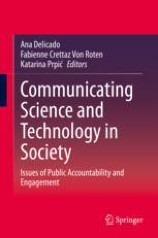
Communicating science and technology in society
Addresses the engagement between science and society from multiple viewpoints. At a time when trust in experts is being questioned, misinformation is rife and scientific and technological development show growing social impact, the volume examines the challenges in involving the public in scientific debates and decisions. It takes into account societal needs and concerns in research, and analyses the interface between the roles of institutions and individuals. From environmental challenges to science communication, participatory technological design to animal experimentation, and transdisciplinarity to norms and values in science, the volume brings together research on areas in which scientists and citizens interact, across diverse, often understudied, socio-cultural contexts in Europe.
