


Refine Results
Sort By
From
To

Offers a superb introduction to theoretical and practical soil mechanics. Special attention is given to the risks of failure in civil engineering, and themes covered include stresses in soils, groundwater flow, consolidation, testing of soils, and stability of slopes. The basic principles of applied mechanics, that are frequently used, are offered in the appendices. The author’s considerable experience of teaching soil mechanics is evident in the many features of the book: it is packed with supportive color illustrations, helpful examples and references.
Lattice Boltzmann models have a remarkable ability to simulate single- and multi-phase fluids and transport processes within them. A rich variety of behaviors, including higher Reynolds numbers flows, phase separation, evaporation, condensation, cavitation, buoyancy, and interactions with surfaces can readily be simulated. This book provides a basic introduction that emphasizes intuition and simplistic conceptualization of processes. It avoids the more difficult mathematics that underlies LB models. The model is viewed from a particle perspective where collisions, streaming, and particle-particle/particle-surface interactions constitute the entire conceptual framework. Beginners and those with more interest in model application than detailed mathematical foundations will find this a powerful "quick start" guide. Example simulations, exercises, and computer codes are included. Working code is provided on the Internet.
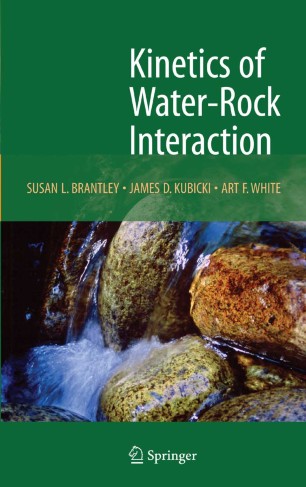
Systems at the surface of the Earth are continually responding to energy inputs derived from solar radiation or from the radiogenic heat in the interior. These energy inputs drive plate movements and erosion, exposing metastable mineral phases at the Earth’s surface. In addition, these energy fluxes are harvested and transformed by living organisms. As long as these processes persist, chemical disequilibrium at the Earth’s surface will be perpetuated. Chemical disequilibrium is also driven by human activities related to production of food, extraction of water and energy resources, and burial of wastes. To understand how the surface of the Earth will change over time, we must understand the rates at which reactions occur and the chemical feedbacks that relate these reactions across extreme temporal and spatial scales. This book addresses fundamental and applied questions concerning the rates of water-rock interactions driven by tectonic, climatic, and anthropogenic forcings.
The subject is described and discussed in three main chapters and different case studies.All topics in this book are complimentary and contribute to a comprehensive understanding of the interactions between global climate change, world water cycle and water resources. A valuable and meaningful interdisciplinary mixture of topics is combined in this book.
Offers an up-to-date overview of the latest scientific findings in regional climate research on the Baltic Sea basin. This includes climate changes in the recent past, climate projections up until 2100 using the most sophisticated regional climate models available, and an assessment of climate change impacts on terrestrial, freshwater and marine ecosystems.
The volume includes selected contributions on conceptual and methodological innovations and empirical insights from case studies on important themes such as multi-level governance, change management, vulnerability assessment, environmental flows, uncertainty analysis and the impacts of climate change. The book addresses a wide interdisciplinary audience of scientists and professionals from academia, industry, and involved in policy making.
Along with a companion full-version software (PMWIN), this text offers an integrated simulation system. PMWIN comes with a professional graphical user-interface, supported models and programs and several other useful modeling tools. The graphical user-interface allows one to create and simulate models.

Daraa Highway - Ghabagheb - Syria
+963-15 2050 - 15 860 380 /1/2/3 - 11 662 3900