



Page 1
Page 1

Intelligent Life in the Universe : Principles and Requirements Behind Its Emergence
This book addresses the possible origins, development and fate of intelligent life in the universe. The author presents a wide-ranging analysis of the type of knowldege that can be inferred about extraterrestial intelligent societies from our own biological, cultural and scientific evolution, and from the likely future of mankind. Providing extensive background information from astronomy, geology, chemistry and biology, the book will appeal to both the scientist and the general reader.

Geology and Habitability of Terrestrial Planets
This book has resulted from a workshop at the International Space Science Institute (ISSI) in Bern, Switzerland (5-9 September 2005) that brought together planetary geologists, geophysicists, atmospheric scientists, and biologists to discuss the multi-faceted problem of how the habitability of a planet co-evolves with the geology of the surface and interior, the atmosphere, and the magnetosphere.
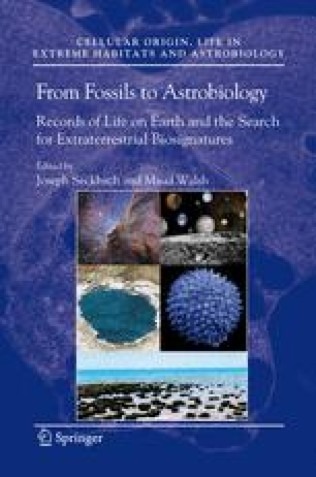
From Fossils to Astrobiology : Records of Life on Earth and Search for Extraterrestrial Biosignatures
From Fossils to Astrobiology reviews developments in paleontology and geobiology that relate to the rapidly-developing field of Astrobiology, the study of life in the Universe. Many traditional areas of scientific study, including astronomy, chemistry and planetary science, contribute to Astrobiology, but the study of the record of life on planet Earth is critical in guiding investigations in the rest of the cosmos. In this varied book, expert scientists from 15 countries present peer-reviewed, stimulating reviews of paleontological and astrobiological studies. The overviews of established and emerging techniques for studying modern and ancient microorganisms on Earth and beyond, will be valuable guides to evaluating biosignatures which could be found in the extraterrestrial surface or subsurface within the Solar System and beyond.
Lonely Minds in the Universe
Probes the subject of extraterrestrial intelligent life, offering scientific and technological implications, discussing the philosophical and religious connotations and rebuffing pseudo-scientific assertions such as 'rare earth'.
Life as We Know It
Life As we Know It ["LAKI"] covers several aspects of Life, ranging from the prebiotic level, origin of life, evolution of prokaryotes to eukaryotes and finally to various affairs of human beings. Although it is hard to define Life, one can, however, characterize it and describe its features. Topics treated are categories of bacteria, algae and fungi, conscience, philosophy, theology, aesthetics, appearance of sport and life destiny, life after clinical death, and thoughts of the world to come ("Olam Haba"). The various chapters have been written so that they are accessible to all - from the avid lay reader to the specialist – and make available multidisciplinary sources of information about Life. This volume will interest open minded scholars, students at all levels of general sciences, natural and Life science, researchers of philosophy, theology, history of Life, astrobiology, and those who wish to widen their knowledge about "who are we in the universe".
Chemical Evolution and the Origin of Life
Up to now, we do not have a generally accepted theory about the origin of life and about the process of development of life, we only have a great number of - to some extent even contradictory – hypotheses. Meanwhile there came up some scientific findings beyond thought only a few years ago.Horst Rauchfuss is comparing the different theories from the view of the latest results and is giving an exciting and easy understandable insight into the present state of research.
About Life : Concepts in Modern Biology
This book uses modern biological knowledge to tackle the question: "What distinguishes living organisms from the non-living world?" In the first few chapters, the authors draw on recent advances in cell and molecular biology to develop an account of the "living state" that applies to all organisms, but only to organisms. Subsequent chapters use this account to explore questions about evolution, the origin of life and the possibility of extraterrestrial life. Towards the end of the book the authors consider human evolution, intelligence and the extent to which our species can be regarded as biologically unique. About Life is written as far as possible in non-technical language; all scientific terms are explained straightforwardly when they are introduced. It is aimed at the general, non-specialist reader, but the novel approach that it takes to general issues in biology will also interest students of the life sciences.
