



Page 1
Page 1

Statistical Mechanics
The completely revised new edition of the classical book on Statistical Mechanics covers the basic concepts of equilibrium and non-equilibrium statistical physics. In addition to a deductive approach to equilibrium statistics and thermodynamics based on a single hypothesis - the form of the microcanonical density matrix - this book treats the most important elements of non-equilibrium phenomena. Intermediate calculations are presented in complete detail. Problems at the end of each chapter help students to consolidate their understanding of the material. Beyond the fundamentals, this text demonstrates the breadth of the field and its great variety of applications.

Quantum Interferometry in Phase Space : Theory and Applications
Quantum Interferometry in Phase Space is primarily concerned with quantum-mechanical distribution functions and their applications in quantum optics and neutron interferometry. In the first part of the book, the author describes the phase-space representation of quantum optical phenomena such as coherent and squeezed states. Applications to interferometry, e.g. in beam splitters and fiber networks, are also presented. In the second part of the book, the theoretical formalism is applied to neutron interferometry, including the dynamical theory of diffraction, coherence properties of superposed beams, and dephasing effects.

Nuclear Fission and Cluster Radioactivity : An Energy-Density Functional Approach
It is the first application to nuclear physics from energy-density functional method, for which Professor Walter Kohn received the Nobel Prize in Chemistry. The book presents a comprehensive extension of the Bohr-Wheeler theory with the present knowledge of nuclear density distribution function.

Extreme Value Theory : An Introduction
Extreme Value Theory offers a careful, coherent exposition of the subject starting from the probabilistic and mathematical foundations and proceeding to the statistical theory. The book covers both the classical one-dimensional case as well as finite- and infinite-dimensional settings. All the main topics at the heart of the subject are introduced in a systematic fashion so that in the final chapter even the most recent developments in the theory can be understood. The treatment is geared toward applications. The presentation concentrates on the probabilistic and statistical aspects of extreme values such as limiting results, domains of attraction and development of estimators without emphasizing related topics such as point processes, empirical distribution functions and Brownian motion.

Existence and Regularity Properties of the Integrated Density of States of Random Schrödinger Operators
The theory of random Schrödinger operators is devoted to the mathematical analysis of quantum mechanical Hamiltonians modeling disordered solids. Apart from its importance in physics, it is a multifaceted subject in its own right, drawing on ideas and methods from various mathematical disciplines like functional analysis, selfadjoint operators, PDE, stochastic processes and multiscale methods. The present text describes in detail a quantity encoding spectral features of random operators: the integrated density of states or spectral distribution function. Various approaches to the construction of the integrated density of states and the proof of its regularity properties are presented.

Mathematical Modeling of Complex Biological Systems : A Kinetic Theory Approach
Describes the evolution of several socio-biological systems using mathematical kinetic theory. Specifically, it deals with modeling and simulations of biological systems—comprised of large populations of interacting cells—whose dynamics follow the rules of mechanics as well as rules governed by their own ability to organize movement and biological functions. The authors propose a new biological model for the analysis of competition between cells of an aggressive host and cells of a corresponding immune system.Because the microscopic description of a biological system is far more complex than that of a physical system of inert matter, a higher level of analysis is needed to deal with such complexity. Mathematical models using kinetic theory may represent a way to deal with such complexity, allowing for an understanding of phenomena of nonequilibrium statistical mechanics not described by the traditional macroscopic approach. The proposed models are related to the generalized Boltzmann equation and describe the population dynamics of several interacting elements (kinetic population models).The particular models proposed by the authors are based on a framework related to a system of integro-differential equations, defining the evolution of the distribution function over the microscopic state of each element in a given system. Macroscopic information on the behavior of the system is obtained from suitable moments of the distribution function over the microscopic states of the elements involved.
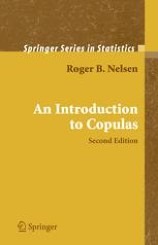
An Introduction to Copulas
Copulas are functions that join multivariate distribution functions to their one-dimensional margins. The study of copulas and their role in statistics is a new but vigorously growing field. In this book the student or practitioner of statistics and probability will find discussions of the fundamental properties of copulas and some of their primary applications. The applications include the study of dependence and measures of association, and the construction of families of bivariate distributions.
