



Page 2
Page 2

Control Theory Tutorial : Basic Concepts Illustrated by Software Examples
Introduces the basic principles of control theory in a concise self-study guide. It complements the classic texts by emphasizing the simple conceptual unity of the subject. A novice can quickly see how and why the different parts fit together. The concepts build slowly and naturally one after another, until the reader soon has a view of the whole. Each concept is illustrated by detailed examples and graphics. The full software code for each example is available, providing the basis for experimenting with various assumptions, learning how to write programs for control analysis, and setting the stage for future research projects. The topics focus on robustness, design trade-offs, and optimality. Most of the book develops classical linear theory. The last part of the book considers robustness with respect to nonlinearity and explicitly nonlinear extensions, as well as advanced topics such as adaptive control and model predictive control.

Control Systems Theory and Applications for Linear Repetitive Processes
After motivating examples, this monograph gives substantial new results on the analysis and control of linear repetitive processes. These include further applications of the abstract model based stability theory which, in particular, shows the critical importance to the dynamics developed of the structure of the initial conditions at the start of each new pass, the development of stability tests and performance bounds in terms of so-called 1D and 2D Lyapunov equations. It presents the development of a major bank of results on the structure and design of control laws, including the case when there is uncertainty in the process model description, together with numerically reliable computational algorithms. Finally, the application of some of these results in the area of iterative learning control is treated --- including experimental results from a chain conveyor system and a gantry robot system.

Control of Singular Systems with Abrupt Changes
In this book many problems like stochastic stability, stochastic stabilization using state feedback control and static output control, Hinfinity control, filtering, guaranteed cost control and mixed H2/Hinfinity control and their robustness are tackled.

Computer Vision Metrics : Survey, Taxonomy, and Analysis
Computer Vision Metrics provides an extensive survey and analysis of over 100 current and historical feature description and machine vision methods, with a detailed taxonomy for local, regional and global features. This book provides necessary background to develop intuition about why interest point detectors and feature descriptors actually work, how they are designed, with observations about tuning the methods for achieving robustness and invariance targets for specific applications. The survey is broader than it is deep, with over 540 references provided to dig deeper. The taxonomy includes search methods, spectra components, descriptor representation, shape, distance functions, accuracy, efficiency, robustness and invariance attributes, and more.
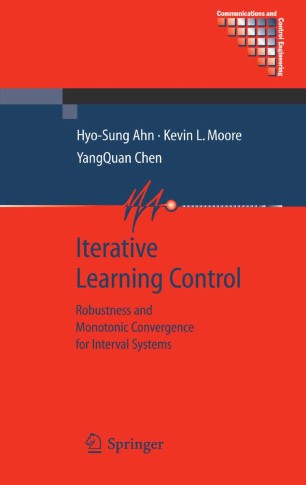
Iterative Learning Control : Robustness and Monotonic Convergence for Interval Systems
This monograph studies the design of robust, monotonically-convergent iterative learning controllers for discrete-time systems. Two key problems with the fundamentals of iterative learning control (ILC) design as treated by existing work are: first, many ILC design strategies assume nominal knowledge of the system to be controlled and; second, it is well-known that many ILC algorithms do not produce monotonic convergence, though in applications monotonic convergence is often essential. Iterative Learning Control takes account of the recently-developed comprehensive approach to robust ILC analysis and design established to handle the situation where the plant model is uncertain. Considering ILC in the iteration domain, it presents a unified analysis and design framework that enables designers to consider both robustness and monotonic convergence for typical uncertainty models, including parametric interval uncertainties, iteration-domain frequency uncertainty, and iteration-domain stochastic uncertainty.

Climate risk in Africa : Adaptation and resilience
This book highlights the complexities around making adaptation decisions and building resilience in the face of climate risk. It is based on experiences in sub-Saharan Africa through the Future Climate For Africa (FCFA) applied research programme. It begins by dealing with underlying principles and structures designed to facilitate effective engagement about climate risk, including the robustness of information and the construction of knowledge through co-production

A Testers Guide to .NET Programming
A Tester's Guide to .NET Programming focuses solely on applied programming techniques for testers. You will learn how to write simple automated tests, enabling you to test tools and utilities. You will also learn about the important concepts driving modern programming today, like multitier applications and object-oriented programming. More businesses are adopting .NET technologies, and this book will equip you to assess software robustness and performance. Whether you're an experienced programmer who's unfamiliar with testing concepts, or you're an experienced tester versed in VB .NET and C#, the included real-world tips and example code will help you start your projects.
3D-Position Tracking and Control for All-Terrain Robots
Rough terrain robotics is a fast evolving field of research and a lot of effort is deployed towards enabling a greater level of autonomy for outdoor vehicles. This book demonstrates how the accuracy of 3D position tracking can be improved by considering rover locomotion in rough terrain as a holistic problem. In this work, a mechanical structure allowing smooth motion across obstacles with limited wheel slip is used. In particular, it enables the use of odometry and inertial sensors to improve the position estimation in rough terrain. A method for computing 3D motion increments based on the wheel encoders and chassis state sensors is developed. The algorithm runs online and can be adapted to any kind of passive wheeled rover. Finally, sensor fusion using 3D-Odometry, inertial sensors and visual motion estimation based on stereovision is presented. The experimental results demonstrate how each sensor contributes to increase the accuracy and robustness of the 3D position estimation.
