



Page 2
Page 2

Core concepts in criminal law and criminal justice ; 2nd ed.
Explores the foundational principles and concepts that underpin the different domestic systems. It will focus on the Germanic and several principal Anglo-American jurisdictions, which are employed as examples of the wider divide between common law and civil law

Coping with Overloaded Criminal Justice Systems : The Rise of Prosecutorial Power Across Europe
The comparative study documented here was supported by the Fritz-Thyssen Foundation and the European Commission. It examined prosecution services in different European countries intending to understand their national role and function within the respective criminal justice system and thereby to highlight common features and important differences between European systems. The prosecution service is regarded as a part of the criminal justice system; a coherent system under pressure to deal with high numbers of cases. Within this system the prosecution level is increasingly becoming the decisive stage reducing its workload by means of simplified methods and proceedings.

Collaborating against child abuse : Exploring the Nordic Barnahus model
This edited collection explores the background and implementation of the Nordic Barnahus (or 'Children's House') model – recognised as one of the most important reforms related to children who are the victims of crime in the Nordic region. This book discusses both its potential to affect change and the challenges facing it. The model was introduced as a response to a growing recognition of the need for more integrated and child-centred services for children exposed to violence and sexual abuse. In the Barnahus structure, different professions work together to ensure that victimized children receive help and treatment and that their legal rights are met. This original study is organised into four broad themes: child-friendliness, support and treatment; the forensic child investigative interview; children’s rights perspectives; and interagency collaboration and professional autonomy.

Coercive human rights: positive duties to mobilise the criminal law under the ECHR
Traditionally, human rights have protected those facing the sharp edge of the criminal justice system. But over time human rights law has become increasingly infused with duties to mobilise criminal law towards protection and redress for violation of rights. These developments give rise to a whole host of questions concerning the precise parameters of coercive human rights, the rationale(s) that underpin them, and their effects and implications for victims, perpetrators, domestic legal systems, and for the theory and practice of human rights and criminal justice. This collection addresses these questions with a focus on the rich jurisprudence of the European Court of Human Rights (ECtHR).
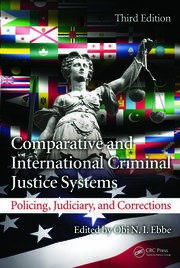
Comparative and international criminal justice systems : policing, judiciary, and corrections
The Nature of Comparative and International Criminal JusticeThe Purpose of Comparative and International Criminal Justice Systems; Crime and Criminal Law: Global PerspectiveCrime: International and Comparative;Overview of Model Criminal Justice Systems
Borders, Mobility and Technologies of Control
Borders, Mobility and Technologies of Control provides a model of criminological inquiry that is global in scope, constructionist in vision, and capable of combining the insights of dialogic and political-economic analyses into a holistic understanding of the growing conflict between nation-states and multitudes.
Asylum Matters : On the Front Line of Administrative Decision-Making
This book examines everyday practices in an asylum administration. Asylum decisions are often criticised as being ‘subjective’ or ‘arbitrary’. Asylum Matters turns this claim on its head.
