



Mathematical Methods in Electro-Magneto-Elasticity
The mechanics of Coupled Fields is a discipline at the edge of modern research connecting Continuum Mechanics with Solid State Physics. It integrates the Mechanics of Continuous Media, Heat Conductivity and the theory of Electromagnetism that are usually studied seperately. For an accurate description of the influence of static and dynamic loadings, high temperatures and strong electromagneticfields in elastic media and constructive installations, a new aproach is required; an approach that has the potential to establish a synergism between the above-mentioned fields. Throughout the book a vast number of problems are considered: two-dimensional problems of electro-magneto-elasticity as well as static and dynamical problems for piecewise homogenous compound piezoelectric plates weakened by cracks and openings. The boundary conditions, the constuctive equations and the mathematical methods for their solution are thoroughly presented, so that the reader can get a clear quantative and qualitative understnding of the phenomena taking place.
Related Books
Materials & sustainability building a circular future
Examines sustainable manufacturing, from the extraction of materials to processing, use, and disposal, and argues that significant changes in all of the above are needed for the world to progress toward a more circular economy. Materials and processing methods are usually chosen with performance as the key metric.
Composite materials : sustainable and eco-friendly materials and application
Covers innovations in the field of composite materials with a specific focus on eco-friendly and environmentally sustainable systems. All composite fields are explored, including polymer, metal, and ceramic matrix composites with an emphasis on sourcing raw materials in a sustainable way as well as the development of composite materials for environmental sustainability.
Building construction methods and systems : principles, requirements and application details
Presents practical information about the design and construction of building projects by addressing the principles of each method, unveiling background factors for requirements, and state-of-the-art application details, and presents general design and application principles of construction methods and technologies without diving into engineering calculations and formulas to keep the content easily understandable by all AEC practitioners and participants.
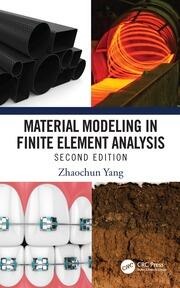
Material Modeling in Finite Element Analysis
Presents some specific problems including the metal-forming process, combustion room, Mullins effect of rubber tires, viscoelasticity of liver soft tissues, small punch test, tunnel excavation, slope stability, concrete slump test, orthodontic wire, and piezoelectric microaccelerometer.
