



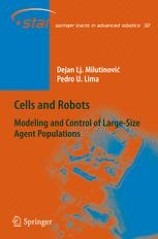
Cells and Robots : Modeling and Control of Large-Size Agent Populations
Cells and Robots is an outcome of the multidisciplinary research extending over Biology, Robotics and Hybrid Systems Theory. It is inspired by modeling reactive behavior of the immune system cell population, where each cell is considered as an independent agent. In our modeling approach, there is no difference if the cells are naturally or artificially created agents, such as robots. This appears even more evident when we introduce a case study concerning a large-size robotic population scenario. Under this scenario, we also formulate the optimal control of maximizing the probability of robotic presence in a given region and discuss the application of the Minimum Principle for partial differential equations to this problem. Simultaneous consideration of cell and robotic populations is of mutual benefit for Biology and Robotics, as well as for the general understanding of multi-agent system dynamics.The text of this monograph is based on the PhD thesis of the first author. The work was a runner-up for the fifth edition of the Georges Giralt Award for the best European PhD thesis in Robotics, annually awarded by the European Robotics Research Network (EURON).
Related Books

Hotel building in Damascus city
Show a hotel building in Damascus. The project is a facility consisting of one basement use as a storage rooms and shelter, and ground story and twelve story.

A structural study and study of the site of Al-Rahma hospital - Deir Ez-Zour
Presents the structural study and design of Al-Rahma Hospital, located in Deir Ez-Zour, Al-Kanamat area near the Euphrates River. The hospital includes two basement levels and ten floors above ground. The basements house medical imaging rooms, storage spaces, and a shelter.
Introduction to finite element analysis : A textbook for engineering students
Covers the basic concepts and applications of finite element analysis. It is specifically aimed at introducing this advanced topic to undergraduate-level engineering students and practicing engineers in a lucid manner. It also introduces a structural and heat transfer analysis software FEASTSMT which has wide applications in civil, mechanical, nuclear and automobile engineering domains.

Fundamentals of durable reinforced concrete
The book presents a framework for specification through internationally adopted codes and standards and summarises the background to probabilistic approaches to durability design, providing a state-of-the-art review of mathematical modelling of deterioration mechanisms along with current directions in test methods for performance-based specifications.
