



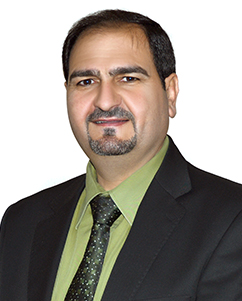
Dr. Ibrahim ALGHORAIBI
A distinguished Syrian researcher and academic specializing in Nanophysics and its applications. He earned his Ph.D. in Nanotechnology and Nanolaser Technology from the National Institute of Applied Sciences (INSA) in Rennes, France, where he also obtained a Research Master’s in Physics. Additionally, he holds a Higher Graduate Diploma and a Bachelor’s degree in Solid State Physics from the University of Aleppo. He is recognized as one of the region's foremost experts in Nanoscience, with pioneering contributions to the development of multipurpose nanomaterials for successful clinical, agricultural, and industrial applications.
Prof. Sayem El-Daher serves as the Director of the Nano-Lab and Head of the Nanotechnology Unit in the Department of Physics at Damascus University. He is the President of the Syrian Nanotechnology Initiative and a member of several national scientific boards, including the Scientific Advisory Committee of the Atomic Energy Commission, the National Committee for Nanotechnology Policy, and the Board of Trustees of the Syrian Foundation for Intellectual Property and Technology. He also serves on the editorial boards of over 31 international scientific journals.
He holds 7 patents in Nanoscience and has received numerous local and international awards, including the Gold Medal at the Al-Basel Fair for Innovation. Notably, he was selected as a "Changemaker" for 2024–2025 by the World Intellectual Property Organization (WIPO). Academically, he has supervised over 63 Master’s and Ph.D. theses, published more than 88 peer-reviewed papers in international journals with over 1,367 citations, and participated in more than 92 international conferences. He teaches advanced courses in Nanophysics, Lasers, Medical Physics, and Research Methodology at the Arab International University (AIU), Damascus University, and several other institutions.
He has led extensive national and international research projects in collaboration with France, Turkey, Egypt, Pakistan, and the European Union. His work has resulted in tangible nano-products, such as:
-
Clinical Nano-dressings for burns and chronic wounds.
-
Nano-water filters and fertilizers for agriculture.
-
Antimicrobial, antifungal, and antiviral materials.
-
Nanomaterials for orthopedic, medical, and cosmetic use.
-
Electro-conductive and fire-resistant nano-fabrics.
Key Scientific Contributions:
-
Green Synthesis: Development of eco-friendly nanoparticles for medical and antibacterial applications.
-
Energy Materials: Fabrication of thin films for optical and photonic purposes.
-
Carbon Nanostructures: Carbon Quantum Dots for biosensing and biomedicine.
-
Smart Agriculture: Using nanomaterials to improve crop productivity and nano-pesticides.
-
Bio-Nanocomposites: Medical nano-scaffolds for bone and tissue regeneration.
-
Solar Energy: Enhancing the efficiency of Dye-Sensitized Solar Cells (DSSC).
His extensive research legacy (2005–2025) covers pioneering work on Quantum Dots and optical communication devices at 1.55 μm (during his tenure in France), expanding into multi-disciplinary nanotechnology applications. His work is published in top-tier journals such as Scientific Reports, RSC Advances, ACS Omega, and Micromachines.
Email-address: e-Goraiby@aiu.edu.sy
