



Page 1
Page 1
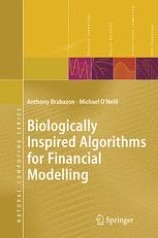
Biologically Inspired Algorithms for Financial Modelling
Then Part I provides a thorough guide to the various bioinspired methodologies – neural networks, evolutionary computing (particularly genetic algorithms and grammatical evolution), particle swarm and ant colony optimization, and immune systems. Part II brings the reader through the development of market trading systems. Finally, Part III examines real-world case studies where BIA methodologies are employed to construct trading systems in equity and foreign exchange markets, and for the prediction of corporate bond ratings and corporate failures.

Agent-mediated electronic commerce : automated negotiation and strategy design for electronic markets : AAMAS 2006 workshop, TADA/AMEC 2006, Hakodate, Japan, May 9, 2006 : selected and revised papers
The design and an alysis of trading agents and electronic trading systems in which they are deployed involve finding solutions to a diverse set of problems, invo- ing individual behaviors, interaction, and collective behavior in the context of trade. A wide variety of trading scenarios and systems, and agent approaches to these, have been studied in recent years. The AMEC series of wo- shops presents interdisciplinary researchon both theoretical and practical issues of agent-mediated electronic commerce ranging from the design of electronic marketplaces and e?cient protocols to behavioral aspects of agents operating in suchenvironments.

50 Years of EU Economic Dynamics : Integration, Financial Markets and Innovations
On the occasion of the 50th anniversary of the European Union experts present their analyses of historical developments and new economic challenges for the EU. After a reflection on historical dynamics, the contributors point out the dramatic economic shifts between Europe, Asia and the US. Representatives from major central banks (including the ECB), other leading banks, and academia analyze the dynamics of the Eurozone and financial market integration in the context of globalization and economic growth. Furthermore, the authors discuss the challenges of information and communication technologies by means of various country analyses. Moreover, the Schumpeterian prospects for Europe and the Lisbon Agenda, the long-term challenges of EU pension reforms, emission trading systems in the EU, and options for a new EU constitution are highlighted. At the bottom line of this EU analysis are major implications for investors, managers, policy-makers and the public at large in both the EU and the global economy.
