



Page 1
Page 1

Trace Elements from Soil to Human
This volume is composed of two parts. Part I – Biogeochemistry of the Human - vironment – presents fundamental information on biogeochemical properties of en- ronmental compartments (soil, water, air, plants, humans) concerning trace elements. Part II – Biogeochemistry of Trace Elements – provides detailed data of the behavior and the occurrence of trace elements in the environment. the format of this book follows the elemental sequences of the contemporary Periodic Table. The book provides data on the production usage, and on the occurrence of trace elements in soils, waters, air, plants, and humans (animals). Environmental stress, and biological functions of these elements are widely discussed.

Textile toxicity
Explores the toxicological implications of various chemicals commonly used in textile manufacturing, including trace elements, flame retardants, benzothiazoles/benzotriazoles, and formaldehyde. Trace elements such as chromium, lead, and antimony, commonly present in clothing, are associated with skin irritation, allergic reactions, systemic toxicity, and carcinogenicity. Flame retardants, particularly brominated and organophosphate types, are linked to endocrine disruption, reproductive toxicity, and developmental harm. Benzothiazoles and benzotriazoles are pervasive in textiles and can permeate the skin, disrupt hormones, and impair neurodevelopment, especially in male offspring during prenatal exposure.

Shilajit
Shilajit is a blackish brown and sticky magic herebomineral .It is found primarily in rocks of the Himalaya and is collected in small quantities from steep rock faces at altitude between 1000_50000 m fossils that have been compressed under layers of rocks for hundreds of years and have undergone a high amount of metamorphosis due to the high temperature and pressure conditions prevalent there Shilajit commonly used in ayurvedic medicine shilajit in its natural form is often contaminated by varying amounts of heavy metals mycotoxins and free radicals so we have to follow some steps to remove these toxicants.There are various methods described in ayurveda for removing toxicants and the most important is triphala decoctionBesides Triphala decoction, Shilajit can be purified using cow urine or dashmool decoction Shilajit contains a humic substance fulvic acid (FA) and humic acid (HA) (60-80%), minerals (20-40%) and up to 5% of trace elements (Fe, Ca, Cu, Zn, Mg, Mn, Mo, P , etc..

Nutrition and diet in health: Principles and applications
Food provides us with essential nutrients involved in many physiological activities and biological processes in the body including growth and development, metabolism, immune function, and overall well-being. Nutrition and Diet in Health: Principles and Applications reviews and discusses the issues related to the roles of nutrition and diets in human health and diseases. The book contains two sections - one section features principles, the other, covers applications. Part One provides information on sustainable use of nutrition and diets in health and diseases; advanced biotechnological approaches to improve nutritional content of food; trace elements in nutrition; drug and nutrient interactions; functional foods and nutraceuticals in health maintenance; and Bio markers of functional foods and nutraceuticals in health maintenance. Part Two discusses the significance of nutrition in selected human diseases, including cardiovascular diseases, cancer, infection, neurodegenerative diseases, and metabolic co-morbidities. It also discusses optimal nutrition for wellness, fitness, pregnancy, mental health, aging, and longevity.
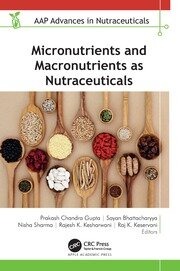
Micronutrients and macronutrients as nutraceuticals
Explains in detail the properties of micronutrients and macronutrients and their diverse uses as nutraceuticals for their beneficial properties, such as their antioxidant activity and immunity-boosting properties and how they can be incorporated into the human diet for optimum health, for growing beneficial bacteria in the gut, and inhibition of pathogens. Interestingly, the authors look at how disease-promoting habits often unfold in childhood, even prenatally, and employing nutrigenomics early on goes a long way toward curbing these chronic diseases later on in life.

Human tooth and developmental dental defects : compositional and genetic implications
Focuses on the qualitative and quantitative properties of the sound enamel and dentin as well as the affected human tooth structures. It examines how genetics impact oral and dental health, the role of fluoride and trace elements in mineralization and the related clinical implications, and the impact of different approaches to diagnose and treat these developmental disorders.

Continental Evolution : The Geology of Morocco : Structure, Stratigraphy, and Tectonics of the Africa-Atlantic-Mediterranean Triple Junction
Morocco is one of the most fascinating lands in the world from the point of view of its geological structure and evolution. Our knowledge on the geology of the country has been greatly improved during the last decades, based on numerous seismic profiles and boreholes, seismological analysis of focal mechanisms, seismic tomography, gravimetric/geodetic modelling and, on the other hand, based on a big National Program of Geological Mapping including modern geochemical analyses (trace elements) and reliable isotopic datings (39Ar-40Ar, U-Pb zircon, Sm-Nd, etc). Moreover, a number of academic studies have been performed in relation with the increasing number of Moroccan universities.
Biogeochemistry of Trace Elements in Arid Environments
Global warming has worsened the water resource crisis in many arid zones worldwide, from Africa to Asia, affecting millions of people and putting them at risk of hunger. Effective management of arid zone resources, including understanding the risks of toxic trace and heavy elements to humans, coupled with the need to produce more food to feed the world’s growing population, has thus become increasingly important. This very timely book, the only one of its kind on the market, fills the gap of our knowledge of trace elements in these regions. This book begins by introducing the nature and properties of arid zone soil, followed by an updated overview and comprehensive coverage of the major aspects of the trace elements and heavy metals of most concern in the world’s arid and semi-arid soils. These aspects include: - content and distribution - solution chemistry - solid-phase chemistry - selective sequential dissolution techniques - transfer fluxes - bioavailability - pollution and remediation In order to illustrate the themes, a comprehensive and focused case study on transfer fluxes of trace elements in Israeli arid soils is presented. Finally it closes with the global perspectives on anthropogenic interferences in the natural trace elements’ distribution.
Analysis of seawater : A guide for the analytical and environmental chemist
It is only in the past few years that methods of adequate sensitivity have become available for true ultra-trace metal determinations in water. In the case of organics in seawater it has now become possible to resolve the complex mixtures of organics in seawater and achieve the required very low detection limits. Fortunately, the interest in micro-constituents in the seawater both from the environmental and the nutrient balance points of view has coincided with the availability of advanced instrumentation capable of meeting the analytical needs. This complete and up-to-date compilation of the currently employed proven methods for the chemical analysis of seawaters includes 45 tables and 48 figures.
Acid Rain - Deposition to Recovery
Acid rain is still with us. Although it is a problem that people have worked diligently to solve, there are still many problem areas throughout the world. In reality the focus of acid rain research has shifted, and this book adds new vision to the topic. It contains papers, selected from Acid Rain 2005, the 7th International Conference on Acid Deposition, that take a broad perspective of the issues, emphasizing a number of themes: - the emission, concentration and deposition of pollutants / - nitrogen and trace elements in ecosystems and their effects on forests, water and soil / - studies of material damage and recovery - critical loads / The book is aimed at scientists and researchers who are working in the area of acid rain and its effects, and on nutrient cycling. This latest research will be of value to those concerned with the mitigation of acid rain effects.
