



Page 1
Page 1

Innovative Internet Computing Systems ; 2nd International Workshop, IICS 2002, Kühlungsborn, Germany, June 20-22, 2002, Proceedings
Constitutes the proceedings of the second international workshop on Innovative Internet Computing Systems, held in Germany in 2002. The 20 papers cover large-scale distributed computing infrastructures, management and retrieval of web-based information, content classification and more.

Innovative Internet Community Systems ; Vol. 3908 ; 5th International Workshop, IICS 2005, Paris, France, June 20-22, 2005. Revised Papers
Traditionally, there are topics discussed in three main aspects. All of them must be considered in a united manner in order to investigate and understand the emergence and evolution of communities in the Internet: knowledge about networking, content and text processing as well as theory. The goal of the I2CS workshop is to bring researchers from both industry and academic fields together to discuss current progress and future developments in these areas and to eliminate the gap between theory and application. At this point, we want to express immense gratitude to all the authors of the submitted papers and to the members of the international Program Committee for their contribution to the success of the event and a program of high quality. In a peer-to-peer review process, 17 papers were selected out of 27 submissions.
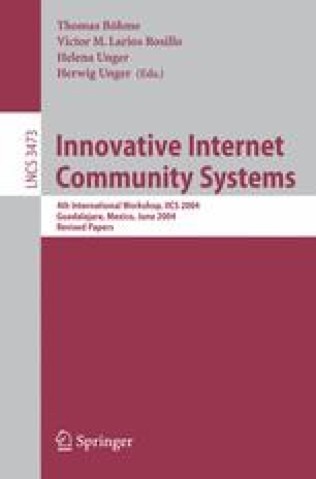
Innovative Internet Community Systems ; Vol. 3473 ; 4th International Workshop, IICS 2004, Guadalajara, Mexico, June 21-23, 2004. Revised Papers
This book constitutes the thoroughly refereed postproceedings of the 4th International Workshop on Innovative Internet Community Systems, IICS 2004, held in Guadalajara, Mexico, in June 2004. The 25 revised full papers presented together with 2 invited papers have been carefully reviewed. They focus mainly on system-oriented problems, text processing, and theoretical foundations of distributed and Internet systems. They also deal with speed and quality-of-service problems of Internet protocols, aspects of cooperation and collaboration in Internet systems, as well as agent and text-processing-based methods. In addition, 9 papers stem from two mini-workshops, one on computational epidemiology and the other on optimization of urban traffic systems.
