



Page 1
Page 1

Il senso e la narrazione = The sense and the narration
Humans are creatures of narration: infinitely they narrate and narrate themselves, intertwine dialogues, light up stories to illuminate the dark caves of the heart and the world, recover and transmute memories. We live between a firm and rough, unknowable reality, an enormous furnace of perturbations and calls and colors, and an elusive, delicate and ephemeral interiority: and between the two, between the world and us, we weave with thought and with words a fragile ponte, a bridge called sense. Swing this bridge at the unequal breath of a cosmic wind, dropping phosphoric fragments: sudden hourglasses, anonymous centaurs, sleepless geometers, distant syllogisms, vanished lineages, black basalts, crazy anchorites, silent plesiosaurs, flutes and bagpipes ... and they recompose figures, and we ask ourselves questions about those figures and tell stories. Only the vertigo of asking and narrating can give meaning to a life that some say is interwoven with pure chance. Forever detached from the flourishing matrix of the world, tormented by thought, prisoners of words, slaves of interpretation, lost in a long corridor of facing mirrors: we are at the center of a great, incomprehensible rumble.
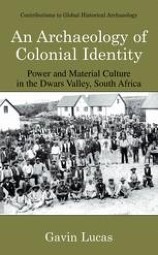
An Archaeology of Colonial Identity : Power and Material Culture in the Dwars Valley, South Africa
This book is the based on the work of many people, and while I discuss many of them in the general context of this book in Chapter 1. The backbone of the book is based on a project, 'Farm Lives' conducted between 1999 and 2002, funded exclusively by the McDonald Institute for Archaeolog-ical Research at the University of Cambridge.
