



Page 1
Page 1

The Universe of General Relativity
Topics discussed include the prehistory of special relativity, early attempts at a relativistic theory of gravitation, the beginnings of general relativity, the problem of motion in the context of relativity, conservation laws, the axiomatization of relativity, classical and contemporary cosmology, gravitation and electromagnetism, quantum gravity, and relativity as seen through the eyes of the public and renowned relativists.

Special Relativity : Will it Survive the Next 101 Years?
After a century of successes, physicists still feel the need to probe the limits of the validity of theories based on special relativity. Canonical approaches to quantum gravity, non-commutative geometry, string theory and unification scenarios predict tiny violations of Lorentz invariance at high energies. The present book, based on a recent seminar devoted to such frontier problems, contains reviews of the foundations of special relativity and the implications of Poincaré invariance as well as comprehensive accounts of experimental results and proposed tests.

Quantum Riemannian Geometry
Provides a comprehensive account of a modern generalisation of differential geometry in which coordinates need not commute. This requires a reinvention of differential geometry that refers only to the coordinate algebra, now possibly noncommutative, rather than to actual points.Such a theory is needed for the geometry of Hopf algebras or quantum groups, which provide key examples, as well as in physics to model quantum gravity effects in the form of quantum spacetime. The mathematical formalism can be applied to any algebra and includes graph geometry and a Lie theory of finite groups. Even the algebra of 2 x 2 matrices turns out to admit a rich moduli of quantum Riemannian geometries. The approach taken is a `bottom up’ one in which the different layers of geometry are built up in succession, starting from differential forms and proceeding up to the notion of a quantum `Levi-Civita’ bimodule connection, geometric Laplacians and, in some cases, Dirac operators ....

Quantum gravity : Mathematical models and experimental bounds
This book presents different mathematical approaches to formulate a theory of quantum gravity. It represents a carefully selected cross-section of lively discussions about the issue of quantum gravity which took place at the second workshop "Mathematical and Physical Aspects of Quantum Gravity" in Blaubeuren, Germany.

Quantum Gravitation : The Feynman Path Integral Approach
The book covers the theory of Quantum Gravitation from the point of view of Feynman path integrals. These provide a manifestly covariant approach in which fundamental quantum aspects of the theory such as radiative corrections and the renormalization group can be systematically and consistently addressed. The path integral method is suitable for both perturbative as well as non-perturbative studies, and is known to already provide a framework of choice for the theoretical investigation of non-abelian gauge theories, the basis for three of the four known fundamental forces in nature. The book thus provides a coherent outline of the present status of the theory gravity based on Feynman’s formulation, with an emphasis on quantitative results.

Planck Scale Effects in Astrophysics and Cosmology
Composed of extensive and detailed notes from the lectures given at the 40th Karpacz Winter School. This school focussed on quantum gravity phenomenology with emphasis on its relation to observational astrophysics and cosmology. These notes have been carefully edited with the aim to give advanced students and young researchers a balanced and accessible introduction to an rather heavily mathematical subject.

Lectures on Quantum Gravity
A primary goal was to foster interaction and communication between participants from different cultures, both in the layman’s sense of the term and in terms of approaches to quantum gravity. We hope that the links formed by students and the school will persist throughout their professional lives, continuing to promote interaction and the essential exchange of ideas that drives research forward. This volume contains improved and updated versions of the lectures given at the School. It has been prepared both as a reminder for the participants, and so that these pedagogical introductions can be made available to others who were unable to attend. We expect them to serve students of all ages well.
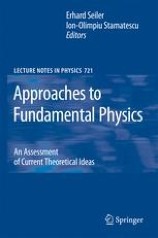
Approaches to Fundamental Physics : An Assessment of Current Theoretical Ideas
This book presents contributions on particle theory, quantum field theory, general relativity, quantum gravity, string theory and cosmology. These represent the outcome of numerous discussions, taking place among the authors over a period of several years, about the research landscape of present-day fundamental theoretical physics. Indeed, the resultant book documents their attempt, out of their respective and highly specialized scientific positions, to find a way of communicating about methods, achievements and promises of the different approaches which shape the development of this field. It is therefore also an attempt to elucidate the connections between these approaches, and present them not as disjoint ventures but rather as facets of a common quest for understanding. Readers interested in fundamental approaches of theoretical physics will find this book highly stimulating and enlightening.
