



Page 1
Page 1

The Music of the Big Bang : The Cosmic Microwave Background and the New Cosmology
Most cosmological information is encoded in the cosmic background radiation by acoustic oscillations in the dense plasma that filled the primordial Universe: a "music" of the big bang, which cosmologists have long been trying to reconstruct and analyze, in order to distinguish different cosmological models, much like one can distinguish different musical instruments by their timbre and overtones. Only lately, this amazing cosmic sound has been unveiled by such experiments as BOOMERANG and MAXIMA and, more recently, by the WMAP satellite. This led to a giant leap in our understanding of the Universe, but the investigation is not ended yet.

Rhythm and Transforms
People quite naturally identify the rhythmic structure of music as they tap their feet and sway in time with the beat. Underlying such mundane motions is an act of cognition that is not easily reproduced in a computer program or automated by machine. Rhythm and Transforms asks (and answers) the question: How can we build a device that can "tap its foot" along with the music? The result is a tool for detecting and measuring the temporal aspects of a musical performance: the periodicities, the regularities (and irregularities), the beat, the rhythm. The impact of such a "rhythm meter" on music theory and on the design of sound processing electronics such as musical synthesizers, drum machines, and special effects devices is described. The "rhythm meter" provides a concrete basis for a discussion of the relationship between the cognitive processing of temporal information and the mathematical techniques used to describe and understand regularities in data.

Musical Haptics
This Open Access book offers an original interdisciplinary overview of the role of haptic feedback in musical interaction. Divided into two parts, part I examines the tactile aspects of music performance and perception, discussing how they affect user experience and performance in terms of usability, functionality and perceived quality of musical instruments. Part II presents engineering, computational, and design approaches and guidelines that have been applied to render and exploit haptic feedback in digital musical interfaces.Musical Haptics introduces an emerging field that brings together engineering, human-computer interaction, applied psychology, musical aesthetics, and music performance.

La musica del Big Bang : Come la radiazione cosmica di fondo ci ha svelato i segreti dell’Universo = The music of the Big Bang : How the cosmic background radiation revealed the secrets of the Universe to us
Cosmic microwave background radiation is the residue of the great heat following the Big Bang. A tenuous sign, over 13 billion years old, in which the answers to many of the questions about the nature of our Universe are hidden. Discovered by chance in 1964, in the last forty years this fossil trace of the origins of the Cosmos has been explored with every available means. Two Nobel Prizes in physics have already been awarded for research involving it, the last in 2006 for the results of the COBE satellite. Much of the information encoded in the cosmic background radiation was impressed by the superimposition of acoustic waves present in the early Universe: a "music" of the Big Bang, which cosmologists have tried for years to reconstruct, using techniques similar to those that allow to distinguish the sound of different musical instruments. Only recently have the first notes of this extraordinary cosmic symphony finally been revealed, but the investigation is not over yet. This book illustrates, with a language suitable even for non-specialists, the theories, observations and discoveries that have brought cosmology into a new era.
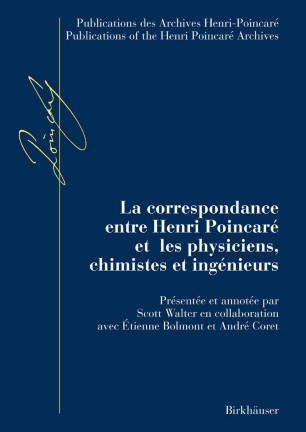
La correspondance entre Henri Poincaré et les physiciens, chimistes et ingénieurs = The correspondence between Henri Poincaré and physicists, chemists and engineers
Cosmic microwave background radiation is the residue of the great heat following the Big Bang. A tenuous sign, over 13 billion years old, in which the answers to many of the questions about the nature of our Universe are hidden. Discovered by chance in 1964, in the last forty years this fossil trace of the origins of the Cosmos has been explored with every available means. Two Nobel Prizes in physics have already been awarded for research involving it, the last in 2006 for the results of the COBE satellite. Much of the information encoded in the cosmic background radiation was impressed by the superimposition of acoustic waves present in the early Universe: a "music" of the Big Bang, which cosmologists have tried for years to reconstruct, using techniques similar to those that allow to distinguish the sound of different musical instruments. Only recently have the first notes of this extraordinary cosmic symphony finally been revealed, but the investigation is not over yet. This book illustrates, with a language suitable even for non-specialists, the theories, observations and discoveries that have brought cosmology into a new era.
