



Page 1
Page 1

Software networks : Virtualization, SDN, 5G, and security ; 2nd ed.
Describes how to create and delete virtual networks on the fly. Indeed, the system is able to create any new network with any kind of virtual resource (e.g. switches, routers, LSRs, optical paths, firewalls, SIP-based servers, devices, servers, access points, etc.). Software Networks shows how this architecture is compatible with new advances in SDN (Software Defined Networking), new high-speed transport protocols such as TRILL (Transparent Interconnection of Lots of Links) and LISP (Locator/Identifier Separation Protocol), NGN, IMS, new generation Wi-Fi, and 4G/5G networks. Finally, the author introduces Clouds of security and the virtualization of secure elements (smartcards) that could certainly transform how to secure the Internet.

Self-Sustaining Systems ; 1st Workshop, S3 2008 Potsdam, Germany, May 15-16, 2008 Revised Selected Papers
S3 is a forum for discussion of topics relating to computer systems and languages that are able to bootstrap, implement, modify, and maintain themselves. One property of these systems is that their implementation is based on small but powerful abstractions; examples include (amongst others) Squeak/Smalltalk, COLA, Klein/Self, PyPy/Python, Rubinius/Ruby, and Lisp. Such systems are the engines of their own replacement, giving researchers and developers great power to experiment with, and explore future directions from within their own small language kernels.

Science and its History : A Reassessment of the Historiography of Science
Professor Joseph Agassi has published his Towards an Historiography of Science in 1963. It received many reviews by notable academics, including Maurice Finocchiaro, Charles Gillispie, Thomas S. Kuhn, Geroge Mora, Nicholas Rescher, and L. Pearce Williams. It is still in use in many courses in the philosophy and history of science. Here it appears in a revised and updated with responses to these reviews and with many additional chapters, some already classic, others new. They are all paradigms of the author’s innovative way of writing fresh and engaging chapters in the history of the natural sciences.

Practical Ruby Projects : Ideas for the Eclectic Programmer
Want to take Ruby to the limit? Looking for new, powerful, and creative ideas that will take Ruby beyond Rails and web programming? If you're comfortable with Ruby, you'll be itching to go further—apply Practical Ruby Projects: Ideas for the Eclectic Programmer and become a master of advanced Ruby techniques. Rubyist Topher Cyll brings several imaginative projects to this book, ranging from making generative music, animations, and turn–based games to implementing simulations, algorithms, and even an implementation of Lisp! Art, music, theory, and games—this book has it all. Best of all, it's all done with Ruby.

Practical Common Lisp
Lisp is often thought of as an academic language, but it need not be. This is the first book that introduces Lisp as a language for the real world. Practical Common Lisp presents a thorough introduction to Common Lisp, providing you with an overall understanding of the language features and how they work. Over a third of the book is devoted to practical examples, such as the core of a spam filter and a web application for browsing MP3s and streaming them via the Shoutcast protocol to any standard MP3 client software (e.g., iTunes, XMMS, or WinAmp). In other "practical" chapters, author Peter Seibel demonstrates how to build a simple but flexible in-memory database, how to parse binary files, and how to build a unit test framework in 26 lines of code.

Object-Oriented Technology. ECOOP 2007 Workshop Reader ; ECOOP 2007 Workshops, Berlin, Germany, July 30-31, 2007, Final Reports
Contains the reports from the workshopsheld at the 21st European Conference on Object-Oriented Programming - ECOOP 2007 - at Technische Universit] at Berlin. Nineteen workshops were heldin the courseofthis conference on July 30 and July 31, 2007, covering a large spectrum of hot research topics. As in previous editions of ECOOP, numerous scientists from academia and industry took the chance to present innovative and topical ideas in an environment ofering optimal conditions for exciting discussions and fruitful interactions. The Workshop Reader which contains the reports from the workshops has been a substantial part of the ECOOP conference for more than10 years

Object-Oriented Technology ; ECOOP 2006 Workshop Reader ; ECOOP 2006 Workshops, Nantes, France, July 3-7, 2006, Final Reports
ECOOP Workshop Reader, a c- pendium of workshop reports pertaining to the ECOOP 2006 conference, held in Nantes during July 3–7, 2006. ECOOP 2006 hosted 19 high-quality research workshops covering a large spectrum of hot research topics. These workshops were chosen through a tight peer review process following a speci?c call for proposals.
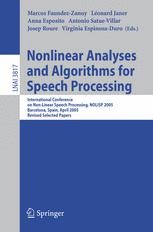
Nonlinear Analyses and Algorithms for Speech Processing ; International Conference on Non-Linear Speech Processing, NOLISP 2005, Barcelona, Spain, April 19-22, 2005, Revised Selected Papers
We present in this volume the collection of ?nally accepted papers of NOLISP 2005 conference. It has been the third event in a series of events related to N- linear speech processing, in the framework of the European COST action 277 “Nonlinear speech processing”. Many speci?cs of the speech signal are not well addressed by conv- tional models currently used in the ?eld of speech processing. The purpose of NOLISP is to present and discuss novel ideas, work and results related to alternative techniques for speech processing, which depart from mainstream approaches. With this intention in mind, we provide an open forum for discussion. Alt- nate approaches are appreciated, although the results achieved at present may not clearly surpass results based on state-of-the-art methods. The call for papers was launched at the beginning of 2005, addressing the following domains: 1. Non-Linear Approximation and Estimation 2. Non-Linear Oscillators and Predictors 3. Higher-Order Statistics 4. Independent Component Analysis 5. Nearest Neighbors 6. Neural Networks 7. Decision Trees 8. Non-Parametric Models 9. Dynamics of Non-Linear Systems 10. Fractal Methods 11. Chaos Modeling 12. Non-Linear Di?erential Equations 13. Others All the main ?elds of speech processing are targeted by the workshop, namely: 1. Speech Coding:Thebit rateavailablefor speechsignalsmustbe strictly l- ited in order to accommodate the constraints of the channel resource.

Introducing Blockchain with Java : Program, Implement, and Extend Blockchains with Java
Includes numerous exercises and test questions to help you solidify what you have learned as you progress through the book, and provides ideas on expanding the codebase to make it your own. You will have access to a fully-functioning repository with Java code. You will have the knowledge necessary to program your own blockchains with Java and you will have a completed project for your portfolio. You will: Know the most important theoretical concepts of the blockchain / Code the blockchain in Java / Create a user interface with JavaFX / Implement SQLite DB using JDBC Driver / Create a P2P multi-threaded app / Create your own cryptocurrency app with full functionality / Implement blockchain technology on a P2P network from scratch using Java, JavaFX, and SQL

ECOOP’ 87 European Conference on Object-Oriented Programming ; Paris, France, June 15-17, 1987. Proceedings
In October 1983 an informal meeting was organized in Le Cap d'Agde with the help of the BIGRE bulletin. Sixty people turned out to hear more than ten presentations on object-oriented programming. More important was their unanimous demand for other, more structured encounters. So, about one year later, the Object group was created by AFCET.

Languages and Compilers for Parallel Computing ; 21th International Workshop, LCPC 2008, Edmonton, Canada, July 31 - August 2, 2008, Revised Selected Papers
This book constitutes the thoroughly refereed post-conference proceedings of the 21th International Workshop on Languages and Compilers for Parallel Computing, LCPC 2008, held in Edmonton, Canada, in July/August 2008.The 18 revised full papers and 6 revised short papers presented were carefully reviewed and selected from 35 submissions. The papers address all aspects of languages, compiler techniques, run-time environments, and compiler-related performance evaluation for parallel and high-performance computing and comprise
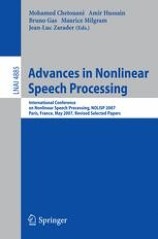
Advances in Nonlinear Speech Processing ; International Conference on Non-Linear Speech Processing, NOLISP 2007 Paris, France, May 22-25, 2007 Revised Selected Papers
This book presented numerous submissions for inclusion in the book. The papers are organized in topical sections on nonlinear and nonconventional techniques, speech synthesis, speaker recognition, speech recognition, speech analysis, and exploitation of non-linear techniques.
