



Page 1
Page 1

Mobile Professional Voluntarism and International Development : Killing Me Softly?
This book explores the impact that professional volunteers have on the low resource countries they choose to spend time in. Whilst individual volunteering may be of immediate benefit to individual patients, this intervention may have detrimental effects on local health systems; distorting labour markets, accentuating dependencies and creating opportunities for corruption. Improved volunteer deployment may avoid these risks and present opportunities for sustainable systems change. The empirical research presented in this book stems from a specific volunteering intervention funded by the Tropical Health Education Trust and focused on improving maternal and newborn health in Uganda.

Control Systems Theory and Applications for Linear Repetitive Processes
After motivating examples, this monograph gives substantial new results on the analysis and control of linear repetitive processes. These include further applications of the abstract model based stability theory which, in particular, shows the critical importance to the dynamics developed of the structure of the initial conditions at the start of each new pass, the development of stability tests and performance bounds in terms of so-called 1D and 2D Lyapunov equations. It presents the development of a major bank of results on the structure and design of control laws, including the case when there is uncertainty in the process model description, together with numerically reliable computational algorithms. Finally, the application of some of these results in the area of iterative learning control is treated --- including experimental results from a chain conveyor system and a gantry robot system.
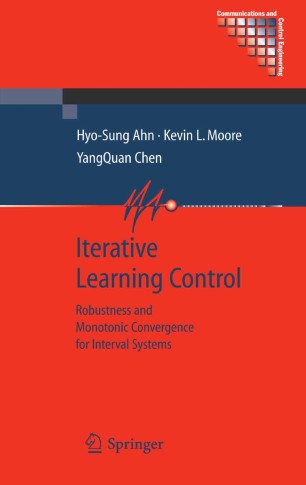
Iterative Learning Control : Robustness and Monotonic Convergence for Interval Systems
This monograph studies the design of robust, monotonically-convergent iterative learning controllers for discrete-time systems. Two key problems with the fundamentals of iterative learning control (ILC) design as treated by existing work are: first, many ILC design strategies assume nominal knowledge of the system to be controlled and; second, it is well-known that many ILC algorithms do not produce monotonic convergence, though in applications monotonic convergence is often essential. Iterative Learning Control takes account of the recently-developed comprehensive approach to robust ILC analysis and design established to handle the situation where the plant model is uncertain. Considering ILC in the iteration domain, it presents a unified analysis and design framework that enables designers to consider both robustness and monotonic convergence for typical uncertainty models, including parametric interval uncertainties, iteration-domain frequency uncertainty, and iteration-domain stochastic uncertainty.
