



Page 1
Page 1

New insights in machine learning and deep neural networks
Gatheres ten exemplary papers, each delineating advancements within the spheres of machine learning and deep neural networks. Commencing with a thorough exploration by Figueira and Vaz, readers are introduced to the nuances of synthetic data generation and evaluation, followed closely by Silva and Pedroso's systematic approach to leveraging deep reinforcement learning within the intricate realm of delivery logistics. Kamran et al. contribute an astute methodology for camouflage object segmentation, whereas Pinheiro and collaborators offer a crafted semi-supervised strategy for predicting EGFR mutations via CT images. Subsequent contributions, such as Lee and Yoo's framework for portrait emotion recognition and Balakrishnan et al.'s analytical exploration of transformer models for Twitter disaster detection, further exemplify the depth of research contained herein.

Mute people aiding application
Communication is an essential tool for human survival. It is a fundamental and effective method of sharing thoughts, needs, feelings, and opinions. However, a large portion of the world's population lacks the ability to communicate with others. Such as the ones suffering from hearing loss, speech disability, or even both. Those disabilities have a significant impact on their lives in terms of work and relationships. The majority of these people are sometimes unable to support themselves financially due to the lack of job opportunities. Given these difficulties, we have decided to develop an application to help them overcome the obstacles they may encounter in their daily lives. After consulting with two deaf and mute people we customized an application that works in two ways. One of which is to translate their sign language in real time by using mobile camera and recognizing hand motion. The other works by converting text-to-voice, and accurately expressing the user’s emotions with the help of the facial emotion recognition.

Human-computer interaction - HCI Intelligent Multimodal interaction environments ; 12th International Conference, HCI International 2007, Beijing, China, July 22-27, 2007, Proceedings, Part III
The 12th International Conference on Human-Computer Interaction, HCI Inter- tional 2007, was held in Beijing, P.R. This volume, edited by Julie A. Jacko, contains papers in the thematic area of Human-Computer Interaction, addressing the following major topics: • Multimodality and Conversational Dialogue • Adaptive, Intelligent and Emotional User Interfaces • Gesture and Eye Gaze Recognition • Interactive TV and Media.
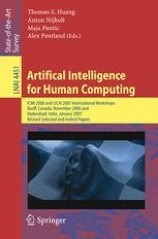
Artifical intelligence for human computing ; ICMI 2006 and IJCAI 2007 International Workshops, Banff, Canada, November 3, 2006 Hyderabad, India, January 6, 2007 Revised Selceted Papers
This book contains the thoroughly refereed post-proceedings of two events discussing AI for Human Computing.It presented a vision of the future of computing technology in which AI, in particular machine learning and agent technology, plays an essential role.

Affect and Emotion in Human-Computer Interaction : From Theory to Applications
The present book provides an account of the latest work on a variety of aspects related to affect and emotion in human-technology interaction. It covers theoretical issues, user experience and design aspects as well as sensing issues, and reports on a number of affective applications that have been developed in recent years.

Advances in Nonlinear Speech Processing ; International Conference on Non-Linear Speech Processing, NOLISP 2007 Paris, France, May 22-25, 2007 Revised Selected Papers
This book presented numerous submissions for inclusion in the book. The papers are organized in topical sections on nonlinear and nonconventional techniques, speech synthesis, speaker recognition, speech recognition, speech analysis, and exploitation of non-linear techniques.

Advances in intelligent computing ; Vol. 3644 ; International conference on intelligent computing, ICIC 2005, Hefei, China, August 23-26, 2005, Proceedings, Part I
This book constitutes the proceedings of the International Conference on Intelligent Computing (ICIC 2005), Based on rigorous peer reviews, the Program Committee selected 563 high-quality papers for presentation at ICIC 2005; Including Topics Artificial Intelligence Computation by Abstract Devices Algorithm Analysis and Problem Complexity Image Processing and Computer Vision Pattern Recognition Evolutionary Biology
