



Page 1
Page 1

Open and Distance Education in Australia, Europe and the Americas : National Perspectives in a Digital Age
This book describes the history, structure and institutions of open and distance education in six countries: Australia, Brazil, Canada, Germany, the UK and the US. It discusses how open and distance education is evolving in a digital age to reflect the needs and circumstances of national higher education systems in these countries, and explores the similarities and differences between the ways in which they are organized and structured. It is the first book to make such comparisons and draw conclusions about the nature of open and distance education in the context of various national higher education systems. In a digital era with growing use of online education as well as open and distance education.

Open and distance education in Asia, Africa and the Middle East : National perspectives in a digital age
This book describes the history, structure and institutions of open and distance education in six countries: China, India, Russia, Turkey, South Africa and South Korea. It describes how open and distance education is evolving in a digital age to reflect the needs and circumstances of the national higher education systems in these countries. It also explores the similarities and differences between how their open and distance higher education systems are managed and structured. The book compare and draw conclusions about the nature of open and distance education in the context of various national higher education systems. In a digital era characterized by the growing use of online, open and distance education, this book will prove particularly valuable for policy-makers and senior administrators who want to learn about establishing or expanding open and distance education services. In addition, it offers a valuable reference guide for researchers, academics and students interested in understanding the different approaches to open and distance education.

Multimedia Introduction to Programming Using Java
Although vital to modern software development, Java and object-oriented programming can pose significant challenges to newcomers. This text, unique in both scope and approach and accompanied by interactive content that you may find on extras.springer.com, addresses that learning curve by providing a careful, classroom-tested presentation of Java -- from the fundamentals of variables, types, and expressions to procedural concepts like loops and sophisticated object-oriented ideas. Additional key features of this work Introduces objects and classes early in the exposition, rendering object-oriented programming intuitive and natural. Develops programs, rather than simply showcasing them. Supports all concepts through complementary lectures on the zip-file featured on extras.springer.com. Contains numerous self-help exercises that encourage readers to practice programming. With its comprehensive appendices and bibliography, systematic approach, and helpful interactive programs on extras.springer.com, this exciting work provides the key tools they needed for successful object-oriented programming. It is ideal for use at the undergraduate and graduate beginning level, whether in the classroom or for distance learning; furthermore, the text will also be a valuable self-study resource or reference volume in any programmer’s library.

Medical terminology systems : A body systems approach
Create an immersive, multimedia experience that tracks each student’s progress until they’ve mastered the language of medicine. Established record of presenting medical word building principles based on competency based curricula. Because of the pedagogical success of previous editions, this edition continues its structural design as a textbook-workbook that complements all teaching formats, including traditional lecture, distance learning, and independent or self-paced study
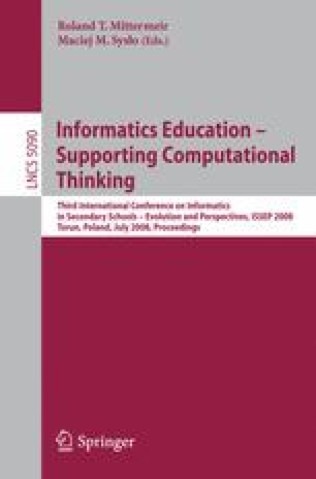
Informatics education - supporting computational thinking ; 3rd International Conference on informatics in secondary schools : Evolution and perspectives, ISSEP 2008 Torun Poland, July 1-4, 2008 Proceedings
Informatics Education – Supporting Computational Thinking contains papers presented at the Third International Conference on Informatics in Secondary Schools – Evolution and Perspective, ISSEP 2008, held in July 2008 in Torun, Poland. As with the proceedings of the two previous ISSEP conferences (2005 in Klag- furt, Austria, and 2006 in Vilnius, Lithuania), the papers presented in this volume address issues of informatics education transcending national boundaries and, the- fore, transcending differences in the various national legislation and organization of the educational system. Observing these issues, one might notice a trend. The p- ceedings of the First ISSEP were termed From Computer Literacy to Informatics F- damentals [1]. There, broad room was given to general education in ICT.

Hybrid Learning and Education ; 1st International Conference, ICHL 2008 Hong Kong, China, August 13-15, 2008 Proceedings
This book constitutes the refereed proceedings of the First International Conference on Hybrid Learning, ICHL 2008, held in Hong Kong, China, in August 2008.The 38 revised full papers presented together with 3 keynote lectures were carefully reviewed and selected from 142 submissions. The papers are organized in topical sections on hybrid education, model and pedagogies for hybrid learning, trends, pervasive learning, mobile and ubiquitous learning, hybrid learning experiences, hybrid learning systems, technologies, as well as contextual attitude and cultural effects.

Distributed Cooperative Laboratories : Networking, Instrumentation, and Measurements
This is a highly interdisciplinary topic, where various aspects converge: multimedia communications and networking, sensor networks, Grid technology, Quality of Service (QoS) provisioning and control, network management, measurement instrumentation and methodology, architecture of measurement systems. The material is organized into six parts: Technologies for Real-Time Interactive Multimedia Communications; Monitoring, Management and Configuration of Networks and Networking Devices; Data Acquisition and Aggregation in Sensor Networks; Grid Structures for Distributed Cooperative Laboratories; Architectures and Techniques for Tele-Measurements; Virtual Immersive Communications and Distance Learning. Each contribution presents a self-contained treatment, within a framework that provides the reader with an up-to-date picture of the most recent state-of-the-art developments.

Creating Web-based Laboratories
Remote web-based experimentation, enabling students and researchers to access the laboratory anytime via the Internet, is becoming an increasingly attractive way to complement or even replace traditional laboratory sessions. Placing a video camera & microphone before the equipment and apparatus to capture what is actually happening in the laboratory allows the images and audio data to be streamed to the client side. Researchers in different countries can share equipment and conduct research cooperatively and remotely. The authors summarise their research and discuss the development of the 5 web-based laboratories launched from the National University of Singapore. The principles, structure, and technologies required for the creation of Internet remote experimentation systems are discussed with particular emphasis on the integration of hardware and software systems. Also highlighted is the design and development of interfaces and components for use in typical web-based laboratories or similar web-control applications.
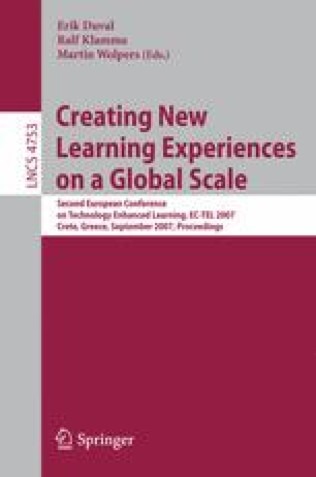
Creating New Learning Experiences on a Global Scale ; 2nd European Conference on Technology Enhanced Learning, EC-TEL 2007, Crete, Greece, September 17-20, 2007, Proceedings
It is holding more than 500 pages of combined wisdom on Technology Enhanced Learning (TEL) in your hands! With the advance of metadata, standards, learning objects, Web 2. 0 approaches to rip, mix and burn learning, wikis, blogs, syndication, user-generated content, W- based video, games and the ubiquitous availability of computing devices we can and have to offer more flexible learning services on a global scale.It provided a unique forum for all research related to technology enhanced learning, including its interactions with knowledge management, business processes and work environments.

Learning to Live in the Knowledge Society ; IFIP 20th World Computer Congress, IFIP TC 3 ED-L2L Conference September 7–10, 2008, Milano, Italy
The IFIP series publishes state-of-the-art results in the sciences and technologies of information and communication. The scope of the series includes: foundations of computer science; software theory and practice; education; computer applications in technology; communication systems; systems modeling and optimization; information systems; computers and society; computer systems technology; security and protection in information processing systems; artificial intelligence; and human-computer interaction. Proceedings and post-proceedings of refereed international conferences in computer science and interdisciplinary fields are featured. These results often precede journal publication and represent the most current research.
Addressing Global Challenges and Quality Education ; 15th European Conference on Technology Enhanced Learning, EC-TEL 2020, Heidelberg, Germany, September 14–18, 2020, Proceedings
The chapters: “Designing an Online Self-Assessment for Informed Study Decisions: The User Perspective”; “Living with Learning Difficulties: Two Case Studies Exploring the Relationship Between Emotion and Performance in Students With Learning Difficulties”; “Applying Instructional Design Principles on Augmented Reality Cards for Computer Science Education”; and “Teaching Simulation Literacy With Evacuations - Concept, Technology, and Material for a Novel Approach” are available open access under a Creative Commons Attribution 4.0 International License via link.springer.com.
