



Page 1
Page 1
New Approaches to Circle Packing in a Square : With Program Codes
This book summarizes results achieved in solving the circle packing problem over the past few years, providing the reader with a comprehensive view of both theoretical and computational achievements. Typically illustrations of problem solutions are shown, elegantly displaying the results obtained.Beyond the theoretically challenging character of the problem, the solution methods developed in the book also have many practical applications. Direct applications include cutting out congruent two-dimensional objects from an expensive material, or locating points within a square in such a way that the shortest distance between them is maximal.

Mathematics of Surfaces XI ; 11th IMA International Conference, Loughborough, UK, September 5-7, 2005, Proceedings
Constitutes the refereed proceedings of the 11th IMA International Conference on the Mathematics of Surfaces, held in Loughborough, UK in September 2005. Among the topics addressed are Voronoi diagrams, linear systems, curvatures on meshes, approximate parameterization, condition numbers, pythagorean hodographs, and more.

Integer programming and combinatorial optimization ; 9th International IPCO Conference, Cambridge, MA, USA, May 27-29, 2002. Proceedings
This volume contains the papers selected for presentation at IPCO 2002, the NinthInternationalConferenceonIntegerProgrammingandCombinatorial- timization, Cambridge, MA (USA), May 27–29, 2002. The IPCO series of c- ferences highlights recent developments in theory, computation, and application of integer programming and combinatorial optimization. IPCO was established in 1988 when the ?rst IPCO program committee was formed. IPCO is held every year in which no International Symposium on Ma- ematical Programming (ISMP) takes places. The ISMP is triennial, so IPCO conferences are held twice in every three-year period. The eight previous IPCO conferences were held in Waterloo (Canada) 1990, Pittsburgh (USA) 1992, Erice (Italy) 1993, Copenhagen (Denmark) 1995, Vancouver (Canada) 1996, Houston (USA) 1998, Graz (Austria) 1999, and Utrecht (The Netherlands) 2001. In response to the call for papers for IPCO 2002, the program committee received 110 submissions, a record number for IPCO. The program committee met on January 7 and 8, 2002, in Aussois (France), and selected 33 papers for inclusion in the scienti?c program of IPCO 2002. The selection was based on originality and quality, and re?ects many of the current directions in integer programming and combinatorial optimization research.

Integer programming and combinatorial optimization ; 13th International Conference, IPCO 2008 Bertinoro, Italy, May 26-28, 2008 Proceedings
The volume contains the papers selected for presentation at IPCO 2008, the 13th International Conference on Integer Programming and Combinatorial - timization that was held in Bertinoro (Italy), May 26–28, 2008. The IPCO series of conferences, sponsored by the Mathematical Progr- ming Society, highlights recent developments in theory, computation, and app- cation of integer programming and combinatorial optimization. The frst conf- ence took place in 1990; starting from IPCO 1995, the proceedings are published in the Lecture Notes in Computer Science series. The 12 previous IPCO conferences were held in Waterloo (Canada) 1990.

Integer programming and combinatorial optimization ; 12th International IPCO Conference, Ithaca, NY, USA, June 25-27, 2007, Proceedings
Constitutes the refereed proceedings of the 12th International Conference on Integer Programming and Combinatorial Optimization, IPCO 2007, held in Ithaca, NY, USA, in June 2007. This book presents 36 revised full papers that were reviewed and selected from over 120 submissions.

Integer Programming and Combinatorial Optimization ; 11th International IPCO Conference, Berlin, Germany, June 8-10, 2005, Proceedings
Since its start in 1990, the IPCO conference series (held under the auspices of theMathematicalProgrammingSociety)hasbecomeanimportantforumforthe presentation of recent results in Integer Programming and Combinatorial Op- mization. This volume compiles the papers presented at IPCO XI, the eleventh conference in this series, held June 8–10, 2005, at the Technische Universit¨ at Berlin. The high interest in this conference series is evident in the large number of submissions. For IPCO XI, 119 extended abstracts of up to 10 pages were submitted. During its meeting on January 29–30, 2005, the Program Committee carefully selected 34 contributions for presentation in non-parallel sessions at the conference. The ?nal choices were not easy at all, since, due to the limited number of time slots, many very good papers could not be accepted. During the selection process the contributions were refereed according to the standards of refereed conferences. As a result of this procedure, you have in your hands a volume that contains papers describing high-quality research e?orts. The page limit for contributions to this proceedings volume was set to 15. You may ?nd full versions of the papers in scienti?c journals in the near future. We thank all the authors who submitted papers. Furthermore, the Program Committee is indebted to the many reviewers who, with their speci?c expertise, helped a lot in making the decisions.

Handbook of Geometric Computing : Applications in Pattern Recognition, Computer Vision, Neuralcomputing, and Robotics
Many computer scientists, engineers, applied mathematicians, and physicists use geometry theory and geometric computing methods in the design of perception-action systems, intelligent autonomous systems, and man-machine interfaces. This handbook brings together the most recent advances in the application of geometric computing for building such systems, with contributions from leading experts in the important fields of neuroscience, neural networks, image processing, pattern recognition, computer vision, uncertainty in geometric computations, conformal computational geometry, computer graphics and visualization, medical imagery, geometry and robotics, and reaching and motion planning. For the first time, the various methods are presented in a comprehensive, unified manner.

Geographic Information Science ; 4th International Conference, GIScience 2006, Münster, Germany, September 20-23, 2006, Proceedings
The GIScience conference series (www. giscience. org) was created as a forum for all researchers who are interested in advancing research in the fundam- tal aspects of geographic information science.The conferences focus on emerging topics and basic research ?ndings across all s- tors of geographic information science. After three highly successful conferences in the United States, this year’s GIScience conference was held in Europe for the ?rst time. The GIScience conferences have been a meeting point for researchers coming from various disciplines, including cognitive science, computer science, engine- ing, geography,information science, mathematics, philosophy, psychology,social science, and statistics. The advancement of geographic information science - quiressuchinterdisciplinarybreadth,andthisisalsowhatmakestheconferences so exciting. In order to account for the di?erent needs of the involved scienti?c disciplines with regard to publishing their research results.
Generalized Curvatures
The central object of this book is the measure of geometric quantities describing N a subset of the Euclidean space (E ,), endowed with its standard scalar product. Let us state precisely what we mean by a geometric quantity. Consider a subset N S of points of the N-dimensional Euclidean space E , endowed with its standard N scalar product. LetG be the group of rigid motions of E . We say that a 0 quantity Q(S) associated toS is geometric with respect toG if the corresponding 0 quantity Q[g(S)] associated to g(S) equals Q(S), for all g?G . For instance, the 0 diameter ofS and the area of the convex hull ofS are quantities geometric with respect toG . But the distance from the origin O to the closest point ofS is not, 0 since it is not invariant under translations ofS. It is important to point out that the property of being geometric depends on the chosen group. For instance, ifG is the 1 N group of projective transformations of E , then the property ofS being a circle is geometric forG but not forG , while the property of being a conic or a straight 0 1 line is geometric for bothG andG . This point of view may be generalized to any 0 1 subsetS of any vector space E endowed with a groupG acting on it.

Fundamentals of computation theory ; 16th International Symposium, FCT 2007, Budapest, Hungary, August 27-30, 2007, Proceedings
This book constitutes the refereed proceedings of the 16th International Symposium Fundamentals of Computation Theory. The papers address all current topics in computation theory.

Fundamentals of computation theory ; 15th International symposium, FCT 2005, Lübeck, Gemany, August 17-20, 2005, Proceedings
This book constitutes the refereed proceedings of the 15th International Symposium Fundamentals of Computation Theory, FCT 2005, held in L]beck, Germany in August 2005. The 46 revised full papers presented together with 3 invited papers were carefully reviewed and selected from 105 submissions. The papers are organized in topical sections on circuits, automata, complexity, approximability, computational and structural complexity, graphs and complexity, computational game theory, visual cryptography and computational geometry, query complexity, distributed systems, automata and formal languages, semantics, approximation algorithms, average case complexity, algorithms, graph algorithms, and pattern matching.

Fun with algorithms ; 4th International conference, FUN 2007, Castiglioncello, Italy, June 3-5, 2007, Proceedings
This book constitutes the refereed proceedings of the 4th International Conference on Fun with Algorithms, FUN 2007, held in Castiglioncello, Italy in June 2007.

Efficient Approximation and Online Algorithms : Recent Progress on Classical Combinatorial Optimization Problems and New Applications
This book provides a good opportunity for computer science practitioners and researchers to get in sync with current state-of-the-art and future trends in the field of combinatorial optimization and online algorithms. Recent advances in this area are presented focusing on the design of efficient approximation and on-line algorithms. One central idea in the book is to use a linear program relaxation of the problem, randomization and rounding techniques.
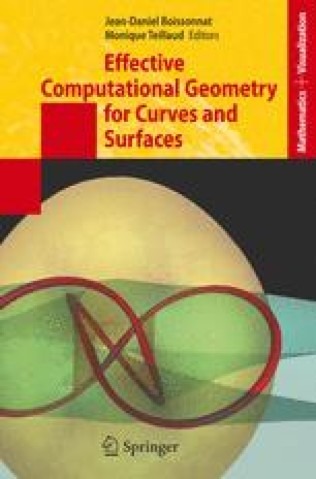
Effective Computational Geometry for Curves and Surfaces
Computational geometry emerged as a discipline in the seventies and has had considerable success in improving the asymptotic complexity of the solutions to basic geometric problems including constructions of data structures,convex hulls, triangulations, Voronoi diagrams and geometric arrangements as well as geometric optimisation. The goal of this book is to take into consideration the multidisciplinary nature of the problem and to provide solid mathematical and algorithmic foundations for effiective computational geometry fo rcurves and surfaces. This book covers two main approaches. In a first part, we discuss exact geometric algorithms for curves and s- faces. We revisit two prominent data structures of computational geometry, namely arrangements (Chap. 1) and Voronoi diagrams (Chap. 2) in order to understand how these structures, which are well-known for linear objects, behave when de?ned on curved objects.
Discrete Geometry, Combinatorics and Graph Theory ; 7th China-Japan Conference, CJCDGCGT 2005, Tianjin, China, November 18-20, 2005, and Xi'an, China, November 22-24, 2005, Revised Selected Papers
Theis book includes discrete algorithmic geometry, combinatorics and graph theory

Discrete Geometry for Computer Imagery Vol. 4245 ; 13th International Conference, DGCI 2006, Szeged, Hungary, October 25-27, 2006, Proceedings
This book constitutes the refereed proceedings of the 13th International Conference on Discrete Geometry for Computer Imagery, DGCI 2006, held in Szeged, Hungary in October 2006. The 28 revised full papers and 27 revised poster papers presented together with two invited papers were carefully reviewed and selected from 99 submissions.
Discrete geometry for computer imagery ; Vol. 3429 ; 12th International Conference, DGCI 2005, Poitiers, France, April 11-13, 2005, Proceedings
This book constitutes the refereed proceedings of the 12th International Conference on Discrete Geometry for Computer Imagery, DGCI 2005, held in Poitiers, France in April 2005. The 36 revised full papers presented together with an invited paper were carefully reviewed and selected from 53 submissions. The papers are organized in topical sections on applications, discrete hierarchical geometry, discrete tomography, discrete topology, object properties, reconstruction and recognition, uncertain geometry, and visualization.
Discrete Geometry for Computer Imagery ; 14th IAPR International Conference, DGCI 2008, Lyon, France, April 16-18, 2008. Proceedings
This book constitutes the refereed proceedings of the 14th IAPR TC-18 International Conference on Discrete Geometry for Computer Imagery, DGCI 2008, held in Lyon, France, in April 2008.
Discrete and computational geometry; Japanese Conference, JCDCG 2004, Tokyo, Japan, October 8-11, 2004
This book constitutes the thoroughly refereed post-proceedings of the Japanese Conference on Discrete Computational Geometry, JCDCG 2004, held in Tokyo, Japan in October 2004, to honor Janos Pach on his fiftieth year. The 20 revised full papers presented were carefully selected during two rounds of reviewing and improvement from over 60 talks at the conference. All current issues in discrete algorithmic geometry are addressed.
Computing the Continuous Discretely : Integer-Point Enumeration in Polyhedra
This textbook illuminates the field of discrete mathematics with examples, theory, and applications of the discrete volume of a polytope. The authors have weaved a unifying thread through basic yet deep ideas in discrete geometry, combinatorics, and number theory.
