



Page 1
Page 1

Modern Formal Methods and Applications
Formal methods are a robust approach for problem solving. It is based on logic and algebraic methods where problems can be formulated in a way that can help to find an appropriate solution. This book shows the basic concepts of formal methods and highlights modern modifications and enhancements to provide a more robust and efficient problem solving tool.Applications are presented from different disciplines such as engineering where the operation of chemical plants is synthesized using formal methods. Computational biology becomes easier and systematic using formal methods. Also, hardware compilation and systems can be managed using formal methods.

Introduction à la résolution des systèmes polynomiaux = Introduction to solving polynomial systems
This book is an introduction to algebraic methods for solving this type of equations. We show how the geometry of algebraic varieties defined by these equations, their dimension, their degree, or their components can be deduced from the properties of the corresponding quotient algebras. For this, we approach methods of effective algebraic geometry, such as Grobner bases, resolution by eigenvalues and vectors, resultants, bezoutians, duality, Gorenstein algebras and algebraic residues.
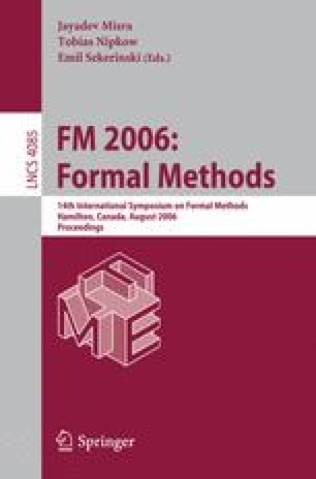
FM 2006: Formal Methods ; 14th International Symposium on Formal Methods, Hamilton, Canada, August 21-27, 2006, Proceedings
This book presents the refereed proceedings of the 14th International Symposium on Formal Methods, FM 2006, held in Hamilton, Canada, August 2006. The book presents 36 revised full papers together with 2 invited contributions and extended abstracts of 7 invited industrial presentations, organized in topical sections on interactive verification, formal modelling of systems, real time, industrial experience, specification and refinement, programming languages, algebra, formal modelling of systems, and more.

Constructive Negations and Paraconsistency
This book presents the author’s recent investigations of the two main concepts of negation developed in the constructive logic: the negation as reduction to absurdity (L.E.J. Brouwer) and the strong negation (D. Nelson) are studied in the setting of paraconsistent logic. The paraconsistent logics are those, which admit inconsistent but non-trivial theories, i.e., the logics which allow making inferences in non-trivial fashion from an inconsistent set of hypotheses. The study is based on algebraic methods, demonstrates the remarkable regularity and the similarity of structures of both lattices of logics, and gives essential information on the paraconsistent nature of logics Lj and N4.The methods developed in this book can be applied for investigation of other classes of paraconsistent logics.

Lie Algebras and Applications
This book, designed for advanced graduate students and post-graduate researchers, provides an introduction to Lie algebras and some of their applications to the spectroscopy of molecules, atoms, nuclei and hadrons. In the first part, a concise exposition is given of the basic concepts of Lie algebras, their representations and their invariants. The second part contains a description of how Lie algebras are used in practice in the treatment of bosonic and fermionic systems. Physical applications considered include rotations and vibrations of molecules (vibron model), collective modes in nuclei (interacting boson model), the atomic shell model, the nuclear shell model, and the quark model of hadrons. One of the key concepts in the application of Lie algebraic methods in physics, that of spectrum generating algebras and their associated dynamic symmetries, is also discussed. The book contains many examples that help to elucidate the abstract algebraic definitions. It provides a summary of many formulas of practical interest, such as the eigenvalues of Casimir operators and the dimensions of the representations of all classical Lie algebras.
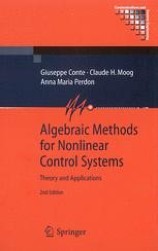
Algebraic Methods for Nonlinear Control Systems
A self-contained introduction to algebraic control for nonlinear systems suitable for researchers and graduate students.The most popular treatment of control for nonlinear systems is from the viewpoint of differential geometry yet this approach proves not to be the most natural when considering problems like dynamic feedback and realization. Professors Conte, Moog and Perdon develop an alternative linear-algebraic strategy based on the use of vector spaces over suitable fields of nonlinear functions. This algebraic perspective is complementary to, and parallel in concept with, its more celebrated differential-geometric counterpart.Algebraic Methods for Nonlinear Control Systems describes a wide range of results, some of which can be derived using differential geometry but many of which cannot.
Algebraic Methodology and Software Technology ; 11th International Conference, AMAST 2006, Kuressaare, Estonia, July 5-8, 2006, Proceedings
This is the proceedings of the 11th edition of the Algebraic Methodology and Software Technology (AMAST) conference series. The rst conference was held in the USA in 1989, and since then AMAST conferences have been held on (or near) fve diferent continents and have been hosted by many of the most prominent people and organizations in the ?eld. The AMAST initiative has always sought to have practical efects by dev- oping the science of software and basing it on a ?rm mathematical foundation. AMAST hasinterpretedsoftwaretechnologybroadly,andhas, for example, held AMAST workshops in areas as diverse as real-time systems and (natural) l- guage processing. Similarly, algebraic methodology is interpreted broadly and includes abstract algebra, category theory, logic, and a range of other ma- ematical subdisciplines.
Algebraic Biology ; 3rd International Conference, AB 2008, Castle of Hagenberg, Austria, July 31-August 2, 2008 Proceedings
This book constitutes the refereed proceedings of the Third International Conference on Algebraic Biology, AB 2008, held at the Castle of Hagenberg, Austria in July 2008 as part of the RISC Summer 2008, organized by the Research Institute for Symbolic Computation.
