



Page 1
Page 1
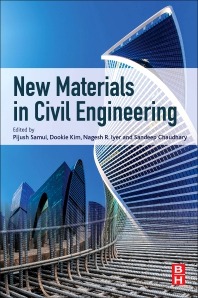
New Materials in Civil Engineering
A valuable guide to the properties, selection criteria, products, applications, lifecycle and recyclability of advanced materials. It presents an A-to-Z approach to all types of materials, highlighting their key performance properties, principal characteristics and applications. Traditional materials covered include concrete, soil, steel, timber, fly ash, geosynthetic, fiber-reinforced concrete, smart materials, carbon fiber and reinforced polymers. In addition, the book covers nanotechnology and biotechnology in the development of new materials.

Nanostructured and advanced materials for applications in sensor, optoelectronic and photovoltaic technology ; Proceedings of the NATO Advanced Study Institute on nanostructured and advanced materials for applications in sensors, optoelectronic and photovoltaic technology ; Sozopol, Bulgaria, 6-17 September 2004
Nanotechnology is an emerging scientific field receiving significant worldwide attention. On a nanometer scale, materials or structures may possess new and unique physical properties. Some of these are now known to the scientific community, but there may well be many properties not yet known to us, rendering it as a fascinating area of research and a suitable subject for a NATO ASI. Yet another aspect of the field is the possibility for creating meta-stable phases with unconventional properties and the ultra-miniaturization of current devices, sensors, and machines. Such nanotechnological and related advanced materials have an extremely wide range of potential applications, viz. nanoscale electronics, sensors, optoelectronics, photonics, nano-biological systems, na- medicine, energy storage systems, etc. This is a wide-ranging subject area and therefore requires the formation of multi-disciplinary teams of physicists, chemists, materials scientists, engineers, molecular biologists, pharmacologists, and others to work together on the synthesis and processing of materials and structures, the understanding of their physical properties, the design and fabrication of devices.

Nanoinformatics
Brings out the state of the art on how informatics-based tools are used and expected to be used in nanomaterials research. There has been great progress in the area in which “big-data” generated by experiments or computations are fully utilized to accelerate discovery of new materials, key factors, and design rules. Data-intensive approaches play indispensable roles in advanced materials characterization. "Materials informatics" is the central paradigm in the new trend. "Nanoinformatics" is its essential subset, which focuses on nanostructures of materials such as surfaces, interfaces, dopants, and point defects, playing a critical role in determining materials properties. There have been significant advances in experimental and computational techniques to characterize individual atoms in nanostructures and to gain quantitative information. The collaboration of researchers in materials science and information science is growing actively and is creating a new trend in materials science and engineering.
Minerals as Advanced Materials I
This book represents a collection of papers presented at the 1st International workshop ‘Minerals as Advanced Materials I’ . The basic idea of the workshop was to identify minerals and mineral objects that have or potentially have unique physical, chemical and structural properties that are of interest from the viewpoint of applied mineralogy and material science.

Micro and Nano Mechanical Testing of Materials and Devices
Nanoscale and nanostructured materials have exhibited different physical properties from the corresponding macroscopic coarse-grained materials due to the size confinement. As a result, there is a need for new techniques to probe the mechanical behavior of advanced materials on the small scales. Micro and Nano Mechanical Testing of Materials and Devices presents the latest advances in the techniques of mechanical testing on the micro- and nanoscales, which are necessary for characterizing the mechanical properties of low-dimensional materials and structures.

Metathesis Chemistry : From Nanostructure Design to Synthesis of Advanced Materials
Recently, an important scientific event in metathesis chemistry, the NATO-Advanced Study Institute New Frontiers in Metathesis Chemistry: From Nanostructure Design to Sustainable Technologies for . Synthesis of Advanced Materials was organized in Antalya, Turkey (September 4-16, 2006). Prominent scientists, young researchers and students, convened for two weeks to debate on the newest trends in olefin metathesis and identify future perspectives in this fascinating field of synthetic organic, organometallic and polymer chemistry with diverse potential applications in materials science and technology. Following the fruitful practice of the previous NATO ASI meetings, selected contributions comprising plenary lectures, short communications and posters are compiled in this special volume dedicated to this outstanding international scientific meeting.

Handbook of Ceramic Composites
HANDBOOK OF CERAMIC COMPOSITES is different from the other books available on this topic. Here, a ceramic composite system or a class of composites has been covered in a separate chapter, presenting a detailed description of processing, properties, and applications. Each chapter is written by internationally renowned researchers in the field. The handbook is organized into five sections: Ceramic Fibers, Non-oxide/Non-oxide Composites, Non-oxide/Oxide Composites, Oxide/Oxide Composites, and Glass and Glass-Ceramic Composites.
Frontiers in Materials Research
This book covers recent progress in advanced materials research as reviewed by forefront researchers in contributions which would also be suitable for researchers and postgraduates in a related field. It starts with comprehensive reviews of exotic materials for electronic devices, such as wide gap semiconductors and organic materials. They are followed by recent topics on eco- and bio-friendly materials, which attract more and more attention in the materials research community. Atomic scale characterization and control of nanostructured materials are discussed in later chapters that review the general possibilities for precise control of structures and properties in the developments of advanced materials.

Civil engineering materials : From theory to practice ; 1st ed.
Presents the state-of-the-art in civil engineering materials, including the fundamental theory of materials needed for civil engineering projects and unique insights from decades of large-scale construction in China. The title includes the latest advances in new materials and techniques for civil engineering, showing the relationship between composition, structure and properties, and covering ultra-high-performance concrete and self-compacting concrete developed in China. This book provides comprehensive coverage of the most commonly used, most advanced materials for use in civil engineering. This volume consists of eight chapters covering the fundamentals of materials, inorganic cementing materials, Portland cement concrete, bricks, blocks and building mortar, metal, wood, asphalt and polymers.

Advanced materials in smart building skins for sustainability : From nano to macroscale
Demonstrates the importance of smart and dynamic building skins in in sustainable buildings / Provides the scientific basis for integration of nanoscale materials in building envelopes with enhanced performance / Illustrates engineering solution and design process incorporating advanced materials in applications of building skins. / Updates readers on the key areas of smart building skins embodied in the novel advanced materials with unique structures and smart properties that enable multiple functions in energy efficiency, solar harvesting, and environmental greenness. It synergistically integrates the topics and knowledge of material design and experimental studies, theoretical analyses of building energy-saving mechanisms and solar energy utilization, and new design methodologies and processes taking advanced materials into account at different scales - from nano to the macroscale.

Advanced materials for oral application
Consists of one editorial, 12 original research articles and two review papers from scientists across the world, with expertise in materials for dental application. The main subjects covered are: biomaterials and techniques for oral tissue engineering and regeneration; biomaterials for surgical reconstruction; CAD/CAM technologies and dedicated materials; novel restorative and endodontic materials and instruments.
Advanced Materials and Structures for Extreme Operating Conditions
The present monograph deals with new advanced materials, including composites, functionally graded materials, materials for high temperature service, advanced approaches to local and non-local analysis of localized damage, new description of crack deactivation, and many more.
