



Page 1
Page 1

Visual Astronomy Under Dark Skies: A New Approach to Observing Deep Space
Modern astronomical telescopes, along with other advances in technology, have brought the deep sky – star clusters, nebulae and the galaxies – within visual reach of amateur astronomers. It isn’t necessary to image deep-sky objects in order to see them; you look at them in real-time by using modern observing techniques and enhancement technology. The first requirement is a truly dark observing site. Given a location with clear, dark night skies everything else follows… this book contains all you need to know about what to observe, how to get superb views of faint and distant astronomical objects, and how to use the best of today’s commercial equipment for visual observing.

Uranus, Neptune, and Pluto and How to Observe Them
This book tells the story of two giants and a dwarf. The giants, Uranus and Neptune, are mostly huge balls of gas, and they make their home in the remotest reaches of the Solar System. The dwarf, Pluto, which can usually be found even farther out than the two giants, was always small, but up until a short while ago, it enjoyed the same status as the other planets, a full-fledged member of the Solar System. Today, Pluto has been re-classified as a "dwarf planet." In this clear and succinct overview of the current research on these remote Solar System objects, Richard Schmude, Jr., tells us what facts we do know about these faraway entities, what we are seeking to know, and also how to observe them for yourself, using commercially available telescopes. He also explains why Pluto was re-classified and what it means, exactly, to be a dwarf planet.

The Universe in X-Rays
In the last 45 years, X-ray astronomy has become an integral part of modern astrophysics and cosmology. There is a wide range of astrophysical objects and phenomena, where X-rays provide crucial diagnostics. In particular they are well suited to study hot plasmas and matter under extreme physical conditions in compact objects. This book summarizes the present status of X-ray astronomy in terms of observational results and their astrophysical interpretation. It is written for students, astrophysicists as well a growing community of physicists interested in the field. An introduction including historical material is followed by chapters on X-ray astronomical instrumentation. The next two parts summarize in 17 chapters the present knowledge on various classes of X-ray sources in the galactic and extragalactic realm. While the X-ray astronomical highlights discussed in this book are mainly based on results from ROSAT, ASCA, RXTE, BeppoSAX, Chandra and XMM-Newton, a final chapter provides an outlook on observational capabilities and projects discussed for the future.

The Sky is Your Laboratory : Advanced Astronomy Projects for Amateurs
For the experienced amateur astronomer who is wondering if there is something useful, valuable, and permanent that can be done with his or her observational skills, the answer is, "Yes, there is!" This is THE book for the amateur astronomer who is ready to take the next step in his or her astronomical journey.

Scientific Detectors for Astronomy 2005 : Explorers of the Photon Odyssey
The 2005 meeting in Taormina, Italy was attended by 127 professionals who develop and use the highest quality detectors for wavelengths from x-ray to sub-mm, with emphasis on optical and infrared detectors. The 87 papers cover a wide range of detector technologies including CCDs, CMOS, APDs, and sub-mm

Imaging planetario : Guida all’uso della webcam = Planetary Imaging : Guide to using the webcam
In this book, Martin Mobberley introduces the amateur to the use of webcams and digital image processing, while providing detailed tips for shooting the Sun, Moon and planets. Each object, with its specific shooting and processing techniques, is treated in a separate chapter. Through the images in this book, the amateur will be able to realize what can be done by applying a webcam to your telescope!
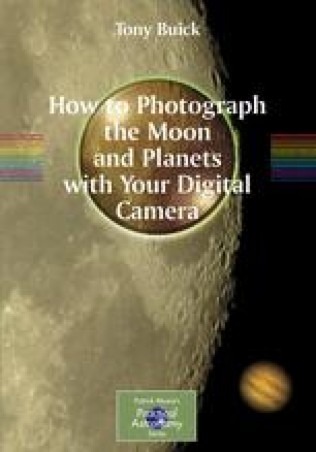
How to photograph the moon and planets with your Digital camera
Using just a regular digital camera along with an amateur astronomical telescope, anyone can produce spectacular photographs of the Moon, as well as surprisingly good images of major planets.Purpose-made astronomical CCD cameras are still very expensive, but technology has now progressed so that digital cameras – the kind you use for everyday photos – are more than capable of being used for astronomy. Tony Buick has written this illustrated step-by-step manual for anyone who has a telescope (of any size) and a digital camera. Look inside at the beautiful color images he has produced – you could do the same.

Electronic Imaging in Astronomy : Detectors and Instrumentation
The second edition of Electronic Imaging in Astronomy: Detectors and Instrumentation describes the remarkable developments that have taken place in astronomical detectors and instrumentation in recent years – from the invention of the charge-coupled device (CCD) in 1970 to the current era of very large telescopes, such as the Keck 10-meter telescopes in Hawaii with their laser guide-star adaptive optics which rival the image quality of the Hubble Space Telescope. Authored by one of the world’s foremost experts on the design and development of electronic imaging systems for astronomy, this book has been written on several levels to appeal to a broad readership. Mathematical expositions are designed to encourage a wider audience, especially among the growing community of amateur astronomers with small telescopes with CCD cameras.

Digital Holography : Digital Hologram Recording, Numerical Reconstruction, and Related Techniques
This book presents a self-contained treatment of the principles and major applications of digital hologram recording and numerical reconstruction (Digital Holography). The first part deals with optical foundations and the theory of holography. The next section describes how to record holograms directly with an electronic sensor (CCD) and describes the various reconstruction techniques. A special chapter is designated to digital holographic interferometry with applications in deformation and shape measurement and refractive index determination. Applications in imaging and microscopy are also described. The next part discusses special techniques such as digital light-in-flight holography, holographic endoscopy, information encrypting and comparative holography. In the last chapter related techniques of speckle metrology are treated briefly.

Digital astrophotography : The state of the Art
This book is the successor to David Ratledge’s much-acclaimed The Art and Science of CCD Astronomy.CCD cameras and their associated technologies have continued to make great strides since the original book was first published almost eight years ago, particularly in the universal availability of color cameras and in the dramatically lower cost of equipment.Digital Astrophotography: The State of the Art provides examples of the latest and best images, and describes how to get the best out of this extraordinary technology.

Creating and Enhancing Digital Astro Images
Digital imaging is now available to all amateur astronomers at a reasonable price. The advent of CCDs, DSLRs and – perhaps most significantly – webcams mean today’s astronomers can make colorful planetary or deep-sky images of breathtaking beauty. The results obtained with even modest equipment can be spectacular, but of course they depend crucially on the computer processing of the images after they have been captured. Enhancing Digital Images is not just an introduction to image processing, it is a deeply practical, comprehensive and fully illustrated in-depth guide to using a digital camera, performing image reduction and undertaking image enhancement – all without jargon or math. Here is everything you need to know about processing digital astronomical images, regardless of whether you are experienced or a relative beginner!

Making Beautiful Deep-Sky Images : Astrophotography with Affordable Equipment and Software
Professor Greg Parker's astronomical photographs are widely known for their excellence, and a selection of them has recently been shown as a public exhibition in the UK. In Making Beautiful Deep-Sky Images, he provides a detailed account of how spectacular deep-sky images can be taken by amateur astronomers using CCD cameras, and how they can subsequently be processed and enhanced in the "electronic darkroom" for maximum beauty and impact. Quite simply, this is a "how to do it" book for people who want to make stunning astronomical pictures.
Lunar and Planetary Webcam Users Guide
In the Lunar and Planetary Webcam User’s Guide Martin Mobberley de-mystifies the jargon of webcams and computer processing, and provides detailed hints and tips for imaging the Sun, Moon and planets with a webcam. He looks at each observing target separately, describing and explaining all specialised techniques in context.

L'astrofilo moderno = The modern amateur astronomer
In less than two decades, amateur astronomy has changed its face. The reason, of course, is technological progress. Cheap but high-quality telescopes, computer-controlled "go-to" mounts, autoguiders, CCD cameras, video cameras and (as always) computers and the Internet are just some of the elements that revolutionized 21st century astronomy. Not only have they made amateur astronomy more "friendly" and fun, but they have also greatly expanded the potential of the amateur astronomer. Martin Mobberley first tackles the basic issues and then analyzes in depth what tools are available on the market. From here he starts to review the revolutionary possibilities that open up for amateur astronomers, from imaging, to spectroscopy, to photometry, to the surveillance of Near-Earth objects - comets and asteroids that can come dangerously close to the Earth.

CCD Image Sensors in Deep-Ultraviolet : Degradation Behavior and Damage Mechanisms
As the deep-ultraviolet (DUV) laser technology continues to mature, an increasing number of industrial and manufacturing applications are emerging. For example, the new generation of semiconductor inspection systems is being pushed to image at increasingly shorter DUV wavelengths to facilitate inspection of deep sub-micron features in integrated circuits. DUV-sensitive charge-coupled device (CCD) cameras are in demand for these applications. Although CCD cameras that are responsive at DUV wavelengths are now available, their long-term stability is still a major concern. This book describes the degradation mechanisms and long-term performance of CCDs in the DUV, along with new results of device performance at these wavelengths.
CCD Astrophotography : High-Quality Imaging from the Suburbs
This is a reference book for amateur astronomers who have become interested in CCD imaging. Those glorious astronomical images found in astronomy magazines might seem out of reach to newcomers to CCD imaging, but this is not the case. Great pictures are attainable with modest equipment. Adam Stuart’s many beautiful images, reproduced in this book, attest to the quality of – initially – a beginner’s efforts. Chilled-chip astronomical CCD-cameras and software are also wonderful tools for cutting through seemingly impenetrable light-pollution. CCD Astrophotography from the Suburbs describes one man’s successful approach to the problem of getting high-quality astronomical images under some of the most light-polluted conditions.
Astronomy with a home computer
Here is a one-volume guide to just about everything computer-related for amateur astronomers!Today’s amateur astronomy is inextricably linked to personal computers. Computer-controlled "go-to" telescopes are inexpensive. CCD and webcam imaging make intensive use of the technology for capturing and processing images. Planetarium software provides information and an easy interface for telescopes. The Internet offers links to other astronomers, information, and software. The list goes on and on.
Astronomical sketching : A step-by-step introduction
At some time we have all gazed through the telescope eyepiece at the magnificent rings and banded globe of Saturn, or seen long shadows reaching across crater floors at the Moon’s terminator – and wondered at the sheer beauty of the sight. It seems almost anachronistic to think of sketching when CCD imaging is available, but astronomical sketching provides an entirely different and deeply personal experience. It means spending time at the eyepiece to really look at what you can see, training your eye to perceive ever greater detail to take the fullest advantage of your telescope's light grasp and resolution.
African Cultural Astronomy : Current Archaeoastronomy and Ethnoastronomy research in Africa
Astronomy is the science of studying the sky using telescopes and light collectors such as photographic plates or CCD detectors. However, people have always studied the sky and continue to study the sky without the aid of instruments this is the realm of cultural astronomy. This is the first scholarly collection of articles focused on the cultural astronomy of Africans. It weaves together astronomy, anthropology, and Africa. The volume includes African myths and legends about the sky, alignments to celestial bodies found at archaeological sites and at places of worship, rock art with celestial imagery, and scientific thinking revealed in local astronomy traditions including ethnomathematics and the creation of calendars. Authors include astronomers Kim Malville, Johnson Urama, and Thebe Medupe; archaeologist Felix Chami, and geographer Michael Bonine, and many new authors.
Advances in Meteoroid and Meteor Science
This volume is a compilation of articles that summarize the most recent results in meteor, meteoroid and related fields presented at the Meteoroids 2007 conference held at the impressive CosmoCaixa Science Museum in Barcelona, Spain. The conference took place between the 11th and the 15th of June and was organized by the Institute of Space Sciences (Consejo Superior de Investigaciones Científicas, CSIC) and the Institut d'Estudis Espacials de Catalunya (IEEC). Researchers in meteor science and supporting fields representing more than 20 countries participated at this international conference.
