



Page 79
Page 79

A Dictionary of Construction, Surveying and Civil Engineering
Covers the key areas of civil and construction engineering, construction technology and practice, construction management techniques and processes, as well as legal aspects such as contracts and procurement. It has been updated with more than 600 new entries spanning subjects such as sustainability, new technologies, disaster management, and building software. New additions include terms such as Air source heat pump, hydraulic failure, mechanical ventilation with heat recovery, off-site construction, predictive performance, sustainable development, and value engineering.

A Dictionary of Biomedicine
A Dictionary of Biomedicine fills the need to define the specialist language used within an evolving field by offering clear, concise definitions of even the most complex biomedical terms. It includes more than 10,000 A-Z entries on all areas of biomedicine, such as genomics and biomedical science. Entries are authoritative and wide-ranging, covering terms from the related areas of anatomy, genetics, molecular bioscience, pathology, pharmacology, and clinical medicine.

A Comprehensible Universe : The Interplay of Science and Theology
Why is our world comprehensible? This question seems so trivial that few people have dared to ask it. In this book we explore the deep roots of the mystery of rationality. The inquiry into the rationality of the world began over two-and-a-half-thousand years ago, when a few courageous people tried to understand the world with the help of reason alone, rejecting the comforting fabric of myth and legend.
A Biomass Future for the North American Great Plains : Toward Sustainable Land Use and Mitigation of Greenhouse Warming
The Great Plains of North America is a major global breadbasket but its agriculture is stressed by drought, heat spells, damaging winds, soil erosion and declining ground water resources. This book explores the possibility that the ecology and economy of the Plains region (and similar regions) would benefit from the introduction of perennial biomass crops. Biomass production and processing on the Plains (possibly aided by genetic engineering) would partially restore a perennial vegetative cover and create new employment opportunities. Biomass also offers a means of reducing fossil fuel use, providing fuel to local power plants and a feedstock for production of cellulosic ethanol, a gasoline substitute. Interest in biofuels is growing rapidly in public, political and business circles with rising fossil fuel prices and because of a growing recognition of the need for energy independence in petroleum importing countries.
25 Years of Transformations of Higher Education Systems in Post-Soviet Countries : Reform and Continuity
A result of the first ever study of the transformations of the higher education institutional landscape in fifteen former USSR countries after the dissolution of the Soviet Union in 1991. It explores how the single Soviet model that developed across the vast and diverse territory of the Soviet Union over several decades has evolved into fifteen unique national systems, systems that have responded to national and global developments while still bearing some traces of the past. The book is distinctive as it presents a comprehensive analysis of the reforms and transformations in the region in the last 25 years; and it focuses on institutional landscape through the evolution of the institutional types established and developed in Pre-Soviet, Soviet and Post-Soviet time. It also embraces all fifteen countries of the former USSR, and provides a comparative analysis of transformations of institutional landscape across Post-Soviet systems.
13th International Conference on Electrical Bioimpedance and the 8th Conference on Electrical Impedance Tomography2007 ; ICEBI 2007, August 29th - September 2nd 2007, Graz, Austria
These proceedings continue the series edited in the framework of the traditional triennial International Conference on Electrical Bio-Impedance (ICEBI), the most important platform for presenting recent scientific achievements in the area of electrical bio-impedance. The XIII ICEBI was held from Aug. 29th – Sept. 02nd 2007 at the Graz University of Technology in Graz, Austria. As already in previous years the 13th ICEBI was held together with the 8th Conference on Electrical Impedance Tomography, the annual meeting for biomedical impedance imaging. Consequently, the proceedings also contain many contributions from this very important and challenging branch of bioimpedance research.
11th Mediterranean Conference on Medical and Biomedical Engineering and Computing 2007 ; MEDICON 2007, 26-30 June 2007, Ljubljana, Slovenia
Biomedical engineering today is a well-recognized area of research. It brings together bright minds from diverse disciplines ranging from engineering, physics, and computer sciences on one side to biology and medicine on the other side. With valuable assistance of members of the International Advisory Committee and Scientific Program Committee, the co-organizing institutions and societies, our sponsors, and distinguished invited lecturers we will ensure that the research and development presented at MEDICON 2007 plenary meetings, scientific sessions, and workshops will truly be relevant and up-to-date. The MEDICON conferences are international events of high scientific standards with long lasting tradition held every third year in one of the Mediterranean countries under the auspices of the International Federation for Medical and Biological Engineering.
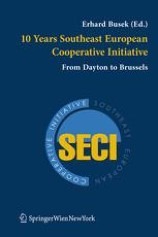
10 Years Southeast European Cooperative Initiative : From Dayton to Brussels
The Southeast European Cooperative Initiative (SECI) was the first international instrument for "peace keeping and peace making". Conceived by the United States with full partnership and participation of the European Union, SECI was a response to the Dayton Agreement. SECI was convinced that sending troops and diplomats did not suffice. It called for a new strategy and approach that would promote economic and social development through regional cooperation. SECI understood that despite their differences, the countries of South East Europe shared many mutual concerns. For the international community, SECI was a prelude to a broader instrument - the Stability Pact for South Eastern Europe, launched in 1999. The approach was a success! This compendium of documents, agreements, analyses and essays gives a glimpse into decision-making processes and results achieved.
