



Page 74
Page 74
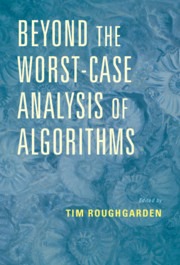
Beyond the Worst-Case Analysis of Algorithms
There are no silver bullets in algorithm design, and no single algorithmic idea is powerful and flexible enough to solve every computational problem. Nor are there silver bullets in algorithm analysis, as the most enlightening method for analyzing an algorithm often depends on the problem and the application. However, typical algorithms courses rely almost entirely on a single analysis framework, that of worst-case analysis, wherein an algorithm is assessed by its worst performance on any input of a given size. The purpose of this book is to popularize several alternatives to worst-case analysis and their most notable algorithmic applications, from clustering to linear programming to neural network training. Forty leading researchers have contributed introductions to different facets of this field, emphasizing the most important models and results, many of which can be taught in lectures to beginning graduate students in theoretical computer science and machine learning.

Beyond global food supply chains : Crisis, disruption, regeneration
Through a set of incisive essays, this incredibly timely book shows how much the COVID-19 pandemic has exposed both vulnerabilities and opportunities - for (racial) capitalism and its discontents alike to intervene in food supply chains. A most welcome publication! This book takes the upheaval of the global COVID-19 pandemic as a springboard from which to interrogate a larger set of structural, environmental and political fault lines running through the global food system. In a context in which disruptions to the production, distribution, and consumption of food are figured as exceptions to the smooth, just-in-time efficiencies of global supply chains, these essays reveal the global food system as one that is inherently disruptive of human lives and flourishing, and of relationships between people, places, and environments. The pandemic thus represents a particular, acute moment of disruption, offering a lens on a deeper, longer set of systemic processes, and shining new light on transformational possibilities.
Behavioral pharmacology of the cholinergic system
The molecular genetics of the cholinergic system including both muscarinic and nicotinic acetylcholine receptors, cholinesterases, acetylcholine synthesis and release have provided significant insights into potential targeting for pharmacological intervention. Cholinergic drugs are being used or evaluated for the treatment of diseases. Thus, this volume aims to broaden our understanding of the current state of cholinergic mechanisms to enable implementation of novel approaches for the development of more effective treatments.
Beginning REALbasic : From novice to professional
REALbasic is an easy-to-learn, powerful, cross-platform programming language, allowing you to write powerful applications that can be distributed across Windows, Mac, and Linux. REALbasic’s success is proven - there are already over 100,000 users, and this number is steadily growing. In a recent promotional effort, 35,000 Visual Basic developers downloaded a free copy of the Windows version of REALbasic, and REAL software has had many requests for decent beginning title on the subject. As far as we know, this is the only up-to-date book planned for the current version, REALbasic 2005, which matches that description. REAL software are enthusiastic about helping us sell the book.
Beginning GIMP : From novice to professional
Beginning GIMP: From Novice to Professional explains how to use the open source image manipulation program, GIMP version 2.4. You'll learn how to install GIMP on Windows, Linux, and MacOS X platforms. Once you've installed the application, you'll learn about the interface and configuration options, and then jump into a quick–and–simple project to familiarize yourself even further. With four–color graphics and screenshots throughout, you'll learn how to prepare camera images for display on web pagesincluding functions like rescaling, cropping, and balancing color. The book also explains with great detail how to utilize layers, paths, and masks. You'll also learn how to draw lines and shapes, use patterns and gradients, and even create your own brushes, patterns, and gradients.
Beginning deep learning with TensorFlow : Work with Keras, MNIST data sets, and advanced neural networks
Stats with an introduction to AI, where you’ll learn the history of neural networks and what sets deep learning apart from other varieties of machine learning. Discovery the variety of deep learning frameworks and set-up a deep learning development environment. Next, you’ll jump into simple classification programs for hand-writing analysis. Once you’ve tackled the basics of deep learning, you move on to TensorFlow 2 specifically. Find out what exactly a Tensor is and how to work with MNIST datasets. Finally, you’ll get into the heavy lifting of programming neural networks and working with a wide variety of neural network types such as GANs and RNNs. Deep Learning is a new area of Machine Learning research widely used in popular applications, such as voice assistant and self-driving cars. Work through the hands-on material in this book and become a TensorFlow programmer! You will: Develop using deep learning algorithms Build deep learning models using TensorFlow 2 Create classification systems and other, practical deep learning applications
Beginning ASP.NET 3.5 in VB 2008 : From novice to professional
The most up–to–date and comprehensive introductory ASP.NET book you'll find on any shelf, Beginning ASP.NET 3.5 in VB 2008 guides you through Microsoft's latest technology for building dynamic web sites. This book will enable you to build dynamic web pages on the fly, and it assumes only the most basic knowledge of Visual Basic 2008.
Beginning ASP.NET 3.5 in C# 2008 : From novice to professional
The most up–to–date and comprehensive introductory ASP.NET book you'll find on any shelf, Beginning ASP.NET 3.5 in C# 2008 guides you through Microsoft's technology for building dynamic web sites. This book will enable you to build dynamic web pages on the fly, and it assumes only the most basic knowledge of C#.
Beginning ASP.NET 2.0 in VB 2005 : From novice to professional
This book includes best practices and comprehensive discussions about key database and XML principles, which are essential for you to become effective with ASP.NET. The book also emphasizes the invaluable coding techniques of object orientation and code behind, which will enable you to build real-world websites immediately rather than just scraping by with simplified coding practices. By the time you've finished this book, you will have mastered the core techniques and possess the necessary knowledge to begin work as a professional ASP.NET developer.
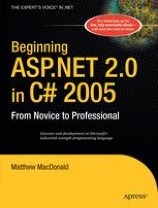
Beginning ASP.NET 2.0 in C# 2005 : From novice to professional
This book provides thorough coverage of ASP.NET, guiding you from beginning to advanced techniques, such as querying databases from within a web page and performance-tuning your site. You'll find tips for best practices and comprehensive discussions of key database and XML principles. The book also emphasizes the invaluable coding techniques of object orientation and code-behind, which will enable you to build real-world websites instead of just scraping by with simplified coding practices. By the time you finish this book, you will have mastered the core techniques essential to professional ASP.NET developers.
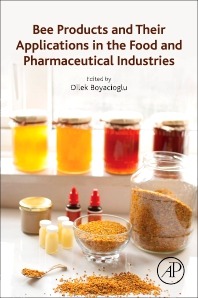
Bee products and their applications in the food and pharmaceutical industries ; 1st ed.
Focuses on the health benefits of selected bee products by looking more closely at their pharmacological potentials and therapeutic applications in coping with various diseases. The book explores some of these products, such as royal jelly, propolis and bee venom, which is highly attractive to the food supplement sector due to the biological actions that are proved by scientific studies. Bee products also attract the cosmetics industry by utilizing those products in various applications such as hair products, toothpaste, sunscreen creams, lip balsams, or facial moisturizing creams. Each chapter focuses on a particular health benefit, providing more compact and detailed information about each activity for a specific interest. The mainframe of the book is based on the medicinal and pharmacological functions of bee products, with the therapeutic applications for each bee product supporting the mechanism of action of their biological functions.

Bee products : Chemical and biological properties
Presents an updated discussion on the chemical composition and biological properties of the main bee products, which until now have been presented separately in different editions This book scoops out studies about bee products most used in marketing and in traditional medicine such as honey, royal jelly, propolis, bee pollen and bee venom Discusses chemical composition and biological function of the different bee products on topics such as nutrition, aging and age-related diseases, cancer, neurodegenerative diseases and pathogen infections Bee products are rich in several essential nutrients and non essential nutrients, as sugars, minerals, proteins, free amino acids, vitamins, enzymes and polyphenols, that seem to be closely related to their biological functions. The effects of these products in nutrition, aging and age-related diseases, cancer, neurodegenerative diseases and pathogen infections are discussed.

Bearing Witness : Ruth Harrison and British Farm Animal Welfare (1920–2000)
This book is the biography of one of Britain’s foremost animal welfare campaigners and of the world of activism, science, and politics she inhabited. In 1964, Ruth Harrison’s bestseller Animal Machines triggered a gear change in modern animal protection by popularising the term ‘factory farming’ alongside a new way of thinking about animal welfare.
Basiswissen pharmakologie = Basic knowledge of pharmacology
Offers a clear and concise overview of all exam-relevant pharmacology content. It guides you through the entire foundational knowledge, from the basics to the most important clinical pictures, in an easily understandable way and aligned with the German National Competency-Based Learning Objectives for Medicine (GK) and National Competency-Based Learning Objectives for Medicine (NKLM). Benefit from the lecturer's many years of experience, who has carefully selected and presented the essential information for you.

Basics of PET Imaging : Physics, Chemistry, and Regulations
This unparalleled text on the basics of PET imaging technology is an ideal resource for technologists and residents preparing for board examinations. the book also serves as a useful reference for practicing nuclear medicine professionals. Chapters are concise but comprehensive and emphasize the fundamentals, including physics, instrumentation and data acquisition, image reconstruction, production of PET radionuclides and radiopharmaceuticals, and regulatory and reimbursement issues.

Basics Masonry Construction - Basics
Masonry construction is usually the top priority in the constructive exercises during the course. The basic principles of dimensions, construction and component joining are developed using simple masonry structures. Topics: Material and dimensions Building physics and load-bearing properties Typical associations Components Execution of masonry
Basic Python for Data Management, Finance, and Marketing : Advance Your Career by Learning the Most Powerful Analytical Tool
Learn how to gather, manipulate, and analyze data with Python. This book is a practical guide to help you get started with Python from ground zero and to the point where you can use coding for everyday tasks. Python is used in all aspects of financial industry, from algo trading, reporting and risk management to building valuations models and predictive machine learning programs. You will: Get started with Python from square one / Extend what's possible on excel with Python / Automate tasks with Python / Analyze data more precisely
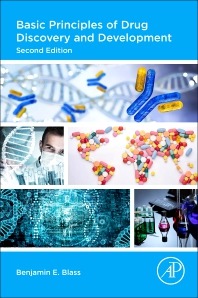
Basic principles of drug discovery and development ; 2nd ed.
Presents the multifaceted process of identifying a new drug in the modern era, which requires a multidisciplinary team approach with input from medicinal chemists, biologists, pharmacologists, drug metabolism experts, toxicologists, clinicians, and a host of experts from numerous additional fields. Enabling technologies such as high throughput screening, structure-based drug design, molecular modeling, pharmaceutical profiling, and translational medicine are critical to the successful development of marketable therapeutics. Given the wide range of disciplines and techniques that are required for cutting edge drug discovery and development, a scientist must master their own fields as well as have a fundamental understanding of their collaborator’s fields.
Basic pharmacokinetics
Introduces basic pharmacokinetic concepts to beginner learners to help them understand the absorption, distribution, metabolism, and excretion of drugs. Accompanying the book is a website with self-instructional tutorials and pharmacokinetic and pharmacokinetic-pharmacodynamic simulations, allowing visualization of concepts for enhanced comprehension. This learning tool received an award from the American Association of Colleges of Pharmacy for innovation in teaching, making it a valuable supplement to this essential text.
Basic knowledge of pharmacology
Concise and up-to-date coverage of the most important drugs Integration of experimental and clinical pharmacology with focus on diseases Discusses the most important drugs (400) in the context of relevant diseases. Summary tables and schemes, MCQ exam questions, case studies and a list of drugs aid memorization of the material before an exam. All chapters are written in the same concise style and use a modern and precise pharmacological nomenclature. After reading of the book, the student will be able to critically assess the proper use of the most important drugs and advise patients properly. The didactic concept of the book has been developed on the author’s own pharmacology courses for which he has received numerous teaching awards. The book takes advantage of the learning spiral, in which material is presented repeatedly from various angles.
