



Page 6
Page 6
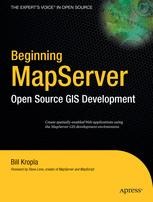
Beginning MapServer : Open Source GIS Development
Beginning MapServer: Open Source GIS Development is the first book of its kind. It offers a comprehensive introduction to MapServer, the development platform for integrating mapping technology into Internet applications. You'll learn how to build and extend dynamic applications using popular languages like PHP, Perl, and Python. After a thorough introduction to installation and configuration, you'll uncover basic MapServer topics and examples. You'll also learn about advanced MapServer features, and how to query and incorporate dynamic data into your application. The book culminates with the creation of an actual mapping application.
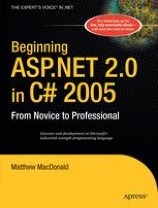
Beginning ASP.NET 2.0 in C# 2005 : From novice to professional
This book provides thorough coverage of ASP.NET, guiding you from beginning to advanced techniques, such as querying databases from within a web page and performance-tuning your site. You'll find tips for best practices and comprehensive discussions of key database and XML principles. The book also emphasizes the invaluable coding techniques of object orientation and code-behind, which will enable you to build real-world websites instead of just scraping by with simplified coding practices. By the time you finish this book, you will have mastered the core techniques essential to professional ASP.NET developers.

Bayesian Networks and Decision Graphs
Probabilistic graphical models and decision graphs are powerful modeling tools for reasoning and decision making under uncertainty. As modeling languages they allow a natural specification of problem domains with inherent uncertainty, and from a computational perspective they support efficient algorithms for automatic construction and query answering. This includes belief updating, finding the most probable explanation for the observed evidence, detecting conflicts in the evidence entered into the network, determining optimal strategies, analyzing for relevance, and performing sensitivity analysis. The book introduces probabilistic graphical models and decision graphs, including Bayesian networks and influence diagrams.It contians two parts. The first part focuses on probabilistic graphical models. Compared with the previous book, the new edition also includes a thorough description of recent extensions to the Bayesian network modeling language, advances in exact and approximate belief updating algorithms, and methods for learning both the structure and the parameters of a Bayesian network. The second part deals with decision graphs, and in addition to the frameworks described in the previous edition, it also introduces Markov decision processes and partially ordered decision problems.
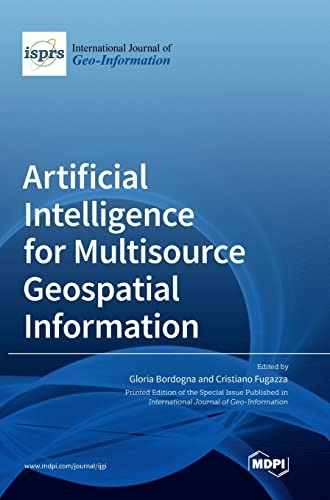
Artificial intelligence for multisource geospatial information
Collects 10 original research contributions published in the Special Issue entitled “Artificial Intelligence for Multisource Geospatial Information” of the ISPRS International Journal of Geo-Information. The focus is on different methods of Geospatial Artificial Intelligence (GeoAI) based on deep learning using different network architectures, clustering, soft computing, and semantic approaches. They are proposed to deal with a variety of Geospatial Big Data (GBD), such as georeferenced texts and photos in social networks, remote sensing images, cartographic maps, multidimensional geo databases, metadata in spatial data infrastructures, and for different tasks, such as for multisource georeferenced text integration and geodata flexible querying, for social sensing by applying sentiment analysis, clustering and geo analysis, for segmentation of roads, clouds and snow, and for detection of small targets and people on the streets.

Algorithmic learning theory ; Vol. 3734 ; 16th international conference, ALT 2005, Singapore, October 8-11, 2005, Proceedings
This volume contains the papers presented at the 16th Annual InternationalConference on Algorithmic Learning Theory (ALT 2005), which was held (Republic of Singapore), 2005. The main objective of theconference is to provide an interdisciplinary forum for the discussion of the the-oretical foundations of machine learning as well as their relevance to practicalapplications. The volume includes 30 technical contributions, which were selected by theprogram committee from 98 submissions.

Algorithmic learning theory ; 18th International conference, ALT 2007, Sendai, Japan, October 1-4, 2007, Proceedings
This volume contains the papers presented at the 18th International Conf- ence on Algorithmic Learning Theory.The main objective of the conference was to provide an interdisciplinary forum for high-quality talks with a strong theore- cal background and scientiبهc interchange in areas such as query models, on-line learning, inductive inference, algorithmic forecasting, boosting, support vector machines, kernel methods, complexity and learning, reinforcement learning, - supervised learning and grammatical inference.

Advances in XML information retrieval and Evaluation ; 4th International workshop of the initiative for the evaluation of XML retrieval, INEX 2005, Dagstuhl Castle, Germany, November 28-30, 2005. Revised and Selected Papers
Content-oriented XML retrieval has been receiving increasing interest due to the widespread use of eXtensible Markup Language (XML), which is becoming a standard document format on the Web, in digital libraries,and publishing. By exploiting the enriched source of syntactic and semantic information that XML markup provides, XML information retrieval (IR) systems aim to implement a more focused retrieval strategy and return document components, so-called XML elements – instead of complete documents – in response to a user query. This focused retrieval approach is of particular bene?t for collections containing long documents or documents covering a wide variety of topics (e.g., books, user manuals, legal documents, etc.), where users’ e?ort to locate relevant content can be reduced by directing them to the most relevant parts of the documents.
Advances in XML information retrieval ; 3rd International workshop of the Initiative for the evaluation of XML retrieval, INEX 2004, Dagstuhl Castle, Germany, December 6-8, 2004
The ultimate goal of many information access systems (e.g., digital libraries, the Web, intranets) is to provide the right content to their end-users. This content is increasingly a mixture of text, multimedia, and metadata, and is formatted according to the adopted –W3C standard for information repositories, the so-called eXtensible Markup L- guage (XML). Whereas many of today’s information access systems still treat do- ments as single large (text) blocks, XML offers the opportunity to exploit the internal structure of documents in order to allow for more precise access thus providing more specific answers to user requests. Providing effective access to XML-based content is therefore a key issue for the success of these systems. The aim of the INEX campaign (Initiative for the Evaluation of XML Retrieval), which was set up at the beginning of 2002, is to establish infrastructures, XML test suites, and appropriate measurements for evaluating the performance of information retrieval systems that aim at giving effective access to XML content. More precisely, the goal of the INEX initiative is to provide means, in the form of a large XML test collection and appropriate scoring methods, for the evaluation of content-oriented XML retrieval systems.

Advances in web-age information management ; Vol. 4016 : 7th International Conference, WAIM 2006, Hong Kong, China, June 17-19, 2006, Proceedings
This book constitutes the refereed proceedings of the 7th International Conference on Web-Age Information Management, WAIM 2006, held in Hong Kong, China in June 2006. The 50 revised full papers presented were carefully reviewed and selected from 290 submissions. The papers are organized in topical sections on, indexing, XML query processing, information retrieval, sensor networks and grid computing, peer-to-peer systems, Web services, Web searching, caching and moving objects, temporal database, clustering, clustering and classification, data mining, data stream processing, XML and semistructured data, data distribution and query processing, and advanced applications.
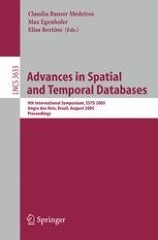
Advances in spatial and temporal databases ; 9th International symposium, SSTD 2005, Angra dos Reis, Brazil, August 22-24, 2005, Proceedings
Constitutes the refereed proceedings of the introduce the papers of the proceedings of the 9th - ternational Symposium on Spatial and Temporal Databases – SSTD 2005. This year’s symposium continues the tradition of being the premier forum for the presentation of research results and experience reports on leading edge issues of spatial and temporal database systems, including data models, systems, applications and theory. ll the needs of novel applications and heterogeneous environments and identify new directions for future research and development. aspects of database systems for managing spatial and temporal data and for supporting their applications. A total of 77 papers were submitted this year from several countries. After a thorough review process, the program committee accepted 24 papers covering a variety of topics, including indexing techniques and query processing, mobile environments and moving objects, and spatial and temporal data streams.
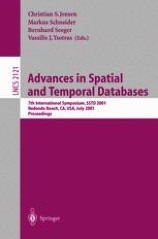
Advances in spatial and temporal databases ; 7th International symposium, SSTD 2001, Redondo Beach, CA, USA, July 12-15, 2001 Proceedings
The Seventh International Symposium on Spatial and Temporal Databases (SSTD 2001), held in Redondo Beach, CA, USA, July 12{15, 2001, brought together leading researchers and developers in the area of spatial, temporal, and spatio-temporal databases to discuss the state of the art in spatial and temporal data management and applications, and to understand the challenges and - search directions in the advancing area of data management for moving objects. The symposium served as a forum for disseminating research in spatial and temporal data management, and for maximizing the interchange of knowledge among researchers from the established spatial and temporal database com- nities. The exchange of research ideas and results not only contributes to the academic arena, but also bene ts the user and commercial communities.
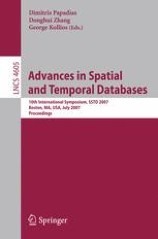
Advances in spatial and temporal databases ; 10th International symposium, SSTD 2007, Boston, MA, USA, July 16.-18, 2007, Proceedings
The book is classified in numerous categories, each corresponding to a conference session. These include continuous monitoring; indexing and query processing; and mining.

Advances in natural language processing ; 5th International Conference ; 1TAL 2006 Turku, Finland, August 23-25, 2006 Proceedings
This book constitutes the refereed proceedings of the 5th International Conference on Natural Language Processing, FinTAL 2006, held in Turku, Finland in August 2006. The book presents 72 revised full papers together with 1 invited talk and the extended abstracts of 2 invited keynote addresses. The papers address all current issues in computational linguistics and monolingual and multilingual intelligent language processing - theory, methods and applications.
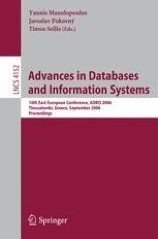
Advances in databases and information Systems ; Vol. 4152 : 10th East European Conference, ADBIS 2006, Thessaloniki, Greece, September 3-7, 2006, Proceedings
This book constitutes the refereed proceedings of the 10th East European Conference on Advances in Databases and Information Systems, ADBIS 2006, held in Thessaloniki, Greece, in September 2006. The 29 high-quality papers were selected in a rigorous reviewing process out of 126 submissions. The papers address a wide range of hot research issues and are organized in topical sections on: XML databases and semantic web, materialized views, database modelling, web information systems and middleware, query processing and indexing, data mining and clustering, and modelling and design issues.

Advances in databases and information systems ; 25th European Conference, ADBIS 2021, Tartu, Estonia, August 24–26, 2021, Proceedings
This book constitutes the proceedings of the 25th European Conference on Advances in Databases and Information Systems, ADBIS 2021, held in Tartu, Estonia, in August 2021. The 18 full papers presented together with 3 keynotes were carefully reviewed and selected from 70 submissions. The selected papers span a wide spectrum of topics in databases and related technologies, tackling challenging problems and presenting inventive and efficient solutions. They are organized in 5 sessions: patterns and events, social media and text mining, indexes, queries and constraints, high-dimensional data and data streams, and data integration.

Advances in Databases and Information Systems ; 12th East European Conference, ADBIS 2008, Pori, Finland, September 5-9, 2008. Proceedings
This book constitutes the refereed proceedings of the 12th East European Conference on Advances in Databases and Information Systems, ADBIS 2008, held in Pori, Finland, on September 5-9, 2008.

Advances in databases : Concepts, systems and applications ; 12th International Conference on database systems for advanced applications, DASFAA 2007, Bangkok, Thailand, April 9-12, 2007 Proceedings
Coverage includes query language and query optimization, data mining and knowledge discovery, P2P and grid-based data management, XML databases, database modeling and information retrieval, Web and information retrieval, database applications and security.

Advances in conceptual modeling : Theory and practice ; ER 2006 Workshops BP-UML, CoMoGIS, COSS, ECDM, OIS, QoIS, SemWAT, Tucson, AZ, USA, November 6-9, 2006, Proceedings
Constitutes the refereed joint proceedings of seven international workshops held in conjunction with the 25th International Conference on Conceptual Modeling, ER 2006, in Tucson, AZ, USA in November 2006. The 39 revised full papers presented together with the outlines of three tutorials were carefully reviewed and selected from 95 submissions.
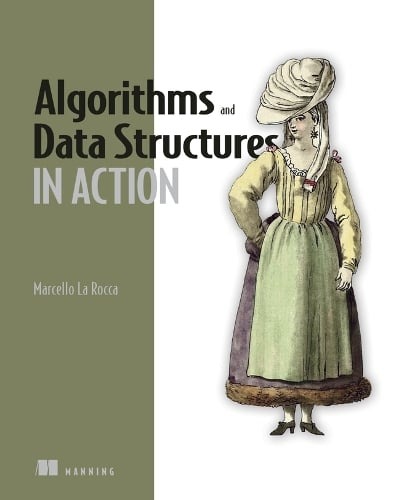
Advanced Algorithms and Data Structures
introduces a collection of algorithms for complex programming challenges in data analysis, machine learning, and graph computing. You’ll discover cutting-edge approaches to a variety of tricky scenarios. You’ll even learn to design your own data structures for projects that require a custom solution. What's inside Build on basic data structures you already know Profile your algorithms to speed up application Store and query strings efficiently Distribute clustering algorithms with MapReduce Solve logistics problems using graphs and optimization algorithms
Accelerated SQL Server 2008
The expert tuition and approach to rapid learning in Accelerated SQL Server 2008, one of the first SQL Server 2008 books available, will enable SQL Server and other database professionals to make the leap to the 2008 release of Microsoft's flagship database management system quickly. Take full advantage of the features of SQL Server 2008, know what tools are available, and quickly realize the power and ease of use that SQL Server 2008 has to offer.
