



Page 6
Page 6
Network-Centric Service-Oriented Enterprise
Network-Centric Service-Oriented Enterprise (NSCOE) is seen as heralding the next generation of mainstream Enterprise-business information collaboration solution that can enforce information and decision superiority in the decentralized, loosely-coupled, and highly interoperable service environments. Network-Centric Service Oriented Enterprise establishes a system-of-systems (SoS) view of information technologies, offering a synergistic combination of data and information-processing capacity upon an innovative networked-management framework.

Network Security, Firewalls, and VPNs ; 3rd ed.
Provides a unique, in-depth look at the major business challenges and threats that are introduced when an organization’s network is connected to the public Internet. Written by industry experts, this book provides a comprehensive explanation of network security basics, including how hackers access online networks and the use of Firewalls and VPNs to provide security countermeasures. Using examples and exercises, this book incorporates hands-on activities to prepare the reader to disarm threats and prepare for emerging technologies and future attacks.

Network control and engineering for QoS, security and mobility, V ; IFIP 19th World Computer Congress,TC-6, 5th IFIP International conference on network control and engineering for QoS, security, and mobility, August 20-25, 2006, Santiago, Chile
International Federation for Information Processing The IFIP series publishes state-of-the-art results in the sciences and technologies of information and communication. The scope of the series includes: foundations of computer science; software theory and practice; education; computer applications in technology; communication systems; systems modeling and optimization; information systems; computers and society; computer systems technology; security and protection in information processing systems; artificial intelligence; and human-computer interaction. Proceedings and post-proceedings of referred international conferences in computer science and interdisciplinary fields are featured. These results often precede journal publication and represent the most current research. The principal aim of the IFIP series is to encourage education and the dissemination and exchange of information about all aspects of computing.
Network Control and Engineering for QoS, Security and Mobility, IV; Fourth IFIP International Conference on Network Control and Engineering for QoS, Security and Mobility, Lannion, France, November 14-18, 2005
The IFIP series publishes state-of-the-art results in the sciences and technologies of information and communication. The principal aim of the IFIP series is to encourage education and the dissemination and exchange of information about all aspects of computing.

Network Classification For Traffic Management : Anomaly detection, feature selection, clustering and classification
Investigates network traffic classification solutions by proposing transport-layer methods to achieve better run and operated enterprise-scale networks. With the massive increase of data and traffic on the Internet within the 5G, IoT and smart cities frameworks, current network classification and analysis techniques are falling short. Novel approaches using machine learning algorithms are needed to cope with and manage real-world network traffic, including supervised, semi-supervised, and unsupervised classification techniques. Accurate and effective classification of network traffic will lead to better quality of service and more secure and manageable networks. Investigates network traffic classification solutions by proposing transport-layer methods to achieve better run and operated enterprise-scale networks. The authors explore novel methods for enhancing network statistics at the transport layer, helping to identify optimal feature selection through a global optimization approach and providing automatic labelling for raw traffic through a SemTra framework to maintain provable privacy on information disclosure properties.
Network and Parallel Computing ; IFIP International Conference, NPC 2008, Shanghai, China, October 18-20, 2008. Proceedings
This book constitutes the refereed proceedings of the IFIP International Conference on Network and Parallel Computing, NPC 2008, held in Shanghai, China in October 2008.The 32 revised full papers presented were carefully selected from over 140 submissions. The papers are organized in topical sections on network technologies; network applications; network and parallel architectures; parallel and distributed software.
Network and Parallel Computing ; IFIP International Conference, NPC 2007, Dalian, China, September 18-21, 2007, Proceedings
The goal of NPC is to establish an international forum for researchers and practitioners to present their - cellent ideas and experiences in all system fields of network and parallel computing. The main focus of NPC 2007 was on the most critical areas of network and parallel computing: network applications, network technologies, network and parallel arc- tectures, and parallel and distributed software.

Neodymium Based Ziegler Catalysts - Fundamental Chemistry
In this volume we try to review the available literature by two independentapproaches to Nd and Ln-catalyzed diene polymerizations. In the first part ofthe volume, which is entitled “Neodymium-Based Ziegler/Natta Catalysts andtheir Application in Diene Polymerization”, a polymer chemist’s view is givenwith strong emphasis on Nd-based catalyst systems. Also technological andindustrial aspects of Nd-catalyzed diene polymerizations are addressed. In thesecond part of the volume, which is entitled “Rare-Earth Metals and AluminumGetting Close in Ziegler-type Organometallics”, a more organometallic per-spective is given and Ln-based catalyst systems are addressed. By the synopsisof these different perspectives, the reader will comprehend the complexity ofLn-based Ziegler catalyst systems and their application to the polymerizationof dienes.

Nb3Sn Accelerator Magnets : Designs, Technologies and Performance
This book is written by world-recognized experts in the fields of applied superconductivity and superconducting accelerator magnet technologies. It provides a contemporary review and assessment of the experience in research and development of high-field accelerator dipole magnets based on Nb3Sn superconductor over the past five decades. The reader attains clear insight into the development and the main properties of Nb3Sn composite superconducting wires and Rutherford cables, and details of accelerator dipole designs, technologies and performance. Special attention is given to innovative features of the developed Nb3Sn magnets. The book concludes with a discussion of accelerator magnet needs for future circular colliders.

Navigational Surgery of the Facial Skeleton and Skull Base
Computer-assisted techniques in the surgery of the facial skeleton including the skull base are depicted for the very first time in this atlas of navigational surgery. Experienced surgeons as well as trainees will benefit from the detailed and well-illustrated information on the use of computer technology in clinical routine, accompanied by the experimental basis of intraoperative accuracy.The interdisciplinary approach brings together maxillofacial surgeons, plastic surgeons, ENT surgeons, and neurosurgeons. New methods of non-invasive referencing and the use of virtual models in the field of oral and cranio-maxillofacial surgery are demonstrated. Clinical cases illustrate the practical use of this new technique.

Navigation and MIS in Orthopaedic Surgery
This textbook offers new insights into the use of computer assisted surgery and minimally invasive surgery in orthopaedic surgery. A comprehensive presentation of scientific work and clinical experience is included encompassing areas of spine, trauma, sports and reconstructive surgery. We have added sections that discuss minimally invasive surgery, as we believe CAS will be an enabling technology for these more challenging approaches by providing a virtual digital "surgical exposure". We have explored areas of new endeavor that may not have current applications.

Navigating Numeracies : Home/School Numeracy Practices
The book aims to further understanding of why some pupils have low achievement in numeracy in the school context. The authors aim to achieve this by a relatively original view that focuses on numeracy as a social practice. They report on their investigations into the meanings and uses of numeracy in school and home and community contexts, using ethnographic-style approaches, including formal and informal interviews and observations. The book will be useful for policy, practice and further research into the teaching and learning of mathematics in schools. It will therefore be of interest to policy makers, teachers and practitioners, academics and practitioners in teacher education, education researchers, and parents and community leaders.

Navigating digital communication and challenges for organizations
Presents a range of methods, strategies, and viewpoints on digital communication and offers an in-depth analysis of the wide range of organisational and strategic communication topics, related concepts, cross-cultural perspectives, and principles to develop interdisciplinary approaches to digital and organisational communication.

Natural Products : Drug Discovery and Therapeutic Medicine
Although the natural product drug discovery programs of the large drug companies are now equaled by programs for the high throughput screening of synthetic compounds generated through combinatorial chemistry, natural compounds still hold great promise to overcome such problems as antibiotic resistance, the emergence of new diseases, the failure to conquer old diseases, and the toxicity of some contemporary medical products. In Natural Products: Drug Discovery and Therapeutic Medicine, a panel of recognized experts and leaders in the field discuss the past successes of natural products as medicines and review future possibilities arising from both conventional and new technologies. High-performance liquid chromatography profiling, combinatorial synthesis, genomics, proteomics, DNA shuffling, bioinformatics, and genetic manipulation all now make it possible to rapidly evaluate the activities of extracts as well as purified components derived from microbes, plants, and marine organisms. The authors apply these methods to new natural product drug discovery, to accessing microbial diversity, to investigating specific groups of products (Chinese herbal drugs, antitumor drugs from microbes and plants, terpenoids, and arsenic compounds), and to exploiting specific sources (the sea, rainforest, and endophytes). These new opportunities show how research and development trends in the pharmaceutical industry can advance to include both synthetic compounds and natural products, and how this paradigm shift can be more productive and efficacious.

Natural product experiments in drug discovery
Explores a wide range of evidence-based complementary medicine and various bio-analytical techniques used to define botanical products. Collecting recent work and current developments in the field of contemporary phytomedicine as well as their future possibilities in human health care, the book includes unique contributions in the form of chapters on phytomedicine and screening biological activities explained with diverse hyphenated techniques, as well as issues related to herbal medications, such as efficacy, adulteration, safety, toxicity, regulations, and drug delivery. Written for the Springer Protocols Handbooks series, chapters feature advice from experts on how to best conduct future experiments. Extensive and practical, Natural Product Experiments in Drug Discovery serves as an ideal reference for students, professors, and researchers in universities, R&D institutes, pharmaceutical and herbal enterprises, and health organizations.

Natural Language Processing and Information Systems ; Vol. 3513 ; 10th International Conference on Applications of Natural Language to Information Systems, NLDB 2005, Alicante, Spain, June 15-17, Proceedings
The development and convergence of computing, telecommunications and information systems has already led to a revolution in the way that we work, communicate with each other, buy goods and use services, and even in the way that we entertain and educate ourselves.The revolution continues, and one of its results is that large volumes of information will increasingly be held in a form which is more natural for users than the data presentation formats typical of computer systems of the past. Natural language processing (NLP) is crucial in solving these problems, and language technologies will make an indispensable contribution to the success of information systems. We hope that NLDB 2005 was a modest contribution to this goal. NLDB 2005 contributed to advancing the goals and the high international standing of these conferences, largely due to its Program Committee, composed of renowned researchers in the field of natural language processing and inf- mation system engineering. Papers were reviewed by three reviewers from the Program Committee. This clearly contributed to the significant number of - pers submitted (95). Twenty-nine were accepted as regular papers, while 18 were accepted as short papers.

Natural Disasters as Interactive Components of Global-Ecodynamics
This book opens a new approach to the study of global environmental changes having unfavourable character for mankind and other living systems. The main advantage of the book consists in the accumulation of knowledge from different sciences to parametrize the global ecodynamic process. Natural catastrophes are considered as an interactive element of global natural dynamics which are described by means of simulation models of global nature/society. The realization of this approach allows the integration within a complex structure of all international and national means of environmental monitoring and provides a tool for objective evaluation of the environmental quality. The main purpose of this book is to develop a universal information technology to estimate the state of environmental subsystems functioning under various climatic and anthropogenic conditions.

Nato And Terrorism : On Scene : New Challenges for First Responders and Civil Protection
This book provides information about how leading agencies across the NATO membership are preparing to confront and respond to terrorists deploying Weapons of Mass Destruction (WMD), Weapons of Mass Killing (WMK) and Weapons of Mass Disruption (WMDi). Based on contributions by experts from NATO member states, Israel and the Russian Federation, this book offers information on fourth generation warfare as a new challenge to first responders. It also provides a variety of insights into methods for preparing for and responding to WMD-, WMK-, and WMDi-events, using new technologies and strategies. Furthermore, the book offers solution for restoring the community to functioning after such a major terror attack. Topics include preparing, planning, operations, equipment, training and unique applications of existing technologies for countering terrorist attacks against cities and their infrastructure.

National Systems of Innovation in Comparison : Structure and Performance Indicators for Knowledge Societies
The book documents major elements of the joint work of eight leading German institutes, elaborated in the context of a regular annual report on Germany's technological performance. It provides much more than the pure compilation of quantitative indicators for international benchmarking, but gives support to an appropriate interpretation of the referring results and suggests relevant conclusions for innovation policy. A special focus is on Germany; so the book also aims at non-German readers interested in specific features of the German innovation system.
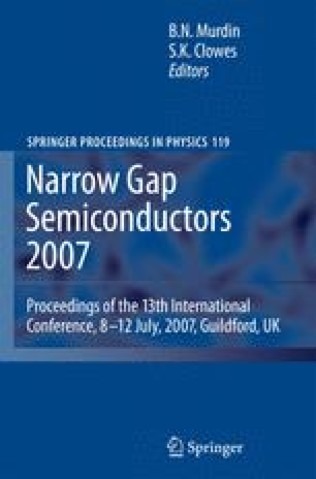
Narrow Gap Semiconductors 2007 ; Proceedings of the 13th International Conference, 8-12 July, 2007, Guildford, UK
Narrow gap semiconductors have provided an exciting field of research and show a number of extreme physical and material characteristics. They are the established material systems for infrared detectors and emitters, and with new developments in the technology these materials are emerging as a viable route to high speed, low power electronics. New kinds of narrow gap semiconductor, such as graphene and other composite nanocrystals, are also providing renewed interest in the underlying physics.
