



Page 5
Page 5

Broadband in Europe: How Brussels Can Wire the Information Society
Broadband is a key enabler of the information society, increasing productivity and competitiveness across all sectors of the economy. Unlike traditional n- rowband connections, broadband provides high speed, always-on connections to the Internet and supports innovative content and services. Direct consumer welfare gains from mass-market adoption of broadband across the EU could easily reach 50 billion euros or more per annum. This is quite apart from the more profound societal shifts that ubiquitous broadband could bring. It may allow the individual to distribute content and ideas independent of traditional media and bring together communities of interest without regard to borders. Public policy for broadband will have a big impact on whether and how quickly these benefits are realised. Getting policy right could bring large benefits for consumers.

Asylum Determination in Europe : Ethnographic Perspectives
The book includes a legal overview of European asylum determination procedures, followed by sections on the diverse actors involved, the means by which they communicate, and the ways in which they make life and death decisions on a daily basis. It offers a contextually rich account that moves beyond doctrinal law to uncover the gaps and variances between formal policy and legislation, and law as actually practiced.

Asian economy and finance : A post-crisis perspective
Topicality of Asian economy has refused to fade for almost four decades; if anything it has been levitating. The Asian economy has changed markedly since the economic and financial crisis of 1997-1998 and is continuing to evolve. As a scholarly subject matter, Asian economy has not stopped attracting academicians, policy mandarins, decision makers in the arena of business and students of Asian economy. The Asian crisis was a cataclysmic event for the region and brought to the surface several systemic limitations, like those in the financial sector, corporate governance, regulatory oversight, legal framework, and exchange rate management. Managers of Asian economy need to get to the bottom of these acutely problematical systemic issues. Additionally, Asian economies need to change with the demands of time and devise their post-crisis development strategy. Asia’s growth model, that served it so well for four decades, is overdue for renewal so that it can re-strengthen its bonds with the ever-evolving regional and global economic reality. The old growth model is likely to be less relevant and effective in the post-crisis future of the Asian economies. It is sure to run into the wall of diminishing returns.

Abuse of Dominant Position : New Interpretation, New Enforcement Mechanisms?
As part of its review of competition law that started in the late 1990s, the European Commission proposes to revise its interpretation and application of the Treaty’s prohibition of abuses of dominant positions. Also, it has instigated a debate about the promotion of private enforcement of EC competition law. The chapters in this volume critically appraise the Commission’s proposals, including the most recent ones. The authors also highlight the repercussions of the proposed ‘more economic approach’ to abuses of dominant positions on private litigants’ opportunities to bring damages actions in national courts for such abuses.

A practical guide on behaviour change support for self-managing chronic disease
Developed under the auspices of the Train4Health project, funded by the Erasmus+ program of the European Union, the book contains six chapters written by international contributors from different disciplines. Chapter one introduces the competencies necessary for delivering effective behavior change support, based on an established program of work, and related learning outcomes. The four following chapters describe how these competencies can be acquired, focusing on concepts and theories, assessing self-management behaviors, implementing change strategies and person-centered communication, using a practical approach.

A new deal for an effective European research policy : The design and impacts of the 7th Framework programme
It underlines an important truth: that science has always advanced most rapidly when it is a collective endeavour, with a strong circulation of knowledge.This book will show how the new Framework Programme was put together and explain why it took the shape it did. It will also set out its potential impacts and the conditions necessary for it to be a success.

50 Years of EU Economic Dynamics : Integration, Financial Markets and Innovations
On the occasion of the 50th anniversary of the European Union experts present their analyses of historical developments and new economic challenges for the EU. After a reflection on historical dynamics, the contributors point out the dramatic economic shifts between Europe, Asia and the US. Representatives from major central banks (including the ECB), other leading banks, and academia analyze the dynamics of the Eurozone and financial market integration in the context of globalization and economic growth. Furthermore, the authors discuss the challenges of information and communication technologies by means of various country analyses. Moreover, the Schumpeterian prospects for Europe and the Lisbon Agenda, the long-term challenges of EU pension reforms, emission trading systems in the EU, and options for a new EU constitution are highlighted. At the bottom line of this EU analysis are major implications for investors, managers, policy-makers and the public at large in both the EU and the global economy.
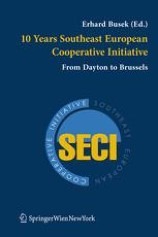
10 Years Southeast European Cooperative Initiative : From Dayton to Brussels
The Southeast European Cooperative Initiative (SECI) was the first international instrument for "peace keeping and peace making". Conceived by the United States with full partnership and participation of the European Union, SECI was a response to the Dayton Agreement. SECI was convinced that sending troops and diplomats did not suffice. It called for a new strategy and approach that would promote economic and social development through regional cooperation. SECI understood that despite their differences, the countries of South East Europe shared many mutual concerns. For the international community, SECI was a prelude to a broader instrument - the Stability Pact for South Eastern Europe, launched in 1999. The approach was a success! This compendium of documents, agreements, analyses and essays gives a glimpse into decision-making processes and results achieved.
