



Page 4
Page 4
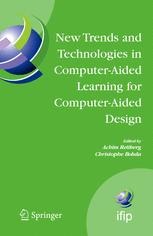
New Trends and Technologies in Computer-Aided Learning for Computer-Aided Design ; IFIP International Working Conference: EduTech 2005, Perth, Australia, October 20-21, 2005
Computation and communication technologies underpin work and development in many different areas. Among them, Computer-Aided Design of electronic systems and E-Learning technologies are two areas which are different but share many concerns. The design of CAD and E-Learning systems already touches on a number of parallels, such as system interoperability, user interfaces, standardization, EML-based formats, reusability aspects (of content or designs), and intellectual property rights. Furthermore, the teaching of Design Automation tools and methods is particularly amenable to a distant or blended learning setting, and implies the interconnection of typical CAD tools, such as simulators or synthesis tools, with e-learning tools. There are many other aspects in which synergy can be found when using E-Learning technology for teaching and learning technology. This workshop, sponsored by IFIP WG 10.5 Design and Engineering of Electronic Systems in cooperation with IFIP WG 3.6 Distance Education, will explore the interrelationship between these two subjects, where Computer-Aided Design meets Computer-Aided Learning. New Trends and Technologies in Computer-Aided Learning for Computer-Aided Design documents recent approaches and results presented at the EduTech 2005 Workshop, which was held in October 2005 in Perth, Australia and sponsored by the International Federation for Information Processing (IFIP). The topics chosen for this working conference are very timely: learning environments, tools and applications for education, education technologies and trends, and teaching in the hardware design area.

New Technologies, Mobility and Security
NTMS’2007 is the first IFIP International Conference on New Technologies, Mobility and Security that was held from May 2 to May 4, 2007 in Paris, France. NTMS'2007 aims at fostering advances in the areas of New Technologies, Wireless Networks, Mobile Computing, Ad hoc and Ambient Networks, QoS, Network Security and E-commerce, to mention a few, and provides a dynamic forum for researchers, students and professionals to present their state-of-the-art research and development in these interesting areas. The event was combined with tutorial sessions and workshops. Tutorials preceded the main program, aiming at the dissemination of mature knowledge and technology advances in the field. One Workshop immediately followed the main conference, offering the opportunity for a more focused exchange of ideas and presentation of on-going research relevant to selected topics.

New Results in Numerical and Experimental Fluid Mechanics VI ; Contributions to the 15th STAB/DGLR Symposium Darmstadt, Germany, 2006
The volume gives a broad overview over the ongoing work in this field in Germany, with the topics being high-aspect ratio wings, low aspect-ratio wings, bluff bodies, laminar flow control and transition, active flow control, hypersonic flows, aeroelasticity, aeroacoustics, mathematical fundamentals/ numerical simulation, physical fundamentals, and facilities.

New Results in Numerical and Experimental Fluid Mechanics V ; Contributions to the 14th STAB/DGLR Symposium Bremen, Germany 2004
This volume contains the contributions to the 14. Symposium of the STAB (German Aerospace Aerodynamics Association). The volume gives a broad overview over the ongoing work in this field in Germany, with the topics being high-aspect ratio wings, low aspect-ratio wings, bluff bodies, laminar flow control and transition, active flow control, hypersonic flows, aeroelasticity, aeroacoustics, mathematical fundamentals/ numerical simulation, physical fundamentals, and facilities.

New Narratives in Eighteenth-Century Chemistry : Contributions from the 1st Francis Bacon Workshop, 21-23 April 2005, California Institute of Technology, Pasadena, California
The eighteenth century has long been considered critical for the development of modern chemistry, yet many crucial features of the period remain largely unknown or unexplored, for general accounts--often built around Lavoisier--have remained quite selective. This volume presents new approaches and topics in an attempt to build a richer, fuller, more complex view of chemical work during the period. Themes include "late-phase" alchemy, professionalization, chemical education, and the links and relations between chemistry and pharmacy, medicine, agriculture, and geology.

New Introduction to Multiple Time Series Analysis
This reference work and graduate level textbook considers a wide range of models and methods for analyzing and forecasting multiple time series. The models covered include vector autoregressive, cointegrated,vector autoregressive moving average, multivariate ARCH and periodic processes as well as dynamic simultaneous equations and state space models. Least squares, maximum likelihood and Bayesian methods are considered for estimating these models. Different procedures for model selection and model specification are treated and a wide range of tests and criteria for model checking are introduced. Causality analysis, impulse response analysis and innovation accounting are presented as tools for structural analysis. The book is accessible to graduate students in business and economics. In addition, multiple time series courses in other fields such as statistics and engineering may be based on it. Applied researchers involved in analyzing multiple time series may benefit from the book as it provides the background and tools for their tasks. It bridges the gap to the difficult technical literature on the topic.

New frontiers in artificial intelligence ; JSAI-isAI International Workshops, JURISIN, AI-Biz, LENLS, Kansei-AI, Yokohama, Japan, November 10–12, 2019, Revised Selected Papers
This book constitutes extended, revised and selected papers from the 11th International Symposium of Artificial Intelligence supported by the Japanese Society for Artificial Intelligence, JSAI-isAI 2019. It was held in November 2019 in Yokohama, Japan. The 26 papers were carefully selected from 46 submissions and deal with topics of AI research and are organized into 4 sections, according to the 4 workshops: JURISIN 2019, AI-Biz 2019, LENLS 16, and Kansei-AI 2019.

New Frontiers in Applied Artificial Intelligence ; 21st International Conference on Industrial, Engineering and Other Applications of Applied Intelligent Systems, IEA/AIE 2008 Wrocław, Poland, June 18-20, 2008 Proceedings
The 75 revised full papers presented were carefully reviewed and selected from 302 submissions. The papers are organized in topical sections on computer vision, fuzzy system applications, robot and manufacturing, data mining and KDS, neural networks, machine learning, natural language processing, internet application and education, heuristic search, application systems, agent-based system, evolutionary and genetic algorithms, knowledge management, and other applications. The book concludes with 15 contributions from the following special sessions: knowledge driven manufacturing systems, joint session on adaptive networked systems and fuzzy knowledge bases, and software agents and multi-agent systems.

New Frontiers in Angiogenesis
New Frontiers in Angiogenesis starts with a comprehensive overview of the field and continues with topics that have been minimally explored. The topics deal with dynamics of vasculogenesis using imaging techniques, bone marrow-derived endothelial cell precursors as potential therapeutic tools, regulation of post-angiogenic vessel regression, vascular mimicry, design and construction of artificial vessels, bioengineering of angiogenesis, and lymphangiogenesis recapitulating angiogenesis in health and disease states. Each chapter is written by leading experts of the subjects. It is hoped that this volume will challenge all of us interested in the field of angiogenesis and cardiovascular biology, in particular those in academia and industries, to think "outside the box" and explore angiogenesis from a fresh angle. It is hoped that New Frontiers in Angiogenesis is thought provoking and serve as a road map for discovering new findings to help betterments of human health.

New Directions in Cognitive Information Retrieval
New Directions in Cognitive Information Retrieval presents an exciting new direction for research into cognitive oriented information retrieval (IR) research, a direction based on an analysis of the user’s problem situation and cognitive behavior when using the IR system. This contrasts with the current dominant IR research paradigm which concentrates on improving IR system matching performance. The chapters describe the leading edge concepts and models of cognitive IR that explore the nexus between human cognition, information and the social conditions that drive humans to seek information using IR systems. Chapter topics include: Polyrepresentation, cognitive overlap and the boomerang effect, Multitasking while conducting the search, Knowledge Diagram Visualizations of the topic space to facilitate user assimilation of information, Task, relevance, selection state, knowledge need and knowledge behavior, search training built into the search, children’s collaboration for school projects, and other cognitive perspectives on IR concepts and issues.

New Computational Paradigms : Changing Conceptions of What is Computable
This book examines new developments in the theory and practice of computation from a mathematical perspective, with topics ranging from classical computability to complexity, from biocomputing to quantum computing. The book opens with an introduction by Andrew Hodges, the Turing biographer, who analyzes the pioneering work that anticipated recent developments concerning computation’s allegedly new paradigms. The remaining material covers traditional topics in computability theory such as relative computability, theory of numberings, and domain theory, in addition to topics on the relationships between proof theory, computability, and complexity theory.

New Challenges in Superconductivity : Experimental Advances and Emerging Theories ; Proceedings of the NATO Advanced Research Workshop, held in Miami, Florida, 11-14 January 2004
This volume contains the proceedings of the 2004 University of Miami Workshop on Unconventional Superconductivity. The workshop was the fourth in a series of successful meetings on High-T Superconductivity and C related topics, which took place at the James L. Knight Physics Building on the University of Miami campus in Coral Gables, Florida, in January 1991, 1995, 1999, and 2004. The workshop consisted of two consecutive events: 1. NATO Advanced Research Workshop (ARW) on New Challenges in Superconductivity: Experimental Advances and Emerging Theories, held on January 11-14, 2004; 2. Symposium on Emerging Mechanisms for High Temperature Superconductivity (SEMHTS), held on January 15-16, 2004.

New Aspects in Phosphorus Chemistry V
The use of polyphosphazenes as fluoroelastomers, flame retardants and self-extinguishing macromolecules, polymeric ionic conductors, biomaterials, and photosensitive polymeric compounds is outlined. This volume,as well as the four precedent volumes,describes only in part the huge number of original papers on phosphorus-related topics. Some further volumes will be necessary in the future to cover all aspects of this chemistry in perpetual rebirth.

New and Evolving Infections of the 21st Century
This new volume of the Emerging Infectious Diseases of the 21st Century Series, has complied a collection of chapters by leading authorities of the world on emerging & evolving infections that is a must read for anyone interested in this topic. The chapters by reknown experts have provided a wealth of up-date information, such as clinical spectrum of disease, epidemiology, pathogenesis, diagnosis, management, prevention and future research.

New Algorithms for Macromolecular Simulation
Molecular simulation is a widely used tool in biology, chemistry, physics and engineering. This book contains a collection of articles by leading researchers who are developing new methods for molecular modelling and simulation. Topics addressed here include: multiscale formulations for biomolecular modelling, such as quantum-classical methods and advanced solvation techniques; protein folding methods and schemes for sampling complex landscapes; membrane simulations; free energy calculation; and techniques for improving ergodicity. The book is meant to be useful for practitioners in the simulation community and for those new to molecular simulation who require a broad introduction to the state of the art.

Neurosurgery : Principles and Practice
This book provides coverage of a broad range of topics in the ?eld of neurosurgery, 5 for residents and registrars in training and for recent graduates of training programs. 6 As neurosurgical training incorporates expertise from centers worldwide, there is a 7 need to have input from specialists in neurosurgery from various countries. This text 8 is a compilation by expert authors in the USA and the UK to provide information on 9 the basic knowledge and clinical management required for optimal care of neuro- 2011 surgical patients. 1 The text is an up-to-date synopsis of the ?eld of neurosurgery from American and 2 British perspectives, which covers the most common clinical conditions encountered 3 by neurosurgeons. The chapters are organized under broad topics, including inves- 4 tigative studies, perioperative care, the role of newer techniques and the management 5 of tumors, vascular and traumatic lesions. Additional topics are then covered, includ- 6 ing pediatrics, spine and peripheral nerve lesions, as well as functional neurosurgery 7 and infections. We anticipate that trainees will ?nd this information useful for certi?- 8 cation examinations and recent graduates of neurosurgical training programs can 9 utilize this text as an update of the most important neurosurgical topics.

Neuroprotection : Method and protocols
Contains cutting-edge molecular biology methods on neuroprotective mechanisms and specific preclinical models of the CNS injury, iseases and planning translation. Chapters guide readers through neuropathology, neuroprotection, Alzheimer’s disease, amyotrophic lateral sclerosis, ALS, Huntington’s disease , multiple sclerosis, Parkinson’s disease, spinal cord injury, traumatic brain injury, and ischemic brain injury. Written in the highly successful Methods in Molecular Biology series format, chapters include introductions to their respective topics, lists of the necessary materials and reagents, step-by-step, readily reproducible laboratory protocols, and tips on troubleshooting and avoiding known pitfalls.

Neuronal cell death : Methods and protocols
Covers comprehensive methods on ways to assess structural and ultrastructural changes in the mitochondria, cytoskeleton, and microglia using state-of-the-art microscopy techniques including super-resolution imaging, electron microscopy, and ultra-high field MRI. The chapters in this book cover topics such as analysis of neurodegeneration in the post-mortem characterization of preclinical animal models, in vivo modeling in cell death in different model systems and brain organoids, single cell clonal analysis using Mosaic Analysis with Double Markers in genetic mouse models, and genome and proteomic methods for analysis of mRNA dynamics and quantitation of targeted peptides.

Neurology Oral Boards Review : A Concise and Systematic Approach to Clinical Practice
Rapid recall of vast amounts of factual material is the key to success in both the Neurology Oral Board examination and in everyday patient care. In Neurology Oral Boards Review: A Concise and Systematic Approach to Clinical Practice, Eroboghene E. Ubogu offers a comprehensive review of relevant topics and examination strategies needed to pass the American Board of Psychiatry and Neurology (ABPN) Part II (Oral) exam, complete with up-to-date, evidence-based guidelines on diagnosis and management in clinical neurology. The author has written the book specifically to satisfy the requirements of the ABPN, with clinical case vignettes designed to allow the examinee to localize the plausible disease process, to indicate which investigations may help in establishing a diagnosis, to deduce treatment plans, and to make a prognosis, including patient and family counseling. The emergency cases test the ability to think critically when faced with a neurological emergency, putting a premium on resuscitation, patient safety, and rapid high-yield investigations. The general neurology cases reflect the breadth of disorders experienced in hospital and outpatient settings. The author also provides a detailed description of the oral ABPN examination and suggests a study regimen that takes into account the difficulties of allotting time to prepare while in post-residency training or practice.

Neurodevelopmental Disorders
The book comprises a number of topics related to psychosocial and motor development and is exemplary with regard to its comprehensiveness, as reviews of the topics presented are generally not available in a single publication. It starts with a timely and critical discussion of the genetics of attention deficit hyperactivity disorder by Dr. Buitelaar in which prospects and challenges of this approach are outlined. The next chapter by Drs. Nicolson and Fawcett deals with dyslexia and its relationship to cerebellar function providing a framework that can explain motor, speed, and phonological deficits in a unified approach. Diagnostic and treatment aspects of speech development disorders are the focus of Dr. Zorowka’s contribution in which, among other issues, the necessity of mul- professional cooperation is stressed. Dr. Sigmundsson then focuses on disorders of motor development. 6-10 % of children have motor competence well below the norm, which often persist.
