



Page 4
Page 4
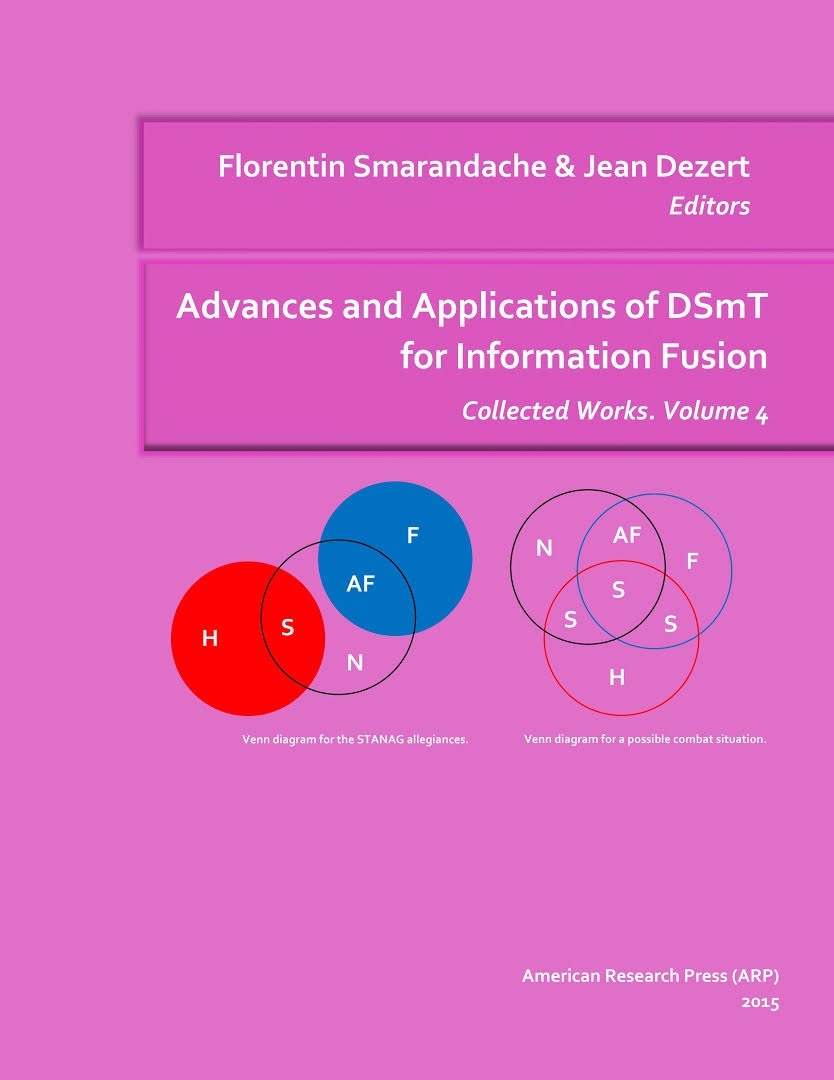
Advances and applications of DSmT for information fusion ; Vol. 4
One of the most comprehensive and flexible fusion theory based on belief functions. It can work in all fusion spaces: power set, hyper-power set, and super-power set, and has various fusion and conditioning rules that can be applied depending on each application. Some new generalized rules are introduced in this volume with codes for implementing some of them. For the qualitative fusion, the DSm Field and Linear Algebra of Refined Labels (FLARL) is proposed which can convert any numerical fusion rule to a qualitative fusion rule. When one needs to work on a refined frame of discernment, the refinement is done using Smarandache s algebraic codification. New interpretations and implementations of the fusion rules based on sampling techniques and referee functions are proposed, including the probabilistic proportional conflict redistribution rule.

Abstract Harmonic Analysis of Continuous Wavelet Transforms
This volume contains a systematic discussion of wavelet-type inversion formulae based on group representations, and their close connection to the Plancherel formula for locally compact groups. The connection is demonstrated by the discussion of a toy example, and then employed for two purposes: Mathematically, it serves as a powerful tool, yielding existence results and criteria for inversion formulae which generalize many of the known results. Moreover, the connection provides the starting point for a – reasonably self-contained – exposition of Plancherel theory. Therefore, the book can also be read as a problem-driven introduction to the Plancherel formula.
A First Course in Statistical Inference
Offers a modern and accessible introduction to Statistical Inference, the science of inferring key information from data. Aimed at beginning undergraduate students in mathematics, it presents the concepts underpinning frequentist statistical theory. Written in a conversational and informal style, this concise text concentrates on ideas and concepts, with key theorems stated and proved. Detailed worked examples are included and each chapter ends with a set of exercises, with full solutions given at the back of the book. Examples using R are provided throughout the book, with a brief guide to the software included. Topics covered in the book include: sampling distributions, properties of estimators, confidence intervals, hypothesis testing, ANOVA, and fitting a straight line to paired data.
