



Page 39
Page 39

Cooperative Design, Visualization, and Engineering ; Vol. 4101 ; 3rd International Conference, CDVE 2006, Mallorca, Spain, September 17-20, 2006, Proceedings
This book constitutes the refereed proceedings of the Third International Conference on Cooperative Design, Visualization, and Engineering, CDVE 2006, held in Mallorca, Spain in September 2006.

Cooperative Control : A Post-Workshop Vol., 2003 Block Island Workshop on Cooperative Control
This carefully edited book presents how natural groupings such as fish schools, bird flocks, deer herds etc. coordinate themselves and move so flawlessly, often without an apparent leader or any form of centralized control. It shows how the underlying principles of cooperative control may be used for groups of mobile autonomous agents to help enable a large group of autonomous robotic vehicles in the air, on land or sea or underwater, to collectively accomplish useful tasks such as distributed, adaptive scientific data gathering, search and rescue, or reconnaissance.

Cooperative Bug Isolation : Winning Thesis of the 2005 ACM Doctoral Dissertation Competition
Efforts to understand and predict the behavior of software date back to the earliest days of computer programming,over half a century ago. In the intervening decades, the need for effective methods of understanding software has only increased; so- ware has spread to become the underpinning of much of modern society, and the potentially disastrous consequences of broken or poorly understood software have become all too apparent.

Control Systems Theory and Applications for Linear Repetitive Processes
After motivating examples, this monograph gives substantial new results on the analysis and control of linear repetitive processes. These include further applications of the abstract model based stability theory which, in particular, shows the critical importance to the dynamics developed of the structure of the initial conditions at the start of each new pass, the development of stability tests and performance bounds in terms of so-called 1D and 2D Lyapunov equations. It presents the development of a major bank of results on the structure and design of control laws, including the case when there is uncertainty in the process model description, together with numerically reliable computational algorithms. Finally, the application of some of these results in the area of iterative learning control is treated --- including experimental results from a chain conveyor system and a gantry robot system.

Control Systems Design : A New Framework
This book will be of great interest to academics and institutional researchers in control system design and to those studying for higher degrees in this area

Control Reconfiguration of Dynamical Systems : Linear Approaches and Structural Tests
The book addresses advanced engineering students, developers and researchers that have a specific interest in control reconfiguration. A good understanding of multi-variable dynamic systems is helpful, but the second part is accessible even without this.

Control of Traffic Systems in Buildings
Control of Traffic Systems in Buildings presents the state of the art in the analysis and control of transportation systems in buildings focusing primarily on elevator groups. The theory and design of passenger traffic and cargo transport systems are covered, together with actual operational examples and topics of special current interest such as: • noisy, on-line and algorithmic optimization; • simulation-based modeling of passengers and goods; • control of cooperative agent-oriented systems; • proposal for a benchmark to compare new control methods; • deployment and testing of transportation systems.

Control of Single Wheel Robots
This monograph presents a novel concept of a mobile robot, which is a single-wheel, gyroscopically stabilized robot. The robot is balanced by a spinning wheel attached through a two-link manipulator at the wheel bearing, and actuated by a drive motor.

Control of Nonlinear Dynamical Systems : Methods and Applications
This book is devoted to new methods of control for complex dynamical systems and deals with nonlinear control systems having several degrees of freedom, subjected to unknown disturbances, and containing uncertain parameters. Various constraints are imposed on control inputs and state variables or their combinations. The book contains an introduction to the theory of optimal control and the theory of stability of motion, and also a description of some known methods based on these theories.

Continuous System Simulation
Continuous System Simulation describes systematically and methodically how mathematical models of dynamic systems, usually described by sets of either ordinary or partial differential equations possibly coupled with algebraic equations, can be simulated on a digital computer.

Content based social platform optimization “Fashion Platform"
The purpose of this project is to design a platform that concentrates on Fashion in addition to assisting users with gathering an informative feedback, as well as linking local stores to those users. This platform will be delivered as a mobile application that is available to any user who is interested in expressing and sharing his/her prevailing taste in fashion simply by posting photos, interacting with other people’s posts and leaving comments for them. The app will also provide some features in an attempt to push the users to be more enthusiastic and to be more encouraged about trying and continuously using this app. Moreover, this platform will incorporate a Shop section, which will be the actual local stores that are connected to it, so the user can buy an item that he/she is fond of.

Container Terminals and Automated Transport Systems : Logistics Control Issues and Quantitative Decision Support
Container transportation is the predominant mode of inter-continental cargo traffic. Since container ships and port terminals involve a huge capital investment and significant daily operating costs, it is of crucial importance to efficiently utilize the internal resources of container terminals and transportation systems. Today there is an ongoing trend to use automated container handling and transportation technology, in particular, in countries with high labour costs. This in turn requires highly sophisticated control strategies in order to meet the desired performance measures. The primary objective of this book is to reflect these recent developments and to present new insights and successful solutions to operational problems of automated container terminals and transportation systems. It comprises reports on the state of the art, applications of quantitative methods, as well as case studies and simulation results. Its contributions are written by leading experts from academia and business.

Construction and Building Automation : From Concepts to Implementation
Intended to be used as a textbook in undergraduate civil engineering and construction courses to introduce cutting edge mechanical, electrical and computer science topics that are needed for civil and construction engineers to collaborate in inter-disciplinary automation projects. Introduces hardware and software needed for automating engineering tasks ; Presents examples of applications in the control of building systems ; Illustrates of the use of automation for improving construction processes ; Provides a lucid introduction to advanced computing concepts, machine learning, artificial intelligence, and control algorithms to construction and engineering students.

Constructing Correct Software
Central to Formal Methods is the so-called Correctness Theorem which relates a specification to its correct Implementations. This theorem is the goal of traditional program testing and, more recently, of program verification (in which the theorem must be proved). Proofs are difficult, though even with the use of powerful theorem provers. This volume explains and illustrates an alternative method, which allows the construction of (necessarily correct) algorithms from a specification using algebraic transformations and refinement techniques which prevent the introduction of errors. Based on teaching material used extensively at Loughborough University, John Cooke introduces the basics, using simple examples and lots of detailed working (which can often be re-used). Constructing Correct Software will provide invaluable reading for students and practitioners of Computer Science and Software Engineering to whom correctness of software is of prime importance.

Constraint handling rules : Current research topics
The Constraint Handling Rules (CHR) language is a declarative concurrent committed-choice constraint logic programming language consisting of guarded rules that transform multisets of relations called constraints until no more change occurs. The aim of this volume was to attract high-quality research papers on these recent advances in Constraint Handling Rules.

Constrained Control and Estimation : An Optimisation Approach
Using the principal tools of prediction and optimisation, this work gives the examples of how to deal with constraints, placing emphasis on model predictive control. It contains results that combine a number of methods, enabling you to build on your background in estimation theory, linear control, stability theory and state-space methods.

Concurrent Zero-Knowledge : With Additional Background by Oded Goldreich
Zero-knowledge proofs are fascinating and extremely useful constructs. Their fascinating nature is due to their seemingly contradictory de?nition; ze- knowledge proofs are convincing and yet yield nothing beyond the validity of the assertion being proved. Their applicability in the domain of cryptography is vast; they are typically used to force malicious parties to behave according to a predetermined protocol. In addition to their direct applicability in cr- tography, zero-knowledge proofs serve as a good benchmark for the study of variousproblemsregardingcryptographicprotocols(e.g.,“securecomposition of protocols”).

CONCUR 2005 - Concurrency Theory
This volume contains the papers presented at CONCUR 2005, the 16th - ternational Conference on Concurrency Theory. The purpose of the CONCUR series of conferences is to bring together researchers,developers, and students in order to advance the theory of concurrency and to promote its applications. The Program Committee selected 38 papers for presentation. Because of the format of the conference and the high number of submissions, many good papers could not be included. Although submissions werereadand evaluated, the papers that appear in this volume may di?er in form and contents from the corresponding submissions.

Concise Guide to Quantum Computing : Algorithms, Exercises, and Implementations
This textbook is intended for practical, laboratory sessions associated with the course of quantum computing and quantum algorithms, as well as for self-study. It contains basic theoretical concepts and methods for solving basic types of problems and gives an overview of basic qubit operations, entangled states, quantum circuits, implementing functions, quantum Fourier transform, phase estimation, etc. The book serves as a basis for the application of new information technologies in education and corporate technical training: theoretical material and examples of practical problems, as well as exercises with, in most cases, detailed solutions, have relation to information technologies. A large number of detailed examples serve to better develop professional competencies in computer science.
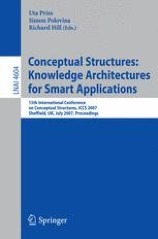
Conceptual Structures: Knowledge Architectures for Smart Applications ; 15th International Conference on Conceptual Structures, ICCS 2007, Sheffield, UK, July 22-27, 2007, Proceedings
Conceptual structures focus on the representation and analysis of concepts, events, actions and objects with applications in - search,softwareengineering,manufacturing and business.The book covers computer science, information technology,artificial int- ligence, philosophy and a variety of applied disciplines to explore novel ways that information technologies can be leveraged to assist human reasoning and interaction for tangible business or social benefits. Conceptual structures can be used to augment human intelligence by facilitating knowledge integration, desion making, the creation of intelligent software systems and the exploration of implicit structures.
