



Page 37
Page 37
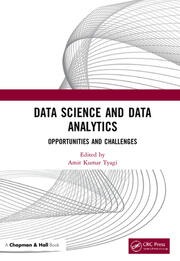
Data science and data analytics : Opportunities and challenges
Gives the concept of data science, tools, and algorithms that exist for many useful applications / Provides many challenges and opportunities in data science and data analytics that help researchers to identify research gaps or problems / Identifies many areas and uses of data science in the smart era / Applies data science to agriculture, healthcare, graph mining, education, security, etc.

Data mining with computational intelligence
Finding information hidden in data is as theoretically difficult as it is practically important. With the objective of discovering unknown patterns from data, the methodologies of data mining were derived Wang and Fu present in detail the state of the art on how to utilize fuzzy neural networks, multilayer perceptron neural networks, radial basis function neural networks, genetic algorithms, and support vector machines in such applications. They focus on three main data mining tasks: data dimensionality reduction, classification, and rule extraction. The book is targeted at researchers in both academia and industry, while graduate students and developers of data mining systems will also profit from the detailed algorithmic descriptions.

Data Mining in Biomedicine
This volume presents an extensive collection of contributions covering aspects of the exciting and important research field of data mining techniques in biomedicine. Coverage includes new approaches for the analysis of biomedical data; applications of data mining techniques to real-life problems in medical practice; comprehensive reviews of recent trends in the field. The book addresses incorporation of data mining in fundamental areas of biomedical research: genomics, proteomics, protein characterization, and neuroscience.

Data Mining for Biomedical Applications ; PAKDD 2006 Workshop, BioDM 2006, Singapore, April 9, 2006, Proceedings
This book constitutes the refereed proceedings of the International Workshop on Data Mining for Biomedical Applications, BioDM 2006, held in Singapore in conjunction with the 10th Pacific-Asia Conference on Knowledge Discovery and Data Mining (PAKDD 2006). The 14 revised full papers presented together with 1 keynote talks were carefully reviewed and selected from 35 submissions. The papers are organized in topical sections on protein-protein interactions, database and search, bio data clustering, and in-silico diagnosis.

Data mining and machine learning applications
Elaborates in detail on the current needs of data mining and machine learning and promotes mutual understanding among research in different disciplines, thus facilitating research development and collaboration. Data, the latest currency of today’s world, is the new gold. In this new form of gold, the most beautiful jewels are data analytics and machine learning. Data mining and machine learning are considered interdisciplinary fields. Data mining is a subset of data analytics and machine learning involves the use of algorithms that automatically improve through experience based on data.

Data Mining and Bioinformatics ; 1st International Workshop, VDMB 2006, Seoul, Korea, September 11, 2006, Revised Selected Papers
This volume contains the papers presented at the inaugural workshop on Data Mining and Bioinformatics at the 32nd International Conference on Very Large Data Bases (VLDB). The purpose of this workshop was to begin bringing - gether researchersfrom database, data mining, and bioinformatics areas to help leverage respective successes in each to the others.

Data Mining : Foundations and Practice
This book contains valuable studies in data mining from both foundational and practical perspectives. The foundational studies of data mining may help to lay a solid foundation for data mining as a scientific discipline, while the practical studies of data mining may lead to new data mining paradigms and algorithms.

Data mining : Concepts, models, methods, and algorithms ; 3rd ed.
Presents the latest techniques for analyzing and extracting information from large amounts of data in high-dimensional data spaces. Explores big data and cloud computing Examines deep learning Includes information on convolutional neural networks (CNN) Offers reinforcement learning Contains semi-supervised learning and S3VM Reviews model evaluation for unbalanced data

Data Mining : A Knowledge Discovery Approach
This book on data mining details the unique steps of the knowledge discovery process that prescribe the sequence in which data mining projects should be performed. Data Mining offers an authoritative treatment of all development phases from problem and data understanding through data preprocessing to deployment of the results. This knowledge discovery approach is what distinguishes this book from other texts in the area. It concentrates on data preparation, clustering and association rule learning (required for processing unsupervised data), decision trees, rule induction algorithms, neural networks, and many other data mining methods, focusing predominantly on those which have proven successful in data mining projects.

Data Management. Data, Data Everywhere ; 24th British National Conference on Databases, BNCOD 24, Glasgow, UK, July 3-5, 2007, Proceedings
One of the most pressing challenges is to ?nd ways of evolving database technology to cope with its new role in underpinning the massively distributed and heterogeneous applications built on top of the Internet. This has afiected both the ways in which data has been accessed and the ways in which it is represented, with XML data management becoming an important issue and, as such, heavily represented at this conference. It has also brought back issues of performance that might have been considered largely solved by the improvements in hardware, since data now has to be managed on devices of low power and small memory as well as on standard client and powerful server machines. We therefore invited papers on all aspects of data management, particularly related to how dataisused in the ubiquitous environment of the modern Internet by complex distributed and scientific applications.

Data management in a connected world : Essays dedicated to Hartmut Wedekind on the occasion of his 70th birthday
Data management systems play the most crucial role in building large application s- tems. Since modern applications are no longer single monolithic software blocks but highly flexible and configurable collections of cooperative services, the data mana- ment layer also has to adapt to these new requirements. Therefore, within recent years, data management systems have faced a tremendous shift from the central management of individual records in a transactional way to a platform for data integration, fede- tion, search services, and data analysis. This book addresses these new issues in the area of data management from multiple perspectives, in the form of individual contributions, and it outlines future challenges in the context of data management.

Data Integration in the Life Sciences ; 4th International Workshop, DILS 2007, Philadelphia, PA, USA, June 27-29, 2007, Proceedings
it cover a wide spectrum of theoretical and practical issues including scienti?c work?ows, - notation in data integration, mapping and matching techniques, and modeling of life science data. It presenting research on new models, methods, or algorithms and 6 papers presenting imp- mentation of systems or experience with systems in practice.

Data Complexity in Pattern Recognition
Data Complexity in Pattern Recognition is unique in its comprehensive coverage and multidisciplinary approach from various methodological and practical perspectives. Researchers and practitioners alike will find this book an insightful reference to learn about the current status of available techniques as well as application areas.

Data Assimilation : The Ensemble Kalman Filter
Data Assimilation comprehensively covers data assimilation and inverse methods, including both traditional state estimation and parameter estimation. This text and reference focuses on various popular data assimilation methods, such as weak and strong constraint variational methods and ensemble filters and smoothers. It is demonstrated how the different methods can be derived from a common theoretical basis, as well as how they differ and/or are related to each other, and which properties characterize them, using several examples.It presents the mathematical framework and derivations in a way which is common for any discipline where dynamics is merged with measurements. The mathematics level is modest, although it requires knowledge of basic spatial statistics, Bayesian statistics, and calculus of variations. Readers will also appreciate the introduction to the mathematical methods used and detailed derivations, which should be easy to follow, are given throughout the book. The codes used in several of the data assimilation experiments are available on a web page.The focus on ensemble methods, such as the ensemble Kalman filter and smoother, also makes it a solid reference to the derivation, implementation and application of such techniques. Much new material, in particular related to the formulation and solution of combined parameter and state estimation problems and the general properties of the ensemble algorithms, is available here for the first time.

Data and applications security XX ; 20th Annual IFIP WG 11.3 Working Conference on data and applications security, Sophia Antipolis, France, July 31-August 2, 2006, Proceedings
For 20 years, the IFIP WG 11. 3 Working Conference on Data and Appli- tions Security (DBSEC) has been a major forum for presenting originalresearch results, practical experiences, and innovative ideas in data and applications - curity.Like the previous conference, the 20th DBSEC has proved to be up to this challenge. DBSEC 2006 received 56 submissions, out of which the program committee selected22 high-qualitypaperscoveringanumber of diverseresearchtopicssuch as access control, privacy, and identity management.

Data Analysis, Classification and the Forward Search ; Proceedings of the Meeting of the Classification and Data Analysis Group (CLADAG) of the Italian Statistical Society, University of Parma, June 6-8, 2005
This book presents new developments in data analysis, classification and multivariate statistics, and in their algorithmic implementation. The volume offers contributions to the theory of clustering and discrimination, multidimensional data analysis, data mining, and robust statistics with a special emphasis on the novel Forward Search approach. Many papers provide significant insight in a wide range of fields of application. Customer satisfaction and service evaluation are two examples of such emerging fields.

Data Analysis and Decision Support
Presents advances in data analysis and decision support and gives an actual overview on the interface between mathematics, operations research, statistics, computer science, and management science. Areas that receive considerable attention in the book are discrimination and clustering, multidimensional scaling, data mining and more.

Data Algorithms with Spark
Apache Spark's speed, ease of use, sophisticated analytics, and multilanguage support makes practical knowledge of this cluster-computing framework a required skill for data engineers and data scientists. With this hands-on guide, anyone looking for an introduction to Spark will learn practical algorithms and examples using PySpark. you will: Learn how to select Spark transformations for optimized solutions Explore powerful transformations and reductions including reduceByKey(), combineByKey(), and mapPartitions() Understand data partitioning for optimized queries Build and apply a model using PySpark design patterns Apply motif-finding algorithms to graph data Analyze graph data by using the GraphFrames API Apply PySpark algorithms to clinical and genomics data Learn how to use and apply feature engineering in ML algorithms Understand and use practical and pragmatic data design patterns

DARPA Grand Challenge : The Great Robot Race
The goal of the new series of Springer Tracts in Advanced Robotics (STAR) is to bring, in a timely fashion, the latest advances and developments in robotics on the basis of their significance and quality. It is our hope that the wider dissemination of research developments will stimulate more exchanges and collaborations among the research community and contribute to further advancement of this rapidly growing field. The volume edited by Martin Buehler, Karl Iagnemma and Sanjiv Singh presents a unique and extensive collection of the scientific results by the teams which took part into the DARPA Grand Challenge in October 2005 in the Nevada desert. This event reached an incredible peak of popularity in the media, the race of the century like someone called it! The Grand Challenge demonstrated the fast growing progress - ward the development of robotics technology, as it showed the feasibility of using mobile robots operating autonomously in real world scenarios.

Darboux Transformations in Integrable Systems : Theory and their Applications to Geometry
This book presents the Darboux transformations in matrix form and provides purely algebraic algorithms for constructing the explicit solutions. A basis for using symbolic computations to obtain the explicit exact solutions for many integrable systems is established. Moreover, the behavior of simple and multi-solutions, even in multi-dimensional cases, can be elucidated clearly. The method covers a series of important equations such as various kinds of AKNS systems in R1+n, harmonic maps from 2-dimensional manifolds, self-dual Yang-Mills fields and the generalizations to higher dimensional case, theory of line congruences in three dimensions or higher dimensional space etc. All these cases are explained in detail.
