



Page 3
Page 3
Fundamental approaches to software engineering ; 25th International Conference, FASE 2022, Held as Part of the European Joint Conferences on Theory and Practice of Software, ETAPS 2022, Munich, Germany, April 2–7, 2022, Proceedings
The papers deal with the foundations on which software engineering is built, including topics like software engineering as an engineering discipline, requirements engineering, software architectures, software quality, model-driven development, software processes, software evolution, AI-based software engineering, and the specification, design, and implementation of particular classes of systems, such as (self-)adaptive, collaborative, AI, embedded, distributed, mobile, pervasive, cyber-physical, or service-oriented applications.

Fundamental approaches to software engineering ; 22nd International Conference, FASE 2019, Held as Part of the European Joint Conferences on Theory and Practice of Software, ETAPS 2019, Prague, Czech Republic, April 6–11, 2019, Proceedings
This book cover software verification; model-driven development and model transformation; software evolution and requirements engineering; specification, design, and implementation of particular classes of systems; and software testing.

Fundamental approaches to software engineering ; 21st International Conference, FASE 2018, Held as Part of the European Joint Conferences on Theory and Practice of Software, ETAPS 2018, Thessaloniki, Greece, April 14-20, 2018, Proceedings
This book contains the proceedings of FASE 2018, the 21th International Conference on Fundamental Approaches to Software Engineering, held in Thessaloniki, Greece, in April 2018, the volume contains regular research papers that cover a wide range of topics, such as program and system analysis, model transformations, configuration and synthesis, graph modeling and transformation,software product lines, test selection, as well as learning and inference.
Functional Verification of Programmable Embedded Architectures : A Top-Down Approach
This book presents a top-down validation methodology that complements the existing bottom-up approaches. It leverages the system architect’s knowledge about the behavior of the design through architecture specification using an Architecture Description Language (ADL). The authors also address two fundamental challenges in functional verification: lack of a golden reference model, and lack of a comprehensive functional coverage metric.

From Specification to Embedded Systems Application
Application documents recent approaches and results presented at the International Embedded Systems Symposium (IESS 2005), which was held in August 2005 in Manaus (Brazil) and sponsored by International Federation for Information Processing (IFIP). The topics which have been chosen for this working conference are very timely: design methodology, modeling, specification, software synthesis, power management, formal verification, testing, network, communication systems, distributed control systems, resource management and special aspects in system design.
From brows to trust : Evaluating embodied conversational agents
This book will help experts and designers in the specification and development of applications incorporating ECAs. Part 1 provides guidelines for evaluation methodologies and the identification of design and evaluation parameters. Part 2 demonstrates the importance of considering the user's perspective and interaction experience. Part 3 addresses issues in fine-tuning design parameters of ECAs and verifying the perceived effect. Finally, in Part 4 lessons learned from a number of application case studies are presented. The book is intended for both ECA researchers in academia and industry, and developers and designers interested in applying the technology.
Foundations of software science and computation structures ; 25th International conference, FOSSACS 2022, Held as Part of the European joint conferences on theory and practice of software, ETAPS 2022, Munich, Germany, April 2–7, 2022, proceedings
This book constitutes the proceedings of the 25th International Conference on Foundations of Software Science and Computational Structures, FOSSACS 2022, which was held during April 4-6, 2022, in Munich, Germany, as part of the European Joint Conferences on Theory and Practice of Software, ETAPS 2022. They deal with research on theories and methods to support the analysis, integration, synthesis, transformation, and verification of programs and software systems.

Foundations of software science and computation structures ; 23rd International conference, FOSSACS 2020, Held as part of the European joint conferences on theory and practice of software, ETAPS 2020, Dublin, Ireland, April 25–30, 2020, proceedings
This book constitutes the proceedings of the 23rd International Conference on Foundations of Software Science and Computational Structures, FOSSACS 2020, which took place in Dublin, Ireland, in April 2020, and was held as Part of the European Joint Conferences on Theory and Practice of Software, ETAPS 2020.
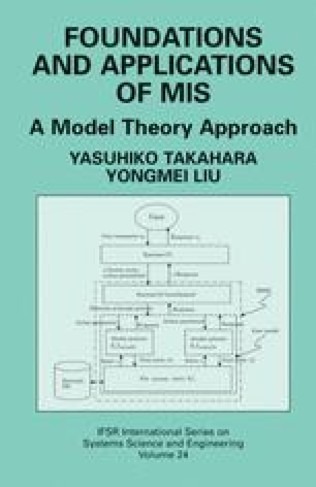
Foundations and applications of MIS : A model theory approach
Foundations and Applications of MIS presents a unique systems theory approach to management information system (MIS) development. The development is driven by the need to eliminate ambiguity in specification, design and construction of the application software. Further, the authors show that the considerable effort being expanded nowadays on validation, verification and testing, as required in current software engineering practices, will be reduced. The approach also reinforces the belief that MIS development is independent of software development. The work presents an approach that provides a theoretical foundation for MIS development from the systems theoretic viewpoint along with practical applications ranging from a transaction processing system to a solver system. Both formal systems theory and automatic system generation based on the authors' newly extended Prolog offer a significant increase in the efficiency of specification, design and production of the application software, as well as an increase in the functional reliability of the software produced. The book assumes a working knowledge of elementary set theory, logic, and familiarity with some systems concepts, such as the automaton model.
Formal Techniques for Networked and Distributed Systems - FORTE 2008 ; 28th IFIP WG 6.1 International Conference Tokyo, Japan, June 10-13, 2008 Proceedings
This book constitutes the refereed proceedings of the 28th IFIP WG 6.1 International Conference on Formal Techniques for Networked and Distributed Systems, FORTE 2008, held in Tokyo, Japan, in June 2008 co-located with TestCom/FATES 2008.The 19 revised full papers and 1 revised short paper presented together with 1 invited talk were carefully reviewed and selected from 44 submissions. The papers cover new approaches, concepts and experience in the application of formal methods for the specification and verification of distributed systems and applications.
Formal Techniques for Networked and Distributed Systems - FORTE 2006 ; 26th IFIP WG 6.1 International Conference, Paris, France, September 26-29, 2006, Proceedings
This book constitutes the refereed proceedings of the 26th IFIP WG 6.1 International Conference on Formal Techniques for Networked and Distributed Systems, FORTE 2006, held in Paris, France, in September 2006. The 26 revised full papers and 4 short papers presented together with 3 invited lectures were carefully reviewed and selected from 177 submissions. The papers focus on the construction of middleware and services using formalised and verified approaches.
Formal techniques for networked and distributed systems - FORTE 2005 ; 25th IFIP WG 6.1 International Conference, Taipei, Taiwan, October 2-5, 2005, Proceedings
FORTE (Formal Techniques for Networked and Distributed Systems) 2005 was sp- sored by Working Group 6.1, Technical Committee 6 (TC6) of the International Fed- ation for InformationProcessing (IFIP).The conferenceseries started in 1981underthe name PSTV (ProtocolSpeci?cation, Testing, and Veri?cation).In 1988,a second series under the name FORTE was started. Both series merged to FORTE/PSTV in 1996. The conference name was changed to FORTE in 2001. During its 24-year history, many important contributions have been reported in the conference series. The last ?ve me- ings of FORTE were held in Pisa (Italy), Cheju Island (Korea), Houston (USA), Berlin (Germany), and Madrid (Spain). The 25th FORTE was held from Sunday to Wednesday, October 2–5, 2005 on the beautiful campus of the National Taiwan University (NTU), Taipei, Taiwan, ROC.
Formal Refinement for Operating System Kernels
The purpose of this book is to show that the formal specification of kernels can be followed by a completely formal refinement process that leads to the extraction of executable code. The formal refinement process ensures that the code meets the specification in a precise sense.
Formal Models of Operating System Kernels
The purpose of this book is to show that the formal specification of kernels is not only possible but also necessary if operating systems are to achieve the levels of reliability and security that is demanded of them today. Specifications of a sequence of kernels of increasing complexity are included, acting as models to enable the designer to identify and reason about the properties of the design – thus making explicit that which is too often left implicit or even unknown.

Formal Methods in Systems Biology ; 1st International Workshop, FMSB 2008, Cambridge, UK, June 4-5, 2008. Proceedings
This book constitutes the refereed proceedings of the First International Workshop on Formal Methods in Systems Biology, FMSB 2008, held in Cambridge, UK, in June, 2008.The 9 revised full papers presented were carefully reviewed and selected from the workshop lectures that all were invited contributions. The purpose of this meeting was to identify techniques for the specification, development and verification of biological models. It also focused on the design of tools to execute and analyze biological models that can significantly advance our understanding of biological systems.
Formal Methods in Software and Systems Modeling : Essays Dedicated to Hartmut Ehrig on the Occasion of His 60th Birthday
By presenting state-of-the-art research results on various aspects of formal and visual modeling of software and systems, this book commemorates the 60th birthday of Hartmut Ehrig. The 24 invited reviewed papers are written by students and collaborators of Hartmut Ehrig who are established researchers in their fields. Reflecting the scientific interest and work of Hartmut Ehrig, the papers fall into three main parts on graph transformation, algebraic specification and logic, and formal and visual modeling.
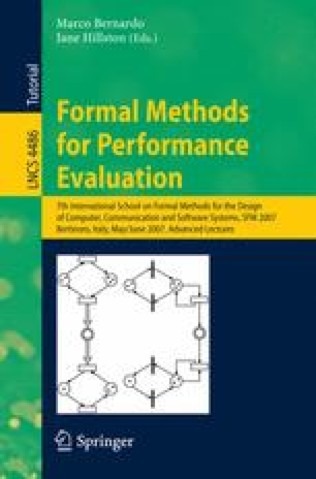
Formal Methods for Performance Evaluation ; 7th International School on Formal Methods for the Design of Computer, Communication, and Software Systems, SFM 2007, Bertinoro, Italy, May 8-June 2, 2007, Advanced Lectures
This book presents a set of 11 papers accompanying the lectures of leading researchers given at the 7th edition of the International School on Formal Methods for the Design of Computer, Communication and Software Systems, SFM 2007.

Formal Methods for Open Object-Based Distributed Systems ; Vol. 4037 ; 8th IFIP WG 6.1 International Conference, FMOODS 2006, Bologna, Italy, June 14-16, 2006, Proceedings
This book constitutes the refereed proceedings of the 8th IFIP WG 6.1 International Conference on Formal Methods for Open Object-Based Distributed Systems, FMOODS 2006, held in Bologna, Italy, June 2006. The book presents 16 revised full papers together with an invited paper and abstracts of 2 invited talks. Coverage includes component- and model-based design, service-oriented computing, software quality, modeling languages implementation, formal specification, verification, validation, testing, and service-oriented systems.
Formal Methods for Open Object-Based Distributed Systems ; Vol. 3535 ; 7th IFIP WG 6.1 International Conference, FMOODS 2005, Athens, Greece, June 15-17, 2005, Proceedings
This volume contains the proceedings of FMOODS2005, the 7th IFIPWG6. 1 International Conference on Formal Methods for Open Object-Based Distributed Systems. The conference was held in Athens, Greece on June 15-17, 2005. The eventwasthe seventh meeting ofthis conference series, whichis held roughly every year and a half, with the earlier events held respectively in Paris, Canterbury, Florence, Stanford, Twente, and Paris. The goal of the FMOOD Sseries of conferences is to bring together researchers whose work encompasses three important and related fields: - formal methods; - distributed systems; - object-based technology. Sucha convergenceis representative of recent advances in the field of distributed systems, and provides links between several scientific and technological communities, as represented by the conferences FORTE, CONCUR, and ECOOP. The objective of FMOODS is to provide an integrated forum for the pres- tation of research in the above-mentioned fields, and the exchange of ideas and experiences in the topics concerned with the formal methods support for open object-based distributed systems.

Formal Methods for Open Object-Based Distributed Systems ; 9th IFIP WG 6.1 International Conference, FMOODS 2007, Paphos, Cyprus, June 6-8, 2007, Proceedings
This book constitutes the refereed proceedings of the 9th IFIP WG 6.1 International Conference on Formal Methods for Open Object-Based Distributed Systems, FMOODS 2007, held in Paphos, Cyprus in June 2007. The papers are organized in topcical sections on model checking rewriting logic components and services algebraic calculi specification, verification and refinenment, and quality of service.
