



Page 26
Page 26

Governance for drought resilience : Land and water drought management in Europe
This book will aid regional water authorities and other relevant stakeholders interested in governance assessment, whether that context is about water, more specifically about drought or flooding events, or other environmental issues. Further, the GAT can and has also been applied more broadly to a range of governance contexts for water management and beyond.

Governance : Systemic foundation and framework
Instead of yet another theory on good governance, this book presents a substantiation of contemporary notions. It builds on the theoretical foundations for taking an overall perspective on social contexts and culminates in a systemic framework that captures social structures based on first principles of viability and sustainability. The framework at hand enables applicants to view social contexts holistically while at the same time envisioning a rich picture of what leverages the implementation of social purposes beyond the boxes of the professional disciplines: social structures can be assessed, strengths and weaknesses identified and measures arrived at. Ultimately, the required structures can be tailor-made to align forces for a joint implementation of purposes. Conventional static hierarchies can be deployed into dynamic social organisms capable of developing and adapting continuously according to the opportunities and challenges faced.

Good pharmacovigilance practice (GVP) : Focus on risk mangement plan (RMP)
Pharmacovigilance which is the science and activities relating to the detection, assessment, understanding and prevention of adverse drug reactions or any other possible drug related problems and Risk Management Strategies which provides a structured and coherent approach to identifying, assessing and managing risk and builds in a process for regularly updating and reviewing the assessment based on new developments or actions taken, conference provides the foundation for strong strategic planning and practical decision-making in pharmacovigilance programs. Stakeholders from medicines research, global regulation, and healthcare will join together to analyse the challenges for safety and pharmacovigilance efforts in this uncertain environment and examine effective strategies for addressing gaps and needs.

Glycerophospholipids in brain : Phospholipases A2 in Neurological Disorders
This unique volume will be invaluable not only to those interested in biochemical properties of phospholipases A2, but also their involvement in neurological disorders. Students will benefit from it as a supplement for a range of neuroscience courses. Clinicians will find it invaluable as well for understanding molecular aspects of neurodegeneration in acute neural trauma (stroke) and neurodegenerative diseases (Alzheimer disease) that are mediated by phospholipases A2.

Glossary of dental implantology
A comprehensive, consensus-based global platform of dental implant terminology for effective communication among dental professionals, clinicians, clinical and basic science researchers, and scientists. Offers clear definitions for dental implant-related terms for use by the whole dental team Fosters a working knowledge of currently used dental implant terminology. Helps team members to communicate more efficiently and effectively. Presents a comprehensive guide for specialist and general dentists, dental students, residents, dental hygienists, and dental laboratory technicians. Includes entries for hardware technology, regenerative materials, lasers, radiology, and more
Globalization and Health : Challenges for health law and bioethics
This timely collection explores ethical and legal dilemmas in healthcare arising from globalization. Conflicts between public interests and individual rights, the challenge of regulating professionals and access to health services, and the effects of a global market all feature prominently in contemporary debates in this area. As a result of globalization, issues in health law and bioethics can no longer be understood solely within political boundaries that define traditional notions of individuals and communities. Rather, solutions for emerging problems require a global conception of rights and obligations, including the re-evaluation of ethical frameworks and legal regimes that currently govern exchanges in healthcare. Leading scholars in bioethics, law, medicine and philosophy from various jurisdictions engage these themes in this volume, and demonstrate the need for transnational solutions in a global age of healthcare.

Global regulations of medicinal, pharmaceutical, and food products
Medicine regulation demands the application of sound medical, scientific, and technical knowledge and skills, and operates within a legal framework. Regulatory functions involve interactions with various stakeholders (e.g., manufacturers, traders, consumers, health professionals, researchers, and governments) whose economic, social, and political motives may differ, making implementation of regulation both politically and technically challenging. This book discusses regulatory landscape globally and the current global regulatory scenario of medicinal products and food products comprehensively.

Global Production : A Handbook for Strategy and Implementation
What is the best configuration for a global production network? What are the different dynamics in low-cost vs. high-cost countries? Getting the answers right is key to building a competitive and efficient global production network. Centers of economic activity are shifting profoundly, globally and even regionally. Production is shifting even more dramatically than the economy as a whole, making it critical for decision makers to know what criteria matter most and how to make the right decisions on where to invest. Regardless of the industry involved, an optimized global footprint can translate to a competitive advantage. A comprehensive redesign typically yields a 20 to 40 percent reduction in manufacturing costs. Global production and purchasing operations create a platform for entry into new markets. Planning and implementing a sustainable globalization strategy, however, takes considerable effort; this book is there to help in that task.

Global perspectives on recognising non-formal and Informal Learning : Why recognition matters
This book deals with the relevance of recognition and validation of non-formal and informal learning in education and training, the workplace and society. In an increasing number of countries, it is at the top of the policy and research agenda ranking among the possible ways to redress the glaring lack of relevant academic and vocational qualifications and to promote the development of competences and certification procedures which recognise different types of learning, including formal, non-formal and informal learning. The aim of the book is therefore to present and share experience, expertise and lessons in such a way that enables its effective and immediate use across the full spectrum of country contexts, whether in the developing or developed world. It examines the importance of meeting institutional and political requirements that give genuine value to the recognition of non-formal and informal learning; it shows why recognition is important and clarifies its usefulness and the role it serves in education, working life and voluntary work; it emphasises the importance of the coordination, interests, motivations, trust and acceptance by all stakeholders.

Global optimization and constraint satisfaction ; 2nd International Workshop, COCOS 2003, Lausanne, Switzerland, Nevember 18-21, 2003, Revised Selected Papers
Theformulationofmanypracticalproblemsnaturallyinvolvesconstraintsonthe variables entering the mathematical model of a real-life situation to be analyzed. It is of great interest to ?nd the possible scenarios satisfying all constraints, and, iftherearemanyofthem,eitherto?ndthebestsolution,ortoobtainacompact, explicit representation of the whole feasible set. The 2nd Workshop on Global Constrained Optimization and Constraint S- isfaction, COCOS 2003, which took place during November 18–21, 2003 in L- sanne, Switzerland, was dedicated to theoretical, algorithmic, and application oriented advances in answering these questions. Here global optimization refers to ?nding the absolutely best feasible point, while constraint satisfaction refers to?ndingallpossiblefeasiblepoints.AsinCOCOS2002,the?rstsuchworkshop (see the proceeedings [1]), the emphasis was on complete solving techniques for problems involving continuous variables that provide all solutions with full rigor, and on applications which, however, were allowed to have relaxed standards of rigor.

Global History and New Polycentric Approaches : Europe, Asia and the Americas in a World Network System
Examines how the discipline had evolved in various historiographies, from Anglo Saxon to southern European, and its emergence in Asia with the rapid development of the Chinese economy motivation to legitimate the current uniqueness of the history and economy of the nation. It contributes to the revitalization of the field of global history in Chinese historiography, which have been dominated by national narratives and promotes a debate to open new venues in which important features such as scholarly mobility, diversity and internationalization are firmly rooted, putting aside national specificities.

Global design to gain a competitive edge : An holistic and collaborative design approach based on computational tools
Global Design to Gain a Competitive Edge collects together papers from the 2008 International Conference on Advanced Design and Manufacture (ICADAM). Recent advancements, emerging trends and new challenges in the fields of design and manufacturing are covered, with a particular focus on the understanding of the impact of distributed team-based design and manufacture on research and industrial practices for global companies.

Global Conflict Resolution Through Positioning Analysis
Positioning analysis penetrates beneath surface issues to their underlying psychological causes and social effects, with the intention of defusing conflict and preventing existing conflict from escalating. As the growing literature shows, positioning analysis methods are not only effective in interpersonal and intergroup problems, but have considerable potential for resolving disputes on the world stage. Global Conflict Resolution through Positioning Analysis starts with the daily disputes that result from our multiple social identities and evolving self-definitions, offers a new framework for understanding historical conflict, and brings vital new perspectives to current political and ideological battles. Twenty expert contributors examine scenarios as simple as a committee meeting of four people, as complicated as centuries-old social movements and the shifting tensions in the Middle East.
Geostatistics Banff 2004
The five major sections are: theory, mining, petroleum, environmental and other applications. The first section showcases new and innovative ideas in the theoretical development of geostatistics as a whole; these ideas will have large impact on (1) the directions of future geostatistical research, and (2) the conventional approaches to heterogeneity modelling in a wide range of natural resource industries. The next four sections are focused on applications and innovations relating to the use of geostatistics in specific industries. Historically, mining, petroleum and environmental industries have embraced the use of geostatistics for uncertainty characterization, so these three industries are identified as major application areas. The last section is open for innovative geostatistical application to address the issues and impact of uncertainty in other industries.

Geophysics of the Canary Islands : Results of Spain's Exclusive Economic Zone Program
This book contains the results of a 9 year (1995-2004) investigation of the Canary Islands Exclusive Economic Zone, using state of the art technology. The main result areas are: a multibeam survey demonstrating the magnitude of catastrophic failures of the Canary Islands; a comparison of the morphology of the Canary Islands with Hawaii; the significance of hydrothermal activity in the Canary Channel associated with Mesozoic salt diapirs; an analysis of the morphology and structure of the offshore extension of the Anaga massif in Tenerife island; a detailed description of the archipelago gravity field and magnetic field of the Canary Islands

Geometric Qp Functions
This book documents the rich structure of the holomorphic Q functions which are geometric in the sense that they transform naturally under conformal mappings. Particular emphasis is placed on recent developments based on the interaction between geometric function/measure theory and other branches of mathematical analysis, including potential theory, complex variables, harmonic analysis, functional analysis, and operator theory." "Largely self-contained, this book will be an instructional and reference work for advanced courses and research in conformal analysis, geometry, or function spaces.

Geometric Group Theory ; Geneva and Barcelona Conferences
This volume assembles research papers in geometric and combinatorial group theory. This wide area may be defined as the study of those groups that are defined by their action on a combinatorial or geometric object, in the spirit of Klein’s programme.The contributions range over a wide spectrum: limit groups, groups associated with equations, with cellular automata, their structure as metric objects, their decomposition, etc. Their common denominator is the language of group theory, used to express and solve problems ranging from geometry to logic.
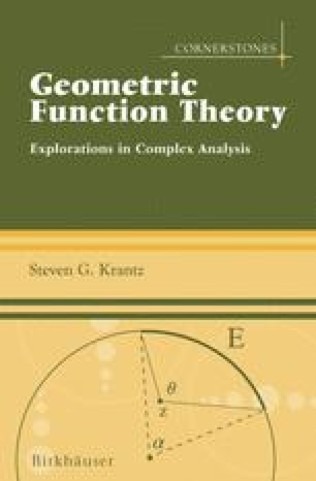
Geometric Function Theory : Explorations in Complex Analysis
Complex variables is a precise, elegant, and captivating subject. Presented from the point of view of modern work in the field, this new book addresses advanced topics in complex analysis that verge on current areas of research, including invariant geometry, the Bergman metric, the automorphism groups of domains, harmonic measure, boundary regularity of conformal maps, the Poisson kernel, the Hilbert transform, the boundary behavior of harmonic and holomorphic functions, the inhomogeneous Cauchy–Riemann equations, and the corona problem.

Geometric and Topological Methods for Quantum Field Theory
This volume offers an introduction, in the form of four extensive lectures, to some recent developments in several active topics at the interface between geometry, topology and quantum field theory. The first lecture is by Christine Lescop on knot invariants and configuration spaces, in which a universal finite-type invariant for knots is constructed as a series of integrals over configuration spaces. This is followed by the contribution of Raimar Wulkenhaar on Euclidean quantum field theory from a statistical point of view. The author also discusses possible renormalization techniques on noncommutative spaces. The third lecture is by Anamaria Font and Stefan Theisen on string compactification with unbroken supersymmetry. The authors show that this requirement leads to internal spaces of special holonomy and describe Calabi-Yau manifolds in detail. The last lecture, by Thierry Fack, is devoted to a K-theory proof of the Atiyah-Singer index theorem and discusses some applications of K-theory to noncommutative geometry. These lectures notes, which are aimed in particular at graduate students in physics and mathematics, start with introductory material before presenting more advanced results. Each chapter is self-contained and can be read independently.
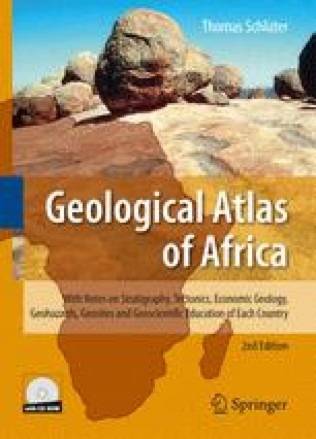
Geological atlas of Africa : With notes on stratigraphy, tectonics, economic geology, geohazards, geosites and geoscientific education of each country
T is atlas is intended primarily for anybody who is in-some background for the arrangement of how the terested in basic geology of Africa. Its originality lies atlas was done. T e second chapter is devoted to the in the fact that the regional geology of each African history of geological mapping in Africa, necessary nation or territory is reviewed country-wise by maps for a fuller appreciation of why this work in Africa is and text, a view normally not presented in textbooks worth doing. Chapter 3 provides an executive s- of regional geology. It is my belief, that there has long mary on the stratigraphy and tectonics of Africa as a been a need in universities and geological surveys, whole, i. e. in the context of no political boundaries.
