



Page 211
Page 211
Formal techniques for networked and distributed systems - FORTE 2005 ; 25th IFIP WG 6.1 International Conference, Taipei, Taiwan, October 2-5, 2005, Proceedings
FORTE (Formal Techniques for Networked and Distributed Systems) 2005 was sp- sored by Working Group 6.1, Technical Committee 6 (TC6) of the International Fed- ation for InformationProcessing (IFIP).The conferenceseries started in 1981underthe name PSTV (ProtocolSpeci?cation, Testing, and Veri?cation).In 1988,a second series under the name FORTE was started. Both series merged to FORTE/PSTV in 1996. The conference name was changed to FORTE in 2001. During its 24-year history, many important contributions have been reported in the conference series. The last ?ve me- ings of FORTE were held in Pisa (Italy), Cheju Island (Korea), Houston (USA), Berlin (Germany), and Madrid (Spain). The 25th FORTE was held from Sunday to Wednesday, October 2–5, 2005 on the beautiful campus of the National Taiwan University (NTU), Taipei, Taiwan, ROC.
Formal techniques for distributed objects, components, and systems ; 40th IFIP WG 6.1 International conference, FORTE 2020, Held as Part of the 15th International Federated Conference on distributed computing techniques, DisCoTec 2020, Valletta, Malta, June 15–19, 2020, Proceedings
This book constitutes the proceedings of the 40th IFIP WG 6.1 International Conference on Formal Techniques for Distributed Objects, Components, and Systems, FORTE 2020, held in Valletta, Malta, in June 2020, as part of the 15th International Federated Conference on Distributed Computing Techniques, DisCoTec 2020.*
Formal techniques for computer systems and business processes ; European performance engineering workshop, EPEW 2005 and International workshop on web services and formal methods, WS-FM 2005, Versailles, France, September 1-3, 2005, Proceedings
This book constitutes the refereed proceedings of two colocated international workshops EPEW 2005 (European Performance Engineering Workshop) and WS-FM 2005 (Web Services and Formal Methods) held in Versailles, France in September 2005. The 20 revised full papers presented were carefully reviewed and selected from 59 submissions. For EPEW 2005 only 10 papers - of the 32 submitted - were accepted for presentation; they deal with queueing theory, bounding techniques, stochastic model checking, communication schemes analysis for high-speed LAN, QOS analysis in wireless ad-hoc networks and optical networks analysis. The main topics of the 10 papers accepted for WS-FM 2005 - from 27 submissions - include: protocols and standards for WS (SOAP, WSDL, UDDI, etc.); languages and description methodologies for Choreography/Orchestration/Workflow (BPML, XLANG and BizTalk, WSFL, WS-BPEL, etc.); coordination techniques for WS (transactions, agreement, coordination services, etc.); semantics-based dynamic WS discovery services (based on Semantic Web/Ontology Techniques or other semantic theories); security, performance evaluation and quality of service of WS; semi-structured data and XML related technologies; comparisons with different related technologies/approaches.
Formal Refinement for Operating System Kernels
The purpose of this book is to show that the formal specification of kernels can be followed by a completely formal refinement process that leads to the extraction of executable code. The formal refinement process ensures that the code meets the specification in a precise sense.

Formal Ontology and Conceptual Realism
Theories about the ontological structure of the world have generally been described in informal, intuitive terms, and the arguments for and against them, including their consistency and adequacy as explanatory frameworks, have generally been given in even more informal terms. The goal of formal ontology is to correct for these deficiencies. By formally reconstructing an intuitive, informal ontological scheme as a formal ontology we can better determine the consistency and adequacy of that scheme; and then by comparing different reconstructed schemes with one another we can much better evaluate the arguments for and against them and come to a decision as to which system it is best to adopt.
Formal Models of Operating System Kernels
The purpose of this book is to show that the formal specification of kernels is not only possible but also necessary if operating systems are to achieve the levels of reliability and security that is demanded of them today. Specifications of a sequence of kernels of increasing complexity are included, acting as models to enable the designer to identify and reason about the properties of the design – thus making explicit that which is too often left implicit or even unknown.
Formal Models of Communicating Systems : Languages, Automata, and Monadic Second-Order Logic
This book studies the relationship between automata and monadic second-order logic, focusing on classes of automata that describe the concurrent behavior of distributed systems.
Formal Modelling in Electronic Commerce
Advances in automation for electronic commerce require improved understanding and formalization of the objects, processes, and policies of commerce itself. These include business objects such as bills of lading and contracts; processes such as workflows and trade procedures; and policies covering such problems as contract or procedure validation and strategic behaviour. This book is about theory, formalization, and proof-of-concept implementation of these and related matters. In addition to presenting state-of-the-art results, the book places this work in the context of nearly twenty years of developments in formal modelling for electronic commerce. A comprehensive bibliography and index are provided.
Formal Modeling and Analysis of Timed Systems ; Vol.4202 ; 4th International Conference, FORMATS 2006, Paris, France, September 25-27, 2006, Proceedings
The aim of FORMATS is to promote the study of fundamental and practical aspects of timed systems, and to bring together researchers from di?erent d- ciplines that share interests in modelling and analysis of timed systems. In this volume, there are articles on: – Foundations and Semantics: contributions to the theoretical foundations of timed systems and timed formal languages as well as comparison between di?erentmodelsusedbydi?erentcommunities(timedautomata,timedPetri nets, timed MSCs, hybrid automata, timed process algebra, timed temporal logics, timed abstract state machines, as well as probabilistic models). – Methods and Tools: techniques, algorithms, data structures, and software toolsforanalyzingtimedsystemsandresolvingtemporalconstraints(mod- checking, simulation, robustness analysis, scheduling, etc).
Formal Modeling and Analysis of Timed Systems ; Vol. 3829 ; 3rd International Conference, FORMATS 2005, Uppsala, Sweden, September 26-28, 2005, Proceedings
This book constitutes the thoroughly refereed post-proceedings of the Third International Conference on Formal Modeling and Analysis of Timed Systems, FORMATS 2005, held in Uppsala, Sweden in September 2005 in conjunction with ARTIST2 summer school on Component Modelling, Testing and Verification, and Static analysis of embedded systems. The 19 revised full papers presented together with the abstracts of 3 invited talks were carefully selected from 43 submissions. The papers cover work on semantics and modeling of timed systems, formalisms for modeling and verification including timed automata, hybrid automata, and timed petri nets, games for verification and synthesis, model-checking, case studies and issues related to implementation, security and performance analysis.

Formal Modeling and Analysis of Timed Systems ; 6th International Conference, FORMATS 2008, Saint Malo, France, September 15-17, 2008. Proceedings
This book constitutes the refereed proceedings of the 6th International Conference on Formal Modeling and Analysis of Timed Systems, FORMATS 2008, held in Saint Malo, France, September 2008.The 17 revised full papers presented together with 3 invited talks were carefully reviewed and selected from 37 submissions. The papers are organized in topical sections on extensions of timed automata and semantics; timed games and logic; case studies; model-checking of probabilistic systems; verification and test; timed petri nets.

Formal Modeling and Analysis of Timed Systems ; 5th International Conference, FORMATS 2007, Salzburg, Austria, October 3-5, 2007, Proceedings
This volume consists of the proceedings of the Fifth International Conference on Formal Modelling and Analysis of Timed Systems (FORMATS 2007). The main goal of this series of conferences is to bring together diverse communities of researchers that deal with the timing aspects of computing systems.

Formal Methods in Systems Biology ; 1st International Workshop, FMSB 2008, Cambridge, UK, June 4-5, 2008. Proceedings
This book constitutes the refereed proceedings of the First International Workshop on Formal Methods in Systems Biology, FMSB 2008, held in Cambridge, UK, in June, 2008.The 9 revised full papers presented were carefully reviewed and selected from the workshop lectures that all were invited contributions. The purpose of this meeting was to identify techniques for the specification, development and verification of biological models. It also focused on the design of tools to execute and analyze biological models that can significantly advance our understanding of biological systems.
Formal Methods in Software and Systems Modeling : Essays Dedicated to Hartmut Ehrig on the Occasion of His 60th Birthday
By presenting state-of-the-art research results on various aspects of formal and visual modeling of software and systems, this book commemorates the 60th birthday of Hartmut Ehrig. The 24 invited reviewed papers are written by students and collaborators of Hartmut Ehrig who are established researchers in their fields. Reflecting the scientific interest and work of Hartmut Ehrig, the papers fall into three main parts on graph transformation, algebraic specification and logic, and formal and visual modeling.
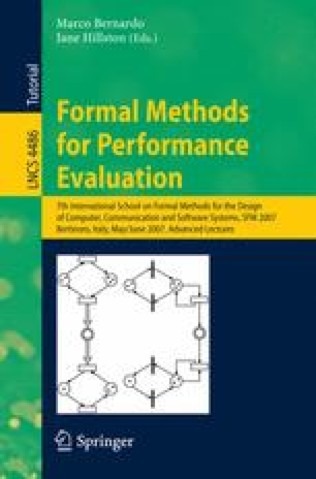
Formal Methods for Performance Evaluation ; 7th International School on Formal Methods for the Design of Computer, Communication, and Software Systems, SFM 2007, Bertinoro, Italy, May 8-June 2, 2007, Advanced Lectures
This book presents a set of 11 papers accompanying the lectures of leading researchers given at the 7th edition of the International School on Formal Methods for the Design of Computer, Communication and Software Systems, SFM 2007.

Formal Methods for Open Object-Based Distributed Systems ; Vol. 4037 ; 8th IFIP WG 6.1 International Conference, FMOODS 2006, Bologna, Italy, June 14-16, 2006, Proceedings
This book constitutes the refereed proceedings of the 8th IFIP WG 6.1 International Conference on Formal Methods for Open Object-Based Distributed Systems, FMOODS 2006, held in Bologna, Italy, June 2006. The book presents 16 revised full papers together with an invited paper and abstracts of 2 invited talks. Coverage includes component- and model-based design, service-oriented computing, software quality, modeling languages implementation, formal specification, verification, validation, testing, and service-oriented systems.
Formal Methods for Open Object-Based Distributed Systems ; Vol. 3535 ; 7th IFIP WG 6.1 International Conference, FMOODS 2005, Athens, Greece, June 15-17, 2005, Proceedings
This volume contains the proceedings of FMOODS2005, the 7th IFIPWG6. 1 International Conference on Formal Methods for Open Object-Based Distributed Systems. The conference was held in Athens, Greece on June 15-17, 2005. The eventwasthe seventh meeting ofthis conference series, whichis held roughly every year and a half, with the earlier events held respectively in Paris, Canterbury, Florence, Stanford, Twente, and Paris. The goal of the FMOOD Sseries of conferences is to bring together researchers whose work encompasses three important and related fields: - formal methods; - distributed systems; - object-based technology. Sucha convergenceis representative of recent advances in the field of distributed systems, and provides links between several scientific and technological communities, as represented by the conferences FORTE, CONCUR, and ECOOP. The objective of FMOODS is to provide an integrated forum for the pres- tation of research in the above-mentioned fields, and the exchange of ideas and experiences in the topics concerned with the formal methods support for open object-based distributed systems.

Formal Methods for Open Object-Based Distributed Systems ; 9th IFIP WG 6.1 International Conference, FMOODS 2007, Paphos, Cyprus, June 6-8, 2007, Proceedings
This book constitutes the refereed proceedings of the 9th IFIP WG 6.1 International Conference on Formal Methods for Open Object-Based Distributed Systems, FMOODS 2007, held in Paphos, Cyprus in June 2007. The papers are organized in topcical sections on model checking rewriting logic components and services algebraic calculi specification, verification and refinenment, and quality of service.
Formal Methods for Open Object-Based Distributed Systems ; 10th IFIP WG 6.1 International Conference, FMOODS 2008, Oslo, Norway, June 4-6, 2008 Proceedings
This book constitutes the refereed proceedings of the 10th IFIP WG 6.1 International Conference on Formal Methods for Open Object-Based Distributed Systems, FMOODS 2008, held in Oslo, Norway, in June 2008.The 14 revised full papers presented together with 1 invited lecture were carefully reviewed and selected from 35 submissions. The papers cover topcics such as semantics of object-oriented programming; formal techniques for specification, analysis, and refinement; model checking; theorem proving and deductive verification.
Formal Methods for Mobile Computing ; 5th International School on Formal Methods for the Design of Computer, Communication, and Software Systems, SFM-Moby 2005, Bertinoro, Italy, April 26-30, 2005, Advanced Lectures
This book presents 8 tutorial survey papers by leading researchers who lectured at the 5th International School on Formal Methods for the Design of Computer, Communication, and Software Systems, SFM 2005, held in Bertinoro, Italy in April 2005. SFM 2005 was devoted to formal methods and tools for the design of mobile systems and mobile communication infrastructures. The 8 lectures are organized into topical sections on models and languages, scalability and performance, dynamic power management, and middleware support.
